Monday, 17 August 2020

Tomboy [2011]

 Tomboy – the magnificent middle chapter in Céline Sciamma’s thematically linked ‘Coming-of-Age Trilogy’, sandwiched between her debut film Water Lilies and Girlhood – is a superbly framed, layered, minimalist and defiantly powerful exploration of non-binary gender identity and gender fluidity, and in turn the oppression of heteronormative societal structures. That these complex themes were handled with exquisite tenderness and a nuanced low-key approach, and within the framework of an affecting coming-of-age story of a young girl struggling to understand who she’s expected to be vis-à-vis who she wants to be, made this an alternately heartwarming and heartbreaking work. Laure (Zoé Héran) is a 10-year old prepubescent girl who, upon relocating to a sleepy Paris suburb with her closely-knit family – comprising of her loving dad (Mathieu Demy), pregnant domineering mother (Sophie Cattani) and cute li’l sister (Malonn Lévana) – finds this an ideal opportunity to experiment with her gender expression, by exploiting her androgynous physical appearance and her anonymity. Hence, to Lisa (Jeanne Disson), who she befriends, and the other kids in the neighbourhood who she joins in their frolic, she presents herself as Mickaël, viz. a boy. This sudden sense of freedom allows her to manifest her trans nature with breathtaking abandon – be it in going shirtless while playing football with the boys or going for a swim in an improvised bathing suit or embarking on first love with Lisa – even if, as one anticipates with a brooding sense of sadness despite the moments of carefree joy, things will invariably and inevitably turn tragically sour. Héran’s fabulous and fearless turn, and Sciamma’s extraordinarily assured treatment of this delicate subject, made this underrated gem all the more affecting, poignant and eloquent.


Director: Celine Sciamma

Genre: Drama/Coming-of-Age

Language: French

Country: France

Saturday, 15 August 2020

In the Shadow of Women [2015]

 In the Shadow of Women, the middle chapter in Garrel’s loosely linked ‘Trilogy of Infidelity’, had all the irresistible hallmarks and formal rigour of the two other ravishing tone poems, viz. Jealousy and Lover for a Day – dazzling B/W photography that evoked a richly moody atmosphere; minimally used score that laced it with melancholy and loneliness; deadpan, omniscient voiceover (provided by his son Louis here); and the theme of casual, self-destructive infidelilty testing the heartbreaking fragility of a petit bourgeois couple’s relationship. Yet – on a darn interesting note – there were some significant departures too here, in that it was the most emotionally low-key and cynical of the lot, thus making a stunning furious outburst and the seemingly happy parting shot stand out in the context; and, it was also the most self-reflexive and overly political too (though Lover for a Day, too, had a sharp exchange on the Algerian War). Pierre (Stanislas Merhar) and Manon (Clotilde Courau) are a stodgy married couple, with his poker faced petulance complementing her mournful demeanour. They’re a filmmaking couple too – poor man’s Straub-Huillet, if you will – as he’s a documentary director while she assists him with the camera and editing, and they’re presently making a doc – on an aged, self-proclaimed veteran of the anti-fascist French Resistance (Jean Pommier) – which seems to be going nowhere, reminiscent in a droll way of the Woody segment in his magisterial Crimes and Misdemeanors. Their delicately strung relationship, however, starts bursting through the seams when he starts a torrid affair with a lovely film archivist (Lena Paugam), and faces collapse – thanks to his brittle male ego – when he gets to know that Manon too has a secret lover.


Director: Philippe Garrel

Genre: Drama/Marital Drama/Romance/Urban Drama

Language: French

Country: France

Thursday, 13 August 2020

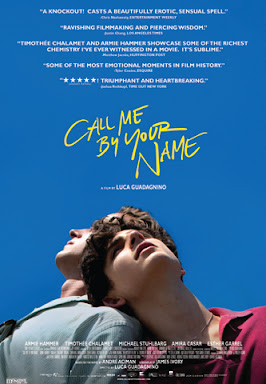
Call Me by Your Name [2017]

There’s something intoxicating about Italy – the lazy elegance, languid charm, sunwashed atmosphere, crumbling splendour – and these flavours were exquisitely captured and evoked in Luca Guadagnino’s sensual and engrossing coming-of-age romance Call Me by Your Name, based on André Aciman’s novel and with a screenplay by James Ivory. What made it especially remarkable was the way in which the politics of queer cinema (even if largely understated here) in a bourgeois intellectual liberal social setup were largely subsumed by the sensuous nature of the portrayals. 17-year old Elio (Timothée Chalamet) lives with his wealthy, erudite and left-libertarian Jewish-Italian parents – warm-hearted father (Michael Stuhlbarg) who’s a respected archeology professor, and dazzling, multi-lingual mother (Amira Casar) – in the beautiful town of Crema in the Lombardy region. He’s an introverted and emotionally vulnerable guy floating through life and largely contented in his personal space – he’s passionate about reading, is a gifted pianist, has a hobby for transcribing music, likes whiling away his time with his affectionate parents or strolling around, and is in a brewing relationship with a lovely young woman (Esther Garrel). His largely tranquil life, however, experiences a tremendous sexual and emotional upheaval upon the arrival of Oliver (Armie Hammer), a dashing American post-doc researcher on a short term exchange and who’ll stay over at their mansion during this period. Confident, extroverted, articulate and popular with the girls, he couldn’t be more different than Elio; and hence, their initially tentative but eventually passionate intimacy reveals them in their diverse shades while consuming them emotionally. Resplendently photographed and liltingly scored, the film comprised of fine turns by all and perhaps one of the most outrageous usages of a fruit in cinema.


Director: Luca Guadagnino

Genre: Drama/Romance/Coming-of-Age

Language: English/Italian

Country: Italy

Wednesday, 12 August 2020

Francofonia [2015]

Musée du Louvre, one of the most extraordinary art galleries in the world, is a Mecca for aesthetes and connoisseurs. Alexander Sokurov’s Francofonia is therefore, first and foremost, a peaen to Paris’ most enduring cultural institution; however, alongside that, it’s also a meditation on the oftentimes heroic act of art preservation in the face of war and occupation, and even, contrarily, a sly commentary on how art troves are usually amassed on the back of a country’s colonialist past. Consequently, this stylistically ambitious essay film is structured into multiple things in parallel – a rambling philosophical treatise, a quasi documentary, a political exposition, an offhanded satire on power, and a strangely affecting buddy film too. Two key facets in the history of this celebrated museum formed the key drivers – the hiding away of numerous renowned artworks and sculptures during the Nazi occupation and the war thereafter, by secretly shifting them to chateaus and manor houses in the countryside (in an astounding display of conviction and foresight), and their remaining hidden thanks to the unlikely friendship between two men whose camaraderie went beyond their national affiliations and political predispositions, viz. Jacques Jaujard (Louis-do de Lencquesaing), the wartime Director of Louvre, a civil servant and a clandestine supporter of the Resistance, and Franz Wolff-Metternich (Benjamin Utzerath), an art historian who was appointed by Hitler to oversee France’s art collection; and, in a seriocomic parallel strand, we see Napolean romping through the galleries boasting of the various artworks he’d amassed as war booties and hunting for paintings memorialising him. Glimpses of some of Louvre’s famous artworks aside, the film was wildly digressive and filled with self-conscious metaphors which was flummoxing at times.


Director: Alexander Sokurov

Genre: Documentary/Essay Film/Drama/Experimental Film

Language: French/Russian

Country: France

Sunday, 9 August 2020

Hospitalité [2010]

The striking similarities in Kōji Fukada’s fabulous, prescient and lacerating, albeit hugely underrated, sophomore film Hospitalité and his Cannes Jury Prize winning Harmonium nearly made them companion works; both centered on bourgeois, suburban Japanese families – sterile married couples tenuously bound together courtesy their kid daughters, with self-run workplaces located as appendages to their homes – whose banal existences get spectacularly disrupted by the arrival of mysterious men who crash into their cloistered lives. Yet, there were significant tonal and thematic departures too – a pungently satirical take on xenophobia and societal hypocrisy, gleefully bordering on the farcical, in the former, as opposed to a sombre study on loss and grief in the latter. Mikio (Kenji Yamauchi) is a soft-spoken middle-aged man married to the attractive and much younger Natsuki (Kiki Sugino); a little daughter from his first marriage and his recently divorced sister make up their nuclear family living in a compact house – where the ground floor serves as a small printing shop that he runs – in a conservative Tokyo neighbourhood where a hyperactive citizen’s watchgroup is driven by their wanton fear of and proud prejudice towards poor immigrants. The family’s fragile stability starts unravelling when Kagawa (Kanji Furutachi), a straight-faced confidence man with mysterious motives, literally installs himself in their home and lives. Thereafter, the narrative proceeded like an exquisitely structured progressive musical composition – on an amusing note to start with, and the tempo being deliciously upped with each new development marked by deadpan humour, before bursting into operatic extravaganza. The bristling social commentary was counterpointed by Fukada’s assured craftsmanship, and aided equally by a fine cast led by a terrific Furutachi as the film’s straight-faced driving force.


Director: Koji Fukada

Genre: Drama/Family Drama/Black Comedy/Social Satire

Language: Japanese

Country: Japan

Saturday, 8 August 2020

Jealousy (La Jalousie) [2013]

While numerous filmmakers, over the years, have made intensely personal movies borne out of facets and episodes from their own lives, Garrel arguably stands out in how nakedly autobiographical nearly his entire filmography has been; no wonder, also, the striking resemblance to Hong Sang-soo in the staggering tonal and thematic homogeneity of their respective oeuvres. His ravishing, engrossing and deeply intimate film Jealousy – the first chapter in his loosely connected ‘Trilogy on Fidelity’ which also comprised of two other magnificent films, viz. In the Shadow of Women and Lover for a Day – hence, along with serving as a beginning to the afore-mentioned trilogy, it was also, in many ways, a hark back to his earlier ‘Autobiographical Series’ (L'Enfant Secret, Les Baisers de Secours, J’Entends plus la Guitare, etc.) where he portrayed aspects of his life by casting people from his life (his father Maurice, his ex-lover Nico, his then wife Brigitte Sy, etc.). This loop was manifested here too, given that it both begins and ends with the breakdown of relationships, with the balance portraying their inherent fragility. The disarmingly simple storyline revolved around a soft-spoken theatre actor (played by the director’s son Louis Garrel), who leaves his wife (Rebecca Convenant) to move in with on-off actress (Anna Mouglalis) struggling with existential crisis, while also bonding with his kid daughter (Olga Milshtein) and lost sister (played by his real-life sister Esther Garrel). Marvelous turns by all – Mouglalis and little Olga were especially astounding – along with the stone-washed B/W photography, haunting guitar-based score and freewheeling vignettes added to the warmth, melancholy and heartbreak of this quietly devastating mosaic that, on hindsight, was more a bittersweet ballad than a movie.


Director: Philippe Garrel

Genre: Drama/Romantic Drama/Urban Drama

 Language: French

Country: France