Showing posts with label War. Show all posts

Friday, 17 July 2026

Put Your Soul on Your Hand and Walk [2025]

Mobile phones have made the world appear smaller than it actually is while also underlining the massive distances separating us; this remarkable film – a disillusioning tableau of a broken world, yet radiating with profound empathy and camaraderie – indelibly demonstrated this dichotomy. Iranian documentary filmmaker and activist Sepideh Farsi, living in exile in Paris since fleeing Tehran in 1984, and Palestinian photojournalist Fatima Hassouna, locked in Gaza City, were able to interact for a year and form a deep bond through video calls, allowing us to get a first-hand account of the horrors and the resilience, despite all three – Farsi, Fatima, and us – fundamentally unable to bridge the irreconcilable chasms, barrier and borders. The devastating state-backed genocide in Palestine has killed 250+ journalists, and Fatima’s death – a targeted missile, just as this docu was selected for screening at Cannes, wiped out her entire family to stop her from recording, archiving and bearing witness using her camera – would’ve been just another count on paper if not for this personal memorial and remembrance. Their seeming differences notwithstanding – Farsi is older, left-wing, atheist, feminist, cynical, was once a political prisoner, and now able to roam the world; Fatima was in her mid-20s, devout, filled with irrepressible hope despite the despair surrounding her, never able to explore her dreams and aspirations, and forever a doomed refugee in her own land – the two women engaged in candid conversations through patchy mobile networks, blockade and bombings. Two facets made this a particularly stirring and expansive ode to courage and resistance – Fatima’s contagious smile, in defiance of the deaths, food shortage and loss of loved ones; and her terrific street photographs that Farsi displayed at regular intervals. 


Director: Sepideh Farsi

Genre: Documentary/Diary Film/Essay Film/Epistolary Film/War

Language: English/Arabic

Country: Palestine/France

Wednesday, 29 April 2026

The Voice of Hind Rajab [2025]

 On 29th January 2024, Hind Rajab, a 5-year-old Palestinian girl, was killed in Gaza by the Israeli Defence Forces. Six of her family members – uncle, aunt and four cousins – were earlier killed, leaving the little girl stranded, while two paramedics were also killed upon trying to rescue her. This massacre, which became a harrowing reminder of the ensuing genocide, and the desperate but ultimately futile rescue attempts by the Palestine Red Crescent Society from their West Bank headquarters, formed the subject of the deeply discomfiting docudrama The Voice of Hind Rajab. Tunisian filmmaker Kaouther Ben Hania, in her previous work Four Daughters, had blended documentary and performative elements into a stunning hybrid film, and she went for a similarly bold formal gamble here. She set it entirely in the humanitarian organization’s office, featuring dramatization of the actual individuals involved in remotely leading the rescue efforts, and used the actual recordings of the little girl’s voice – helpless, confused, afraid and too young to fully comprehend this horrendous scenario – to lend authenticity to the proceedings. While the adults in the room – call centre worker Omar (Motaz Malhees); his supervisor Rana (Saja Kilani); Mahdi (Amer Hlehel), who’s responsible for coordinating with the authorities and paramedics; and Nisreen (Clara Khoury), who provides counselling to the traumatized employees – battle through the night, their emotionally fraught conversations shot in near-real-time – that portrayed the extreme psychological toll and bordered on histrionics – made for an unsettling contrast to the actual voice of the deceased kid. This counterbalancing between commentaries on the war crime and staged verisimilitude – and reducing the girl to just an anchoring voice – was an ethically fraught choice, even if it was a distressing watch.


Director: Kaouther Ben Hania

Genre: Drama/Docudrama/War

Language: Arabic

Country: Tunisia

Friday, 16 January 2026

The Train [1964]

 Watching The Sorrow and the Pity and The Train within a few days of each other was rather ironic, given how the former demythologized the idea of widespread French resistance during the German occupation while the latter emphatically celebrated it. John Frankenheimer, who took charge after Burt Lancaster got Arthur Penn fired, dramatically altered Penn’s script – which was more character-driven and primarily focussed on the value of art – into a kinetic, action-packed movie foregrounded on the titular locomotives. Along the lines of John Sturges’ The Great Escape from a year back, this too was fiction spun around facts – or “faction”, as one might call it – set during WW2, and was a similarly rip-roaring war film that nevertheless retained tangible character developments and political stances. It’s August 1944 and Colonel Waldheim (Paul Scofield), an “aesthete Nazi” who loves “degenerate” modern art, decides to take the crème de la crème of artworks housed in Jeu de Paume to Berlin – at any costs necessary – upon sensing Paris’ imminent liberation by the Allies. The museum’s desperate curator appeals to the French Resistance to prevent this given their incalculable cultural significance. Labiche (Lancaster), a railway inspector at the station from which this prized cargo will depart and leader of the local Resistance cell down to its last three men, reluctantly agrees to sabotage Waldheim’s plans despite not caring much for art. Stunningly photographed in B/W – deploying a mix of wide-angles, deep focus, and ingenious single takes – the battle of wits between the two men, manically driven by contrasting objectives, was matched by thrilling set-pieces involving authentic trains. The fine support cast included the striking Jeanne Moreau as a brusque inn-keeper forced into chooses sides.


Director: John Frankenheimer

Genre: Action/Thriller/War

Language: English

Country: US

Sunday, 28 September 2025

Lessons of Darkness [1992]

 Werner Herzog’s hypnotic essay Lessons of Darkness was an assemblage of two strikingly contrasting facets. It was an intensely grim and fatalistic meditation on warfare, carnage, the abyss of human folly and madness, and their infinite capacities for cruelty. This bleak meditation was accompanied by spectacular aerial photography of the ecological disaster wrought upon by the 1991 Gulf War, and these were made even more viscerally arresting through slow-mo shots, long takes, Herzog’s distinctively clipped style of speaking, and grand Wagnerian score. This, therefore, was akin to an apocalyptic tone poem on derangement and destruction by a filmmaker who’s been classified as a “poet of doom”. No wonder, some viewers were offended by it upon its release – alleging that this was akin to aestheticization of wars – and which Herzog angrily countered by quoting examples of Hieronymous Bosch and Goya who’d also made breathtaking artistic works foregrounded on violence and grotesquerie. Broken into thirteen short chapters, the moody docu shows us scarred and damaged landscapes, and in particular nightmarish images of the Kuwaiti oil fires, albeit largely without any political or geographical contexts. In his typically ironic tone, he even shows us how the expert fire extinguishing team reignited the fires – by throwing torches into the gushing oil flows – so that they have something more to extinguish. These flamboyant, widescreen and “obscenely beautiful” vistas were briefly interspersed with sobering chronicles of torture and trauma experienced by the locals, and shared by a couple of women. The film’s ominous undercurrents, vivid abstractions, and counterpointing of sparse and lurid expressions made it a fitting member of the German filmmaker’s oeuvre that’s filled with similar exercises across both narrative fictions and essayistic nonfictions.


Director: Werner Herzog

Genre: Documentary/Essay Film/War

Language: German/Arabic

Country: Germany

Sunday, 21 September 2025

Images of the World and the Inscription of War [1989]

 The German word “Aufklärung”, as Harun Farocki informs in this intellectually rigorous meditation and exceptionally dialectical video essay, means both “enlightenment” and “reconnaissance”. This paradoxical implication intrinsically informed the work and what it posited – viz. scientific reasoning and technological progress are intimately related to the military-industrial complex and warfare. The specific technology under Farocki’s forensic investigation, here, was that of photography, and in turn a branching into how perception of an image and the contexts and meanings that one infers from it, are heavily influenced by what we’re trying or intending to see. These complex aspects were clinically evoked, principally, through the examination of an aerial photograph of the IG Farben industrial plan that was taken by an American aircraft in 1944, as a precursor to bombing it (though that wasn’t ultimately carried out). It was only 30 years later that 2 CIA analysts realized that it had also captured the Auschwitz extermination camp – the barracks, gas chambers, crematoria and even trucks delivering poison pellets disguised as a Red Cross vehicle – but which remained a “blind spot” until then. Hence, if the American bombers had destroyed IG Farben it, ironically, wouldn’t have been for its role in the Holocaust. The essay also covered enquiries into surveillance and camouflage – from WW2 to police identikits – which makes images inherently political and induces image manipulations. In perhaps the film’s most haunting moment, Farocki showed an inmate at a Nazi concentration camp – a beautiful woman – instinctively striking a pose for the camera. The docu was especially fascinating in the massive ground covered in its slender length, and also how it turned out to be such a riveting work despite its highly analytic form.


Director: Harun Farocki

Genre: Documentary/Essay Film/War

Language: English

Country: Germany

Saturday, 2 August 2025

The Garden of the Finzi-Continis [1970]

 Giorgio Bassini’s semi-autobiographical masterpiece The Garden of Finzi-Continis was as much a haunting Holocaust novel as a stirring ode to unrequited love, and through the titular Finzi-Continis – a wealthy, aristocratic and intellectual family who lived a life of cultured seclusion and went to their deaths without any resistance – a lamentation on the passage of a certain way of life. Vittorio De Sica’s adaptation echoed, with a touch at once tender and wistful, the book’s understated tone, melancholy, personal heartbreak, collective loss and doomed atmosphere. The narrative began in 1938, just as Mussolini’s fascist government starts enacting oppressive and restrictive laws against Jewish-Italian citizens, and ended in 1943 when the Jews started getting rounded up and herded to death camps. That fateful stretch was evoked through the Finzi-Continis family – with their huge mansion, refined manners, sprawling gardens, and cloistered existence within large walls – and especially the enigmatic Micòl (Dominique Sanda). They’re portrayed through the eyes of Giorgio (Lino Capolicchio), a studious middle-class guy, who’s hopelessly in love with the strikingly beautiful Micòl and enamoured with the family. When Jews are banned from the local tennis club, the family’s private tennis court is opened to them – though the ones who join include non-Jews too, like the left-wing Malnate (Fabio Testi) – and when the public library becomes off-limit, Giorgio finds refuge in the family’s huge personal library. Things, unfortunately, go further downhill rapidly, as he finds Micòl becoming ever more aloof and beyond reach, and the Jewish community in Ferrara being pushed towards annihilation. Beautifully photographed in soft-focus and washed-out colours, the film – initially supposed to be directed by Valerio Zurlini – became a late-career revival for the once pioneer of Italian neorealism.


Director: Vittorio De Sica

Genre: Drama/War Drama/Romantic Drama/Holocaust Movie

Language: Italian

Country: Italy

Thursday, 5 September 2024

Land and Freedom [1995]

 Loach’s deeply underrated gem Land and Freedom remains a singular work in his oeuvre, for his rare foray into historical epic – thus presaging the excellent The Wind that Shakes the Barley – and into a setting far removed from his preferred milieu of working-class Britain. Yet, it was also profoundly linked to the political inquiries, meditations and dissents that he’s pursued throughout his career. This rousing ode to the collective spirit of resistance – albeit, one tampered with bleak setbacks and heartbreaking defeats – opens with the death of the aged Liverpudlian Dave Carne, upon which his granddaughter (Suzanne Maddock) delves into his mementoes at his flat – newspaper cuttings, letters, photographs, and earth wrapped in a red cloth, the immensely moving significance of which will emerge later – and thereby pieces together an extraordinarily eventful chapter from his younger days. Unfolding in 1936 over flashbacks, David (Ian Hart), an unemployed Communist, travels to Spain to enlist with the International Brigade and fight with the Republicans against Franco. However, he ends up joining the Marxist Revolutionary and unwaveringly anti-fascist group POUM. There he experiences the thrill of fighting fascists, seeing a freed village opting for collectivization, befriending comrades, and having a tender romance with a fiery Catalan fighter (Rosana Pastor), as well as facing terrible losses, witnessing the appropriation of the left by Stalinists, and most devastatingly, the collapse of shared dreams. Marvellously shot on location that lent it both poetic and gritty textures, this electrifying collaboration between Loach and playwright Jim Allen recalled Homage to Catalonia, Orwell’s unforgettable memoir from his days of walking with POUM revolutionaries during the Spanish Civil War, and ended on a stirring display of solidarity during David’s funeral.


Director: Ken Loach

Genre: Drama/Historical Epic/War

Language: English/Catalan

Country: UK

Sunday, 1 September 2024

The Wind That Shakes the Barley [2006]

 The Wind that Shakes the Barley was equal parts poetic and political, as evidenced by its deeply elegiac title that referenced a revolutionary Irish folk ballad written by Robert Dwyer Joyce. A rare foray by Ken Loach into a complex, sprawling and historical canvas – that, and its fearless dive into a bloody civil war from which no one comes out either physically or morally unscathed made it a splendid companion piece to his magnificent Spanish Civil War saga Land and Freedom – it focused first on the Irish War of Independence and then the Irish Civil War over a turbulent couple of years, viz. 1920-22. Beginning on a tranquil note, we see a group of young guys playing “hurling” against an enchanting background. The game, unfortunately, becomes a tipping point, as they’re rounded up by the vicious “Black and Tans” – British soldiers stationed in Ireland to crush the IRA’s rebellion – and a youngster is executed for refusing to speak in English. Damien (Cillian Murphy), a studious, soft-spoken and pacifist doctor, does a radical volte face upon witnessing this and another act of mindless thuggery, and joins the IRA outfit led by his elder brother Teddy (Pádraic Delaney). Structured roughly into two halves, we first see them fighting as comrades-in-arms against British imperialism; but, upon formation of “Irish Free State”, they become profoundly opposed as Teddy decides to forcibly support the compromise struck with Britain while Damien continues his struggle for complete independence and socialist state. Beautifully shot in sombre palettes, filled with murky moral intransigencies that bloody conflicts invariably elicit, and led by riveting turns, this film was at once furious, bleak and melancholic… just like a revolutionary folk ballad.


Director: Ken Loach

Genre: War/Historical Epic

Language: English

Country: Ireland/UK

Thursday, 18 July 2024

Viduthalai Part 1 [2023]

 Vetrimaaran’s blistering Tamil film Viduthalai Part 1 – it was planned as a single work, but later decided for release in two parts – delved into inflammatory political topics and fearlessly questioned mainstream narratives, over its expansive scope. The director used both popular and agitational narrative devices while depicting how those fighting for their rights are branded enemies of the state; civic and judicial boundaries are brazenly transgressed – in the name of ushering “development” and battling “militancy” – while suppressing any dissidence against the state; flagrant police brutality and custodial tortures; and the ironic scenario wherein those representing the lowest rung within the armed forces – paid pittance, denied basic conditions, and treated like non-entities by the chain of command – are made to sacrifice their lives and their humanity while waging brutal wars. The said lowest common denominator here is the newly-recruited Kumaresan (Soori), who’s joined a police unit stationed at a dense forest in order to eliminate the rebel tribal leader Perumal (Vijay Sethupathi), who’s violently opposing handing over of their lands to a mining company. The naïve protagonist, employed as a driver and factotum, immediately falls foul of the savage OC upon disobeying orders while helping a villager; this, in turn, leads to a touching romance with an orphaned tribal girl (Bhavani Sre), growing consciousness upon witnessing the bending of truths and perpetration of brutality by his colleagues, and increasing awareness of the man who the state calls a villain but respected as “teacher” by the local villagers. The film’s bravura and stunningly orchestrated 8-minute single-take opening sequence – capturing the grief, chaos and myriad activities at the site of a devastating train derailment – had set the stage for this riveting work.


Director: Vetrimaaran

Genre: Crime/Thriller/Action/War

Language: Tamil

Country: India

Wednesday, 28 February 2024

Léon Morin, Priest [1961]

 Léon Morin, Priest remains a fascinating anomaly in Melville’s filmography, considering that a secular Jew and left-wing atheist made this seemingly straight-faced work so heavily invested in theological and religious discourses. Yet, scratch the surface, and one finds its sly, ambiguous, enigmatic and roguish aspects aimed at subverting conventional spiritual portrayals. Adapted from Béatrix Beck's renowned novel, it additionally formed the middle-chapter in Melville’s famed trilogy on the Resistance, preceded by his austere debut feature Le Silence de la Mer, and followed by the exhilarating Army of Shadows. However, unlike the other two films, inquiries into the Occupation didn’t occupy the foreground here, even though they undeniably informed the context and proceedings. It’s centred on the tantalizing relationship between the eponymous pastor (Jean-Paul Belmondo, fresh of his smashing success in Godard’s Breathless, in his first collaboration with Melville) – a deadpan, charming and articulate working-class priest who’s persuasive in his job as a man of cloak, while also being aware of the impact he has on the women in the French Alpine town, as the men are either away or arrested or have died – and Barny (Emmanuelle Riva, who’d become a Nouvelle Vague icon through her engrossing turn in Resnais’ Hiroshima Mon Amour), an atheist, sensual, cynical, politically engaged and unsatisfied single mother who’s vocally supportive of Communist rebels, dismissive of the church, and bold in her carnal desires. On an impish whim, she visits Léon to tease him, but ends up getting converted as well as attracted to him. Though not one of Melville’s greatest works, this luminously shot film, led by gripping turns by the two actors, made for an intelligent, nuanced and beguiling work in his canon.


Director: Jean-Pierre Melville

Genre: Drama/Psychological Drama/Religious Drama/War

Language: French

Country: France
Saturday, 24 February 2024

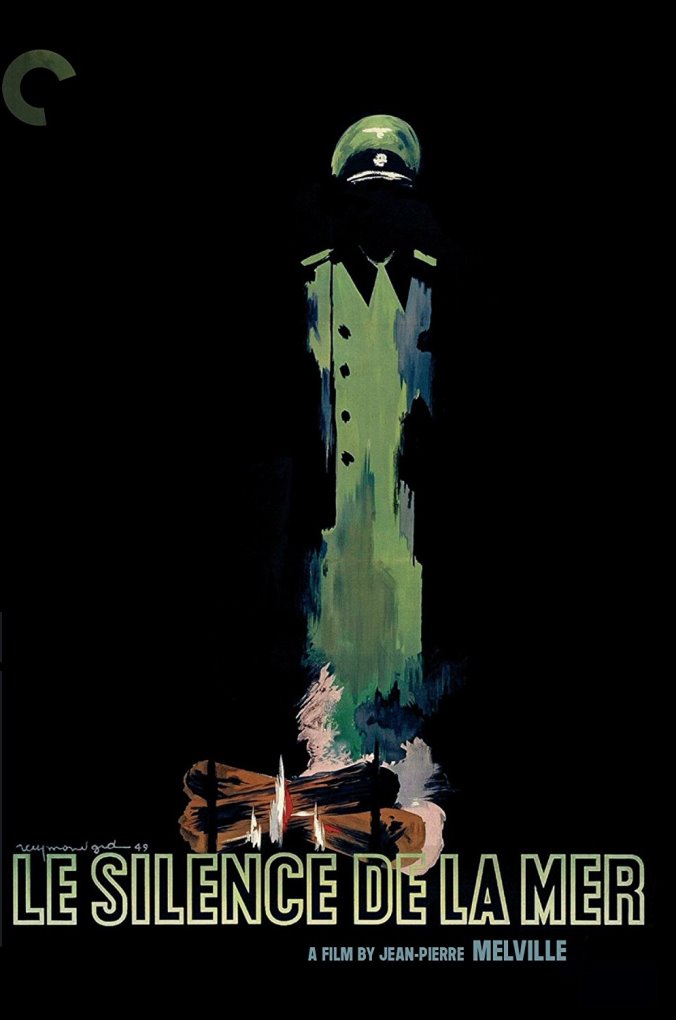
The Silence of the Sea [1949]

 It was only appropriate that Jean-Pierre Melville, who belonged to a left-wing family and adopted this nom de guerre during his involvement with the French Resistance, made his filmmaking debut with Le Silence de la Mer, an adaptation of the book by Vercors (nom de plume of Jean Bruller), who too was a member of the Resistance during the Nazi occupation of France. The book was secretly published and distributed, and became an influential underground text, which Melville eloquently acknowledged in several ways – the opening scene indicated its clandestine and dissident nature; he filmed in the same house in which it was written; and he’d agreed to pull the plug on the film, including destroying the negatives, if Bruller refused approval for release. This Bressonian film – that is to say, spare, austere, minimalist and poetic parable with a deep moral core – clearly presaged Melvelle’s formal and aesthetic signatures that he’d take to bravura heights in subsequent years. In what he’d ironically quipped an “anti-film”, it focused on verbose one-way exchanges – brilliantly shot indoors in heavily expressionistic B/W by Henri Decaë – involving just three characters. A German officer (Howard Vernon), with a gushing love for French literature, is stationed in a house inhabited by an ageing French man (Jean-Marie Robain) and his young niece (Nicole Stéphane). Over the next few months, the naïve lieutenant indulges in sentimental monologues every evening, while the French pair refuses to acknowledge his presence, leading to a solemn meditation on political naïveté and passive resistance. It ended with a powerful line, which is the uncle’s sole response to the German during his departure, “It’s a noble thing for a soldier to disobey a criminal order.”


Director: Jean-Pierre Melville

Genre: Drama/Political Drama/War

Language: French

Country: France

Sunday, 15 August 2021

Once Upon a Time There Was One Country [1995]

 Kusturica’s riotously allegorical, unhinged, extravagant, sweeping, farcical, bitingly satirical and darkly ironic retelling of contemporary history of Yugoslavia – a country that, as the title so poignantly makes it clear, doesn’t exist anymore – was 5 ½ hours of dazzling anarchy, exhilarating madness, subversive exuberance and trippy fever dream like few others. This grandiose work, interestingly, had two versions – the 3 ½ hour theatrical cut, released as Underground, which won Kusturica his 2nd Palm d’Or, and this expansive long-cut that was shown on Serbian television; while the former was a fabulous achievement in itself, the filmmaker’s epic, delirious and incendiary vision arguably realized its full potential in the broader miniseries canvas. Set over half a century from 1941 till around 1992, it covered three crucial chapters in the country’s turbulent past – the Nazi occupation during the WW2, the Tito years during the Cold War era, and the devastating Yugoslav Wars that tore the country apart – through a complex ménage à trois between Blacky (Lazar Ristovski), a gregarious, anti-fascist, fearless Communist resistance leader; Marko (Miki Manojlović), a self-serving, duplicitous and slimy antagonist, and Natalija (Mirjana Joković), a stunningly beautiful, popular and opportunistic theatre actress who both men are in love with. While they start out as inseparable friends and fellow guerilla partisans, Marko tricks Blacky into an underground shelter and concocts an elaborate ruse in order to keep him there, while he steal his girlfriend, becomes an arms trafficker and gets wealthy, until all hell breaks loose. Filled with outstanding set-pieces, surreal splashes, lively ensemble cast, jaundiced world-views, carnivalesque atmosphere, unpredictable narrative arc, extraordinarily foot-tapping brass score and a profoundly heartbreaking finale, this was filmmaking at its most bravura, hyperbolic and unforgettable.


Director: Emir Kusturica

Genre: Black Comedy/Political Satire/War/Historical Epic/Miniseries

Language: Serbian

Country: Serbia

Thursday, 15 April 2021

Da 5 Bloods [2020]

 Watching Spike Lee’s Da 5 Bloods – like his devilishly funny previous feature BlacKkKlansman – one can’t often say whether it was a serious political film masquerading as a kinetic entertainer, or the other way round. But, either way, there’s no denying its chutzpah. Equal parts unfettered war film, pointed political protest, messy morality play, badass adventure tale and bittersweet buddy movie, it didn’t shy away from bristling commentary, meditation and indignation on entrenched racialism, while also being wildly entertaining. It begins with 5 middle-aged Vietnam War vets – level-headed Otis (Clarke Peters), deeply troubled Paul (Delroy Lindo), easy-going Melvin (Isiah Whitlock Jr.) and conscientious Eddie (Norm Lewis) – reuniting at Ho Chi Minh City decades after the odious war, in order to locate a treasure they – serving under their enormously revered squad leader Norm (Chadwick Boseman), who was killed in action – had chanced upon during a particularly bloody mission. Add to this motley group Paul’s estranged son (Jonathan Majors), a spunky French lady (Mélanie Thierry) who’s into clearing unexploded landmines, a former Vietnamese prostitute who Otis had an affair with during his GI days, a double-faced mercenary (Jean Reno) et al, and it’s quite clear that their tryst is bound to be as volatile and violent as the last time they were here. The gradually unfolding plot – a few ham-handed moments aside – was bolstered by tense set-pieces, caustic ironies – around still prevalent scars among Viet Cong descendants, references to American braggadocio, counter-propaganda by silken-voiced Hanoi Hannah (Veronica Ngo), etc. – and an especially gripping performance by Lindo. The proceedings were rousingly juxtaposed with archival footage highlighting Black history from slavery and their disproportionate conscription in wars to the Civil Rights and BLM movements.


Director: Spike Lee

Genre: War Drama/Buddy Film/Adventure Film

Language: English

Country: US

Friday, 26 February 2021

Passenger (Pasażerka) [1963]

 The blurring and mythologization of events through conveniently subjective filters of memory and perception – thus leading to multiple versions of truths – formed distinctive threads in Munk’s formally audacious oeuvre. It remains therefore such an enormous tragedy that he left behind just three completed films – his brilliantly ironic debut Man on the Tracks; the virtuoso diptych Eroica; and his subversive, darkly funny masterpiece Bad Luck – before his untimely death while he was mid-way through his next feature. Passenger, his unfinished final film – a joint adaptation with Zofia Posmysz from her radio play Passenger from Cabin Number 45 – persisted with the above-mentioned motif, with politics of memory around the Holocaust also forming a crucial element. It begins with Liza (Aleksandra Śląska), a German woman traveling on a luxury liner with her wealthy husband – who barely knows about her sordid past, viz. that she was a Nazi officer at the Auschwitz – in her first trip back to Europe since WW2. Her existential veneer, however, starts collapsing upon spotting a woman in the ship – who reminds her of Martha (Anna Ciepielewska), a defiant Jewish inmate from the camp – and she starts revealing her dark past. Yet, interestingly, she initially shares a more heroic version, though what actually transpired was murkier than that. Munk was able to film the two bleak flashbacks, which were stitched together; he, though, had further versions planned which couldn’t be made. The wryly satirical “present”, contrarily, was half-done; this part, consequently, was depicted through eerily grainy B/W photographs, accompanied by a deadpan voice-over, and that, on hindsight, aptly complemented the satirical tone. Watching this tantalizing gem one can only ruefully wonder how many more blazing stuff Munk could’ve made.


Director: Andrzej Munk

Genre: Drama/War Drama/Psychological Drama

Language: Polish

Country: Poland