Showing posts with label Crime/Gangster. Show all posts

Saturday, 8 August 2026

Live Flesh (Carne Trémula) [1997]

 Pedro Almodóvar – who’d pivoted from campy, lowbrow farce with his fabulous preceding film The Flower of My Secret – did a free adaptation of British writer Ruth Rendell’s crime novel with this sexy and absorbing tale of pathological obsessions and jealousies setting off violent crimes. Balancing hot-blooded passions with barely controlled restraint – and demonstrating that style IS substance in his films, and thereby the indistinguishability between the two – the Spanish filmmaker mixed the proceedings with romantic and marital complexities, outrageous coincidences, lush melodrama, and sardonic commentaries on Spain’s Francoist past, for a feverishly imagined ménage à cinq. Naïve 20-year-old Victor (Liberto Rabal), who’s become besotted with the ravishing Elena (Francesca Neri) in her 30s after a one-night-stand, inadvertently triggers a catastrophic shoot-out that perennially changes their lives as well as two cops – the saner David (Javier Bardem) and the more volatile Sancho (Pepe Sancho) – and Sancho’s wife Clara (Ángela Molina) who Sancho is insanely suspicious of for her supposed infidelity. That baroque sequence puts Victor in jail and turns David paraplegic. Fast-forward few years later, and a now-hardened Victor is craving for a saucy revenge upon finding out that David has become a star basketball player at the Paralympics and married to Elena, but gets embroiled into a fervent clandestine affair with the much-older Clara instead, who’s desperate to leave Sancho. David, meanwhile, is convinced that David plans to seduce Elena, who’s toned down from his drug-addled past, and this unapologetically contrived setup accelerates rearrangement of equations and reckless flareups. Filled with voluptuous emotions, bold colour palettes, sumptuous soundtrack, and teasing Buñuel references, the film was bookended by trippy “nativity” sequences, with the former featuring Penélope Cruz in a cameo.


Director: Pedro Almodovar

Genre: Crime Thriller/Romantic Thriller/Marital Thriller

Language: Spanish

Country: Spain

Thursday, 18 June 2026

Once Upon a Time in Gaza [2025]

 Directed by Nasser Brothers – identical Palestinian twins Tarzan and Arab – Once Upon A Time in Gaza is what the seemingly hackneyed title suggests, viz. a wacky potpourri of politics and meta-references. It’s made in the veins of a revisionist Western – populated with crooked characters, crumbling moralities, wry ironies, stylized dynamics, grimy landscapes and random violence – and set in the titular city which has been under a draconian siege for decades. It’s particularly shaped by the brothers’ intent in capturing life – with its idiosyncrasies, inconsistencies and arbitrariness – beyond the blockade, apartheid and genocide that informed its backdrop, and strongly recalled the great Elia Suleiman’s films. Divided into two disparate halves, the first was led by Osama (Majd Eid), a gregarious and amoral hustler who runs a small falafel outlet and peddles in smuggled painkillers on the side; he employs the unassuming Yahya (Nader Abd Alhay), and faces a deadly face-off with Abou (Ramzi Maqdisi), a nasty cop wanting a pie of the drug trade. The focus shifts to Yahya in the second half where, traumatized by Osama’s murder by Abou (who’s now grown in power), he’s offered to star as a martyred revolutionary in an agitprop action film sponsored by Gaza’s Ministry of Culture. Though the two halves felt disjointed – sardonic slice-of-life followed by deliberately self-reflexive events – they together carried a free interpretation of the good, the bad and the ugly personas from Sergio Leone’s iconic spaghetti Western. Majid was captivating, as were the grubby locales, subaltern subtext and deadpan humour. Filmed in Jordan by the exiled brothers, it also featured snippets from the subversive, over-the-top movie-within-movie, and operatically-scored funeral processions that nodded at Kalatozov ‘s magnificent I Am Cuba.


Director: Tarzan & Arab Nasser

Genre: Black Comedy/Political Satire/Crime Thriller/Buddy Film/Neo-Western/Action

Language: Arabic

Country: Palestine

Saturday, 13 June 2026

Dead Man's Wire [2025]

 Gus Van Sant’s Dead Man’s Wire was filled with absorbing zeitgeist, gritty 1970s vitality, sly humour and subversive “state of the nation” satire, and channelled two Sydney Lumet gems. Like Dog Day Afternoon, its protagonist is a regular Joe who commits a sensational crime in an act of desperation, triggers a media circus, and becomes an anti-establishmentarian folk hero; and, like Network, he’s incredibly angry at capitalist greed. Based on an actual event from February 1977 – and all the more phenomenal for it – it starts off with Tony Kiritsis (Bill Skarsgård), intending to kidnap Meridian Mortgage Company’s owner M.L. Hall (Al Pacino), whose mala fide and predatory business practices have cost him his commercial property which he’d dreamt of turning into a shopping centre. However, as Hall Sr. is enjoying a lavish impromptu vacation, Tony kidnaps his son Richard (Dacre Montgomery) instead, and walks/drives him to his own apartment – through cops, journalists and passers-by – by devising an audacious improvisation that lent the film its title. He then holds the man captive for the next 72 hours while engaging in negotiations with the company’s lawyers, the FBI and local cops via a local RJ (Colman Domingo), who’s loved for his velvety voice and his jazz music show. Tony’s demand is simple – compensation for his financial loss and a public apology. Skarsgård was spellbinding – bringing in a blend of fury, screwball planning, vulnerability and uncanny media savvy – and Pacino was captivating in his cameo as a platinum-grade douchebag. They were complemented by a great soundtrack, analogue visual compositions and controlled farce, as the film portrayed class war and rotten corporate opportunism – all too prescient even today – while also delivering crackerjack entertainment.


Director: Gus Van Sant

Genre: Thriller/Crime Thriller/Docudrama

Language: English

Country: US

Wednesday, 20 May 2026

Portobello [2025]

 It’s quite astonishing that Marco Bellochhio, a (hopefully) soon-to-be nonagenarian who made his directorial debut six decades back, is still making films that’re bold, ambitious, caustic, rebellious, comprises of electrifying moments and filled with throbbing vitality. His second television miniseries – made four years after Exterior Night, a similarly vigorous and riveting recounting of a complex and sensational chapter from contemporary Italian history – Portobello flamboyantly glided through a real-life soap opera filled with kitsch, melodrama, scandal-mongering, lurid machinations, “theatre of the absurd” and a proto version of cancel culture. Enzo Tortora (Fabrizio Gifuni, in his third consecutive collaboration with Bellocchio and fourth overall) was at the peak of his popularity in the early-1980s when things took a spectacular nose-dive for him and he was plunged into a bizarre nightmare. He was the host of the enormously popular weekly TV show – a rather cheesy programme that was fervently devoured by 28 million viewers – when Giovanni Pandico (Lino Musella), a creepy and egotistic Comorra member who was obsessed with Tortora and turns into an informant for the Italian authorities, falsely alleges the latter of being a drug trafficker for the mafia out of sheer spite. Few of his fellow turncoats, too, join him in that, and as a result Tortora’s life comes crashing down, leading to a frustrating, traumatic and seemingly endless battle with an obsessed state prosecution. Bellocchio splendidly captured the zeitgeist through ambitiously mounted set-pieces and production designs, and the utterly farcical nature of the scenario through a mix of drama, bombast and sardonic humour, thereby making this a thrilling seriocomic ride. The firebrand Italian filmmaker’s pointed jabs at his country’s social, political, judicial, religious and criminal layers continue unabated.


Director: Marco Bellocchio

Genre: Drama/Legal Drama/Crime Drama/Biopic/TV Miniseries

Language: Italian

Country: Italy

Saturday, 2 May 2026

The Mastermind [2025]

 Kelly Reichardt’s minimalist “anti-genre” exercises – subversion of genre trappings, prioritizing inaction over actions, and leaving cine-goers without conventional payoffs – have produced anti-road movies (Wendy and Lucy, Certain Women), anti-Westerns (Meek’s Cutoff, First Cow), anti-political/legal thrillers (Night Moves, Certain Women), and anti-relationship/domestic dramas (Certain Women, Showing Up). She’s now made an absorbing anti-heist film with the beguiling and captivating The Mastermind. On that note, it recalled two other marvellous recent films – Rodrigo Moreno’s The Delinquents (especially how they glided through mischievous non-sequiturs) and Alice Rohrwacher’s La Chimera (both starred Josh O’Connor as roguish art thieves, though the similarities in their characters ended there). The protagonist here may well be the world’s worst art thief, giving a deliberately ironic ring to the film’s hyperbolic title. Aimless, unemployed, emotionally stunted, financially dependent on his well-off parents and working wife, and once considered very promising, JB (O’Connor) is the quintessential drifter. The Massachusetts resident hatches a foolhardy plot to steal four paintings – tellingly, by the American abstract painter Arthur Dove, thereby demonstrating his intellectual superiority over his material stupidity – by borrowing money from his mom, employing fellow losers and with no follow-through or backup plans. Significant portions of the film delved into the aftermaths of the robbery, as things go south right-away and JB is forced to go on the lam. The terrific jazz score complemented the improvisational form, and O’Connor embodied his character’s aloof, self-serving, hangdog charm, untouched by the era he’s living in, viz. the 1970s, anti-Vietnam War protests and counter-culture movements. The zeitgeist, incidentally, existed in the edges, bleeding in through the brilliant diagetic soundscape (TV programmes, radio bulletins, people speaking in the backgrounds), until JB inadvertently walks into it.


Director: Kelly Reichardt

Genre: Crime Drama/Heist Film/Road Movie

Language: English

Country: US

Saturday, 7 March 2026

The Getaway [1972]

 Sam Peckinpah delivered a gripping genre exercise with The Getaway – arguably the most straight-up actioner in his incendiary career – and an archetypal, albeit lesser-known, early entry in the pantheon of gritty 1970s American crime cinema. It was a substantial hit too, despite stretching mainstream sensibilities with its nihilism, violence and cynical amorality, facing considerable behind-the-scenes turbulence, and receiving negative critical reviews (which has fortunately reversed with time). The credit for its appeal goes as much to Peckinpah’s high-throttle direction and leading man Steve McQueen’s “King of Cool” on-screen persona, as the enormously cinematic source novel by Jim Thompson – with its blend of heist gone awry, sociopathic outlaws, on-the-road thrills and brooding violence – and the crackerjack script by Walter Hill, who rewrote the original adaptation by Thompson, including completely doing away with the novel’s final third and its pungently surreal finale. The film’s rakish stylistic flourishes were evident at the outset during the ingenious opening montage – capturing overlapping moments in times while introducing incarcerated career criminal “Doc” McCoy (McQueen) who’s up for parole – which was accompanied by flamboyant freeze frames and terrific sound design by Quincy Jones. Upon securing his release, he’s arm-twisted into immediately planning a bank robbery, which starts unravelling from the get-go thanks to a sleazy, rotten partner (Al Lettieri) who intends to double cross Doc at the first opportunity, and an alarming escalation in unplanned body counts. He’s consequently forced to go on the lam along with his wife (Ali MacGraw) – who doubles as a driver with fine get-away skills, thereby potentially serving as a prototype for Hill’s protagonist in The Driver – and partake in spectacular shoot-outs that stretch plausibility, while planning an escape to Mexico.


Director: Sam Peckinpah

Genre: Action/Crime Thriller/Road Movie

Language: English

Country: US

Monday, 15 December 2025

Secret Défense [1998]

 Jacques Rivette, in a rare foray into genre cinema with Secret Défense, made the narrative both freer and more expansive while also retaining the brooding atmosphere that one associates with slow-burn crime movies. The resulting work was a compelling exercise in psychological suspense that succeeded, over a generous runtime of nearly three hours, in being a taut thriller as well as a meditation on secrets, obsessions, modernity and solitude. Rivette’s smouldering emphasis on the moments and spaces between actions made the film particularly intriguing, and that was exhibited through the near-real-time sequences involving Paris metro rides, and – in perhaps the film’s most riveting segment – an anxiety-ridden 20-minute train ride sequence. Sylvie (Sandrine Bonnaire), a research scientist still getting over her father’s death five years back, gets an unanticipated visit from her troubled younger brother Paul (Grégoire Colin) – they haven’t spoken since the funeral – who tells her that their dad’s death wasn’t accidental; he’s convinced their dad’s former business partner Walser (Jerzy Radziwilowicz), who’s taken over his company, stays in the sprawling mansion where they’d grown up, and maintains a discomfiting proximity with their mother (Françoise Fabian), has murdered their dad, and he therefore intends to exact a bloody revenge. Sylvie isn’t fully convinced but jolted enough, and decides to do the job herself so that Paul is spared the agony. Things, however, become messy when she accidentally kills Walser’s stunning young secretary/lover (Laure Marsac), only for her sister (also played by Marsac) to start looking for her missing sister. The formally rigorous work was marked by visual interplay between technological modernity of life in Paris vis-à-vis ominous serenity of the country, and excellent turns by both Bonnaire and Radziwilowicz.


Director: Jacques Rivette

Genre: Thriller/Crime Thriller/Mystery

Language: French

Country: France

Monday, 10 November 2025

Twin Peaks: Fire Walk with Me [1992]

 David Lynch’s arresting prequel to Twin Peaks – greenlighted after the show was cancelled, and which massively polarized everyone upon its release – couldn’t have been more radically different from the television series. While the first two seasons were splashed with cute Americana, despite the outrageous events that unfolded, the film was edgy, visceral, grungy, nightmarish and enthralling. The two together, consequently, reminded me of three of his films – Blue Velvet, Lost Highway and Mulholland Drive – in how they’d juxtaposed idyllic exteriors with grotesque underbellies. The film, which evoked a suburban purgatory through disturbing depictions of abuse behind closed doors and monsters inside the closets, took the viewers into the turbulent life of Laura Palmer (Sheryl Lee) leading to her vicious murder that the series began with. It, incidentally, kicked-off with a MacGuffin involving two FBI Agents – Chester (songwriter Chris Isaak) and Sam (Kiefer Sutherland) – investigating Teresa Banks’ brutal murder that the show had referred to. The narrative, subsequently, dove into the final seven days of Laura – a beautiful high-school student who everyone admires, but whose secret double life is spiralling out of control, exacerbated by the assaults she’s been facing at the hands of her obsessive father Leland (Ray Wise) who’s possessed by the malevolent spirit of Bob, cocaine addiction, wilful prostitution, self-destructiveness and intense trauma – leading ultimately to her tragic end. The film’s most gripping sequence took place in a grimy underground pub – accompanied by a loud, jangling and addictive score – where the tortured heroine, along with her best friend Dona (Moira Kelly, replacing Lara Flynn Boyle who didn’t reprise her role) are swept into a netherworld where three leery middle-aged men take advantage of the two underaged girls.


Director: David Lynch

Genre: Horror/Psychological Thriller/Crime/Mystery

Language: English

Country: US

Friday, 7 November 2025

Twin Peaks [1990-91, 2017]

 Twin Peaks – the surrealist, grisly, horror, mystery, campy and goofy soap opera that David Lynch co-created with Mark Frost – was a surprise hit when it premiered in 1990, and became a pop-culture phenomenon with a cult following despite its eccentric, outlandish and bizarre plot elements. The first season – arguably the highest-point in the series – opened with the murdered body of the beautiful but troubled high school student Laura Palmer (Sheryl Lee) in the tranquil town of Twin Peaks. It followed, on one hand, the murder investigation led by the incorrigibly optimistic and doggedly persuasive FBI Agent Dale Cooper (Kyle MacLachlan) supported by the local Sheriff, and on the other, the private affairs, sly ploys and nefarious machinations of the town’s offbeat residents which included corrupt businessmen, impassive cops, mad psychiatrists, punks, drifters, and striking damsels (Lara Flynn Boyle, Sherilyn Fenn, and Joan Chen), along with teasing forays into alternate realms. The longer second season concluded the investigation, and then took the plot forward. With the broader narrative scope, it succeeded in being more playful, madcap and adventurous, while also stepping the gas too much on occasions on silly humour and psychedelic excesses. Though the second season ended on a cliffhanger note, and Lynch followed it immediately with the gripping prequel feature Twin Peaks: Fire Walk With Me, it was a whopping 2 ½ decades before a much-awaited third season finally arrived. Largely bereft of the campy Americana and soap opera elements of the earlier seasons, this alternately arresting, ingenious and exasperating season – filled with multiple parallel plots, interludes and detours, alongside both returning and new cast members – took the narrative forward, backwards and sideways into a bonkers, mind-bending trip.


Director: David Lynch

Genre: Series/Crime/Mystery/Comedy/Horror/Thriller/Drama

Language: English

Country: US

Sunday, 2 November 2025

The Godfather Part II [1974]

 The Godfather wasn’t just scintillating cinema, it was a smash hit too. Francis Ford Coppola, consequently, got a free-hand for the follow-up, and he expanded the tapestry into a breathtaking saga which was broader and richer, as well as darker and edgier. He leveraged unutilized sections from Mario Puzo’s titular novel covering the past – beginnings and rise of a young Vito Corleone (Robert De Niro) – while simultaneously taking the principal narrative centred around Michael Corleone (Al Pacino) forward as he accelerates his chilling spiral – driven by the Machiavellian quad of power, capital, corruption and violence – which he’d embraced in the previous film. The second part, therefore, was both an adapted prequel and an original sequel backed by a sprawling script. While Vito’s journey was laced with warmth and was driven by memories of Sicily, familial loyalty, bonds he forged with fellow Italian-Americans, and street-smarts, making the flashback sections an elegiac immigration story, Micheal’s was colder and harsher as he displays a terrifying ability to outsmart his rivals and terminate anyone who offends him, propelled by his ruthless cunning and an absolute inability to forgive. Thus, as he battles the duplicitous Hyman Roth (Lee Strasberg) and antagonistic politicians, he also gets into shattering conflicts with his simple-minded elder brother Fredo (John Cazale), his profoundly disenchanted wife Kay (Diane Keaton), and hot-headed old-timer Frank (Michael V. Gazzo). While the film – aided by Nino Rota’s haunting score – abounded with stunning performances, Pacino’s stood out as one of devastating ferocity which made Michael’s character simultaneously arresting, volatile and diabolical; his interactions with Fredo were particularly unforgettable. The film, incidentally, also painted a captivating time-capsule of Cuba as it transitioned from Batista to Castro.

p.s. This is my latest revisit of this film. My earlier review can be found here.


Director: Francis Ford Coppola

Genre: Crime Drama/Gangster/Family Drama/Epic

Language: English/Sicilian

Country: US

Wednesday, 29 October 2025

The Godfather [1972]

 Right from its magnificent and elaborately staged opening sequence – featuring the boisterous wedding party of the daughter of formidable Sicilian-American “Don” Vito Corleone (Marlon Brando), intercut with the mafia boss bestowing extra-judicial favours – The Godfather established itself as a work of mythic ambitions and immersive power. Adapted from Mario Puzo’s bestselling novel of the same name, this became a remarkable turning point for Francis Ford Coppola – who agreed to direct it because he was struggling with debts – as he went on an incredible four-film run the kind of which is rare in world cinema. This epic tapestry on the warped honour codes, complex familial bonds, elemental forms of justice and retribution, and the unholy marriage of harsh Sicilian mores and brash American capital, was gloriously evoked through its sprawling length, brilliant ensemble cast, mix of leisurely plot developments and stunning brutality, majestic cinematography and score (by Gordon Willis and Nino Rota, respectively), and a gripping peek into the closed world of organized crime that gave a bold new direction to both the gangster genre and immigrant story. The operatic tale of a once powerful patriarch passing his reigns to a reluctant heir – Micheal Corleone (Al Pacino) – and the latter’s conversion from someone who’d embraced a civilian life into an incarnation of chilling ruthlessness, was further enriched by its array of supporting characters (featuring James Caan, Robert Duvall, Diane Keaton, John Cazale, Sterling Hayden, etc.), plot detours, unforgettable set-pieces, and dark social and political commentaries. Coppola’s fiendish spins on life’s supposed conventionalities – marriage, friendship, family gatherings, religious occasions, etc. – made it especially engrossing, and which he expanded into an even grander dimension in the magisterial sequel The Godfather Part II.

p.s. This is my latest revisit of this film. My earlier review can be found here.


Director: Francis Ford Coppola

Genre: Crime Drama/Gangster/Epic/Family Drama

Language: English/Sicilian

Country: US

Monday, 21 July 2025

Wolfsburg [2003]

 Christian Petzold’s spare and chilling psychological thriller Wolfsberg carried the weight of Germany’s political history, even if that wasn’t explicitly laid out; the titular city’s past is intertwined with the Nazi era as, founded by Hitler in 1938 as the seat for Volkswagen’s massive automotive factory, it became a military-industrial complex during WW2 during which it produced armaments and freely utilized slave labour. Car as a symbol of modernity, class hierarchy and commodity capitalism, unsurprisingly, played a pivotal role, and the film’s themes of grief, guilt and moral crisis hinged around it. Additionally, like The State I Am In which preceded it and Yella couple of films later, it also culminated with a shattering car crash. The film began with an unsettling hit-and-run incident as Philipp (Benno Fürmann), an auto salesman having an argument with his fiancée over the phone while driving his luxury car, accidentally hits a kid on a bicycle. He leads an entitled life, but at the cost of tolerating his domineering boss – the owner of the auto dealership where he works – and his self-obsessed girlfriend who’s his boss’ pampered sister. The kid’s mother Laura (Nina Hoss), meanwhile, is a single mom and exploited supermarket worker. While Philipp is silently racked with contrition upon being unable to confess – more so when the kid dies – Laura is crushed to the point of contemplating suicide as well as seeking vengeance. Guilt, grief, secrecy and wrath make for a messy cocktail; consequently, when these two lost souls get drawn into a tender romantic relationship, it’s bound to lead to damaging repercussions. Hoss and Fürmann were both magnetic in Petzold’s icy portrayal of dread, three-way class conflict and societal alienation.


Director: Christian Petzold

Genre: Crime Thriller/Romantic Drama

Language: German

Country: Germany

Saturday, 12 July 2025

Property Is No Longer a Theft [1973]

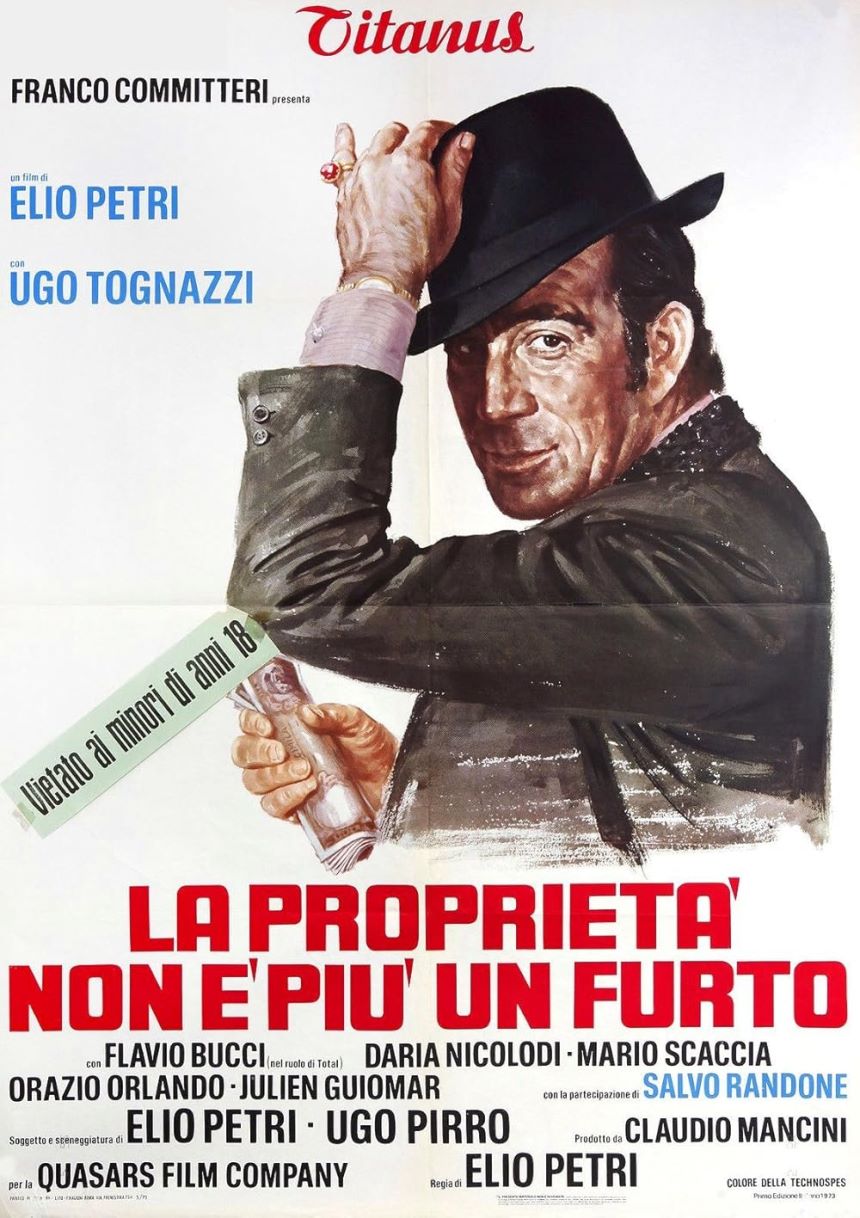
 The title for Elio Petri’s blistering comedy Property Is No Longer A Theft can be taken both at face value and with a heavy dose of irony; that, and the droll ingenuity of its phrasing, readily recall the two preceding films in his ‘Trilogy of Neurosis’, viz. the blazing masterpiece Investigation of a Citizen Above Suspicion and the abrasive agitprop The Working Class Goes to Heaven. Though considerably underrated, it remains an unequivocally brilliant work thanks to the interplay of aesthetic ferocity and intellectual dare that the iconoclastic filmmaker brought in while blending radical politics and ferocious polemics with deliciously gonzo, sleazy, provocative B-movie aesthetics and even Brechtian splashes. The narrative is built around a farcical war of attrition between Total (Flavio Bucci), a young bank cashier who’s literally allergic to money and calls himself “Mandrakian Marxist”, and a wealthy, corrupt and glibly offensive businessman called “The Butcher” (Ugo Tognazzi). Upon witnessing the bank manager’s sycophancy towards the latter, Total quits his job, begins stalking Butcher – the very embodiment of the evils of capitalism for him – and starts stealing his belongings – inane things at first, before progressing to expensive objects and even his mistress (Daria Nicolodi). The Butcher, meanwhile, avoids reporting Total to the maniacal investigating cop (Orazio Orlando), as he’s massively over-reported his loss to the insurance. This anarchic film’s script was as unhinged as its characters, which also comprised of a vaudeville master thief (Mario Scaccia) and Total’s bemused father (Salvo Randone), and is bookended by three riotous sequences – a chaotic bank robbery where the clerks unleash vicious dogs upon the robbers; a salesman’s hilarious demo of anti-theft devices; and an amusing paean to thieves and robbers.


Director: Elio Petri

Genre: Crime Comedy/Black Comedy/Social Satire/Political Satire

Language: Italian

Country: Italy

Thursday, 10 July 2025

We Still Kill the Old Way [1967]

 Elio Petri’s filmography can be roughly divided into two categories – relatively restrained films (albeit, not completely bereft of stylistic flourishes) during the first half of his career, and formally exuberant and politically outspoken works subsequently – with We Still Kill the Old Way squarely belonging to the former camp. This muted and moody political conspiracy thriller reminded me of the tone, build-up and oblique storytelling of Francesco Rosi’s superb film Illustrious Corpses. No surprises, perhaps, that both were adapted from Leonardo Sciascia’s novels, this one being from To Each His Own. It began with an audacious long-take – with a “flying” camera providing panoramic views of the Sicilian town in which it’s set – before dramatically diving into the narrative as an oddball Tati-esque postman, while on the way to delivering a letter, discusses about it with the town’s laidback but curious residents. The said letter is an anonymous threat to a womanizing pharmacist, which soon materializes into his murder by unknown assailants during a hunting trip with his friend Antonio. While this is treated as an open-and-shut case of honour killing, a mild-mannered but dogged leftist Professor (Gian Maria Volonté in a fine atypical casting) starts suspecting that Antonio was the real target instead, rather than an unlucky collateral. Sparked by his identification of the newspaper – read by political and religious conservatives – that’s used for composing the threat mails, he starts obsessively digging into the death that’s bound to be detrimental to his physical wellbeing. Along the way he finds himself falling for his dead friend’s widowed wife (a delectably inscrutable Irena Papas), as the plot increasingly thickens. Vivid cinematography and Luis Bacalov’s idiosyncratic score added to the film’s captivating atmosphere.


Director: Elio Petri

Genre: Crime Thriller/Political Thriller

Language: Italian

Country: Italy

Sunday, 6 July 2025

The Assassin (L'Assassino) [1961]

 L'Assassino, Elio Petri’s solid if underrated debut, combined three aspects of his filmmaking that’d manifest more markedly in his later, better-known films. It introduced his love for genre cinema, B-movies and gonzo aesthetics; it underscored his disdain for unchecked consumerism and moral rot in contemporary Italian society (a theme in multiple landmark Italian films of the 1960s); and it provided teasing glimpses into how his left-wing politics was inseparable from his craft (he formerly wrote Marxist film criticisms for L'Unità). Then matinee idol Marcello Mastroianni, who Petri scored for the lead role (they’d collaborate thrice more), retained a soft corner for this film, even though he starred in some of the most seminal Italian films of that period. He was excellent as Alfredo, an antiques dealer of dubious standing, a lothario, a bon vivant and a scoundrel, who’s arrested from his posh apartment in Rome on suspicions of murdering his older ex-mistress Adalgisa (Micheline Presle), a wealthy socialite who was also his business sponsor and partner until recently. He owed her money, was one of the last persons to see her alive and had just switched to a younger girlfriend who’s a moneyed heiress, and therefore the suspicion. Additionally, the Commissario (Salvo Randone) – who’s heading the case and hopes to wear him down with interminable waiting and interrogations – hates his “type”. Scripted by the great Tonino Guerra, the film alternated the “present” – which occurs over 1 ½ days – with frequent flashbacks into Alfredo’s chequered past, thus making this as much an investigation into the protagonist as one into the case at hand. The sparkling B/W cinematography and smooth jazz score added to the fatalist atmosphere of this “anti-realist thriller”.


Director: Elio Petri

Genre: Crime Thriller/Mystery

Language: Italian

Country: Italy

Sunday, 15 June 2025

The Color of Lies [1999]

 A sleepy, closely-knit provincial town in Brittany – a place that Chabrol has returned to multiple times across his career – is a bubbling hotbed of secrets, suspicions, deceit, intrigue and criminal tendencies in Chabrol’s smouldering, deftly underplayed and excellent thriller The Colour of Lies. The deliberately paced narrative is bookended by two violent events – the rape and murder of a 10-year-old girl, and a death by falling that could either be accidental or not – while there’re other misdemeanours that’re underway in parallel. The film’s languid atmosphere, however, belied these, as Chabrol was more interested in portraying the moral rot, the societal malaise and the psychological repercussions as opposed to making a regular crime and mystery movie. When the body of the girl is discovered, the cops – led by the new, young and gently tenacious chief of police Frédérique (Valeria Bruni Tedeschi), who’s also an outsider – immediately consider the embittered painter and art teacher René (Jacques Gamblin) as the primary suspect, as he was the last person to see her alive. Once a promising artist whose career crashed upon being wounded in the 1980s, he earns a pittance by teaching local kids and is largely dependent on the earnings from his vivacious wife Vivianne (Sandrine Bonnaire), who’s a professional physiotherapist. While she loves him and defends him against the growing rumours, she gets drawn into a sly affair with Desmot (Antoine de Caulnes), a slick, shady and highly successful writer who glibly collaborates with both left and right-wing establishments. Beautifully chiselled turns by the actors led by Gamblin and Bonnaire, the sultry restraint of its images, the gossipy amoral community, and the understated finale all added to the film’s sordid charm.


Director: Claude Chabrol

Genre: Thriller/Crime Thriller/Mystery

Language: French

Country: France

Friday, 6 June 2025

La Cérémonie [1995]

 Claude Chabrol had impishly quipped that La Cérémonie – one of his greatest accomplishments, and which I’d been craving to revisit ever since I read A Judgement in Stone, the terrific source novel by Ruth Rendell – that it’s a “Marxist film”. This deliciously insidious tour de force work wasn’t just a cutting dissection of class structures, dynamics and conflicts, it literally culminated into a violent class war. He transplanted the novel from the British to the French countryside, retaining the unnerving interplay between a provincial locale’s overly tranquil environs and its sordid undercurrents with sinister possibilities, while replacing the author’s faux-reportage prose with a venomously ironic tone that made this an icily controlled domestic thriller. The malevolent tale is spearheaded with stunning aplomb by two of the most fabulous French actresses – Sandrine Bonnaire, as the taciturn, eerily withdrawn and inscrutable Sophie who’s pathologically ashamed of her illiteracy, and Isabelle Huppert, as the chirpy, eccentric, borderline unhinged and devilishly volatile Jeanne. A ticking bomb is planted the day the wealthy, cultured and deeply snobbish Lelièvres – comprising of the ravishingly beautiful Catherine (Jacqueline Bisset), her quietly arrogant second husband Georges (Jean-Pierre Cassel), his gently condescending college-going daughter Melinda (Virginie Ledoyen), and her gauche adolescent son – hire Sophie as resident maid in their isolated mansion, and the fuse gets lit when the latter ends up befriending Jeanne, an impetuous postmistress who loves prying into people’s secrets and holds a smouldering grudge against the family for their privilege and indifference. Further, the feral pair are subconsciously craving for delayed vendetta against the social order for their disreputable pasts, and their roiling resentments erupt into a shockingly manic climax that Chabrol must’ve especially relished filming.

p.s. This is a revisit. My earlier review of this film can be found here.


Director: Claude Chabrol

Genre: Crime Thriller/Black Comedy

Language: French

Country: France

Sunday, 18 May 2025

Santosh [2024]

 British-Indian filmmaker Sandhya Suri’s gripping, smouldering and impressive debut feature Santosh operated in the grim intersectionality of class, caste, religion and gender, and the foul cesspit of disenfranchisement, bigotry, caste violence, Islamophobia, misogyny and police brutality. That may seem like a lot is going on for one movie. It’s therefore to Suri’s credit – aided perhaps by her background as a documentarian – that these themes were organically interlaced into the script, thereby ensuring that they’re integral to this police procedural involving the investigations into the rape and murder of a young Dalit girl in the ironically named north Indian state of “Chirag Pradesh”. The clincher was that these subterranean realities were evoked through the gaze of a woman protagonist – privileged by her caste and religion, but not so much by her class and gender – in an inversion to this otherwise “masculine” genre and the heavily male-dominated police force. Shahana Goswami was terrific – in a turn marked by seething fury and restraint – as the eponymous Santosh, a recently widowed woman who decides to inherit her husband’s job of a police constable, and therefore his salary and accommodation, in order to secure her social and financial independence. There, she immediately encounters an environment reeking of patriarchy, prejudices, sexism and apathy, and soon after finds herself amidst an increasingly vile morass on account of the afore-mentioned crime. The scenario was suffused with additional nuance upon the arrival of a seasoned senior inspector (Sunita Rajwar) to lead this politically volatile case, as on hand she treats Santosh with courtesy and even protectiveness – albeit, coloured with sensual undertones on occasions – while, on the other, she has a murky past of custodial torture and cynical expediency.


Director: Sandhya Suri

Genre: Crime Thriller/Police Procedural

Language: Hindi

Country: India/UK

Monday, 14 April 2025

Miséricorde (Misericordia) [2024]

 Alain Guiraudie channelled Claude Chabrol – the latter’s recurring love for delivering cutting and subversive social critiques through tales of passion and crime in provincial France – in his delectably teasing pastoral noir Miséricorde. The film also possessed a morbid sense of humour – that was at its most darkly funny in a sequence where the protagonist is served mushrooms for dinner that’ve grown at the site of a murdered man’s corpse, recalling Imamura’s penchant for macabre fun – and an increasingly absurdist streak, interlaced with charged homoerotic overtones. It began on a creepily banal note, as the protagonist – shot from his POV – drives through winding country roads in near silence; one can already sense that unseemly developments await at his destination. He’s Jérémie (Félix Kysyl), a soft-spoken baker presently out-of-work, who’s returned to his bucolic hometown of Saint-Martial to attend the funeral of his former boss who he admired. Things take uncomfortable turns from get-go as the middle-aged widow (Catherine Frot), who figured Jérémie was in love with her deceased husband, offers him an extended stay at her place and is poker-faced about the ensuing intimacy, while her volatile and aggressive son (Jean-Baptiste Durand) – possibly triggered by some repressed memories – is increasingly hostile to Jérémie as he thinks that the latter is planning to seduce his mom, which rapidly escalates into violence. Jérémie, meanwhile, has a soft-corner for an unemployed pot-bellied loner, while an impish local priest (Jacques Develay), who’s also an avid forager of mushrooms, is attracted to Jérémie. The tranquil environs of this sleepy village evidently mask a saucy core rippling with delicious amorality and sizzling carnality, and this duality found sly accompaniments in this droll, playful and earthy work.

p.s. Watched it at the 2025 Bangalore International Film Festival (BIFFES).


Director: Alain Guiraudie

Genre: Thriller/Crime Thriller/Black Comedy

Language: French

Country: France

Saturday, 5 April 2025

The Girl with the Needle [2024]

 Magnus von Horn’s harrowing The Girl with the Needle, that transformed a real time and a true crime event into nightmarish gothic horror, walked a razor’s edge between bleak period film, intense exercise in exploitation cinema and extreme miserabilism. With a rigorous formal grammar – informed by Carl Theodor Dreyer’s spare desolation, German expressionism, Lynchian grotesquerie and von Trier’s provocative portrayals of suffering – it crafted a fervid, claustrophobic and unsparing vision of deprivation, sordidness and violence. But what made it, for me, most unsettling was its moral ambiguity and troubling representations bordering on exploitative. Set in 1919 as the devastating WW1 is culminating, and in a Copenhagen that’s a hellish mix of muck and destitution, the film’s protagonist is Karoline (Vic Carmen Sonne) whose woes and misfortunes are portrayed with ambivalence and even apathy. Living in squalid conditions and working as a lowly seamstress at a grimy factory, she’s left pregnant – which she unsuccessfully tries aborting – when her affair with her boss comes to a cruel ended. Meanwhile her husband, who she’d assumed dead, returns with debilitating war trauma and a grisly facial disfigurement that gets him employed as a circus freak. Her life takes a seemingly positive turn when she befriends Dagmar (Trine Dyrholm), who claims to illicitly arrange adoptions of unwanted babies; Karoline, in turn, becomes a wet nurse to Dagmar’s 7-year-old daughter. Unbeknownst to her – and viewers who aren’t invested in Danish history – this genial middle-aged lady is the notorious Dagmar Overbye. The film, which began with overlapping images of faces grimacing into rictuses that reminds one of Goya and Munch’s paintings, bristled with visceral terror that – complemented by its disconcerting score – remained through till the end.

p.s. Watched it at the 2025 Bangalore International Film Festival (BIFFES).


Director: Magnus von Horn

Genre: Historical Drama/Crime Drama/Psychological Horror

Language: Danish

Country: Denmark