Showing posts with label Korean Cinema. Show all posts

Sunday, 28 June 2026

What Does That Nature Say to You [2025]

 Lengthy alcohol-soaked interactions – as speeches slur, conversations digress, inhibitions get lowered, and anxieties, fissures and disappointments get subtly exposed – have defined Hong Sang-soo’s droll, observational slices of life. The pivotal sequence that his seriocomic 33rd feature gradually builds towards is also an inebriated gathering where banal discussions, albeit with simmering undercurrents, transition into an edgy meltdown and disapproving opinions. Passing the “alcohol test” was therefore a crucial consideration in his amusing take on the “meet the parents” premise; however, that said, in his delectably mellow and understated world – where life plays in a minor key – confrontations and judgements are both transient and quickly forgotten. Ha (Ha Seong-guk), a thirty-something amateur poet who’s detached ties with his wealthy and influential father in order to pursue beauty shorn of societal chains, is invited by his girlfriend (Kang So-yi) of three years – who’s come to accept his quirky lifestyle choices – into her parents’ sprawling hilltop home. Her family, however, may not be as understanding, despite their outwardly genial natures. The father (the wonderful HSS regular Kwon Hae-hyo) disarmingly engages Ha in rambling banter – trying his antiquated car, showing him around, egging him to bond with the family, and finally sloshing him with makgeolli –; the discerning mother (Cho Yun-hee), a poet herself who gets Ha to open up about his poetry skills; and the sister (Park Mi-so), supposedly battling depression, steadily needling him about his privilege that’s at odds with his romanticized desire for the life of a starving artist. In a quirky formal choice, the typically unadorned visuals in the customary long takes became hazy on occasions, complementing Ha’s frequent avoidance of glasses in his preference for blurry vision of things.


Director: Hong Sang-soo

Genre: Drama/Comedy/Slice-of-Life

Language: Korean

Country: South Korea

Thursday, 16 April 2026

No Other Choice [2025]

 Park Chan-wook’s filmography is replete with wickedly feral killers who complement method with madness. No Other Choice’s anti-hero, conversely, was ridiculously inept at murder despite being naturally drawn to it, thus making this an interesting entry in his canon. Adapted from Donald Westlake’s novel The Axe – previously adapted by Costa-Gavras, and which Park had wanted to make since long – it drips with liberal doses of farce, satire, cutting humour, chaotic violence, and an exceptionally jaundiced view of a broken, hyper-capitalist society. Man-su (Lee Byung-hun) – a veteran in the paper industry who’s loyally been with the same organization for twenty-five years – is a model citizen with a beautiful wife (Son Ye-jin), an ancestral home that he’s painstakingly reinstated, and heteronormative ideals. His amusingly bland life comes crashing down when, upon a takeover by Americans relentlessly driven by automation and efficiency, he – along with many others – are summarily “axed”. The new bosses supposedly have no other choice, and in turn Man-su becomes convinced that he too has none but to bump off his competition – former colleagues similarly struggling with crushing unemployment – to secure a prized job opening. In another movie, he would’ve been the wronged guy forced by desperate circumstances; however, in Park’s world of controlled malice and moral dystopia, Man-su – like his bosses – always had other choices that were nullified by his class trappings and “killer instincts”, while “cut-throat” competition conveniently justify murderous ends. Powered by a compelling turn by Lee (reuniting with Park twenty-five years after Joint Security Area), a fine supporting act by Son, and Park’s love for gorgeous and meticulously designed visuals, the film was sad, crazy, grisly, bitter and funny, despite its deliberate silliness and excesses.


Director: Park Chan-wook

Genre: Black Comedy/Social Satire/Crime Thriller

Language: Korean

Country: South Korean

Sunday, 11 May 2025

A Traveler’s Needs [2024]

 A Traveler’s Needs – Hong Sang-soo’s third collaboration with Isabelle Huppert – is a film of spontaneous comings and goings, loopy repetitions, eccentric digressions, and fleeting impressions. This is, furthermore, a droll and idiosyncratic tableau on improbable encounters and oddball language lessons. Huppert, whose fabled career is filled with incongruous, anomalous and unhinged characters, is a delectably strange cat here as Iris (Huppert), a whimsical and coquettish French woman of an unknown past and dubious disposition. Since her arrival in Korea, she’s been drifting in Seoul, earning money by teaching French to well-off locals using a self-devised method that’s hilariously weird, and sharing apartment with a naïve young guy for whom she’s somewhere between an attraction, wise mentor and unlikely mother figure. Over the amusing and playful narrative’s loosely-strung chapters, we see Iris teaching and interacting with a young woman who’s become fond of her quirky tutor; being interviewed by a woman (Lee Hye-young) who wants to employ her but is flabbergasted by her pedagogy, and then bonding with her and her genial husband (Kwon Hae-hyo) over makgeolli – Iris’ beverage of choice – and the poetry of Yun Dong-ju, who was arrested and killed at the age of 28 for his anti-Japanese resistance in occupied Korea during WW2; having meandering conversations with the infatuated Inguk (Ha Seong-guk) with whom she stays; and drinking more makgeolli and listening to bad English translations of Kwon’s poems. In a deadpan aside – the only stretch without Huppert in it – we see Inguk being berated by his passive-aggressive mother (Cho Yun-hee) who’s shocked at his choice of roommate. The minimalist script, consequently, unfolded as a charming and observational take on aimless travels, intercultural companionships and existential ennui.


Director: Hong Sang-soo

Genre: Comedy/Slice-of-Life

Language: English/Korean/French

Country: South Korea

Tuesday, 11 June 2024

In Our Day [2023]

 Hong Sang-soo’s chatty yet deadpan In Our Day – made in his characteristically unadorned visual language, unassuming aesthetic grammar and the kind of radical cinematic purity that he’s obsessively internalized – comprises of two parallel threads with such a fleeting link that they might as well be happening at different points in time rather than simultaneously. However, the way these two mirrored each other – in their succinct structures, trio of characters that includes a weary former artist and a visiting young admirer, being steadfastly confined in an apartment, rambling conversations that hint at dwelling on the larger questions of life only to impishly pull back, and the way they ambled along – gave it the form of a wistful diptych. The first thread is centred around a retired movie actress (Kim Min-hee) who has put up at the apartment of an old friend (Song Sunmi) where she’s visited by a naïve cousin aspiring to become an actress. The second thread is set in the flat of an ageing former poet (Ki Joo-bong) – who’s been asked by his doctor to stay off alcohol and cigarettes and has suddenly attained cult following among young readers – is the subject of a documentary being made by a young film student (Park Miso) as part of her coursework, while a callow young guy visits him for insights into art and life. The film, typical of Hong’s love for locating existential truths within his miniature cavasses – oftentimes through wry digressions and ambling drifts – includes a lazy cat, a forgotten guitar, playing “rock paper scissors”, trying non-alcoholic beers, and most memorably, savouring ramen with chili paste. The poet, by the way, does eventually fall back on soju and smoke.


Director: Hong Sang-soo

Genre: Drama/Comedy/Slice of Life

Language: Korean

Country: South Korea

Saturday, 26 August 2023

The Novelist's Film [2022]

 Self-reflexive and metatextual elements, quotidian urban settings, rambling alcohol-fuelled conversation, passive-aggressive interactions, moments of epiphany – captured through rigorous form, improvisational style, loosely-strung narrative, sparse aesthetics, limpid storytelling, and wry, playful tones with undercurrents of melancholy – and performed by actors belonging to a small pool of regulars – Korean maestro Hong Sang-soo’s excellent 27th narrative was delightfully laced with his distinctive signatures. And yet – thus underscoring the unassuming Korean filmmaker’s brilliance – this deceptively complex, gently affecting and nakedly personal film marvellously displayed his panache for serving refreshingly fascinating wines in amiably familiar bottle, while reinforcing his love for the medium. Lee Hye-young, who was memorable in the lead role in Hong’s sublime 2021 film In Front of Your Face – where the middle-aged former star played a middle-aged former star – is a famous, veteran novelist here struck with writer’s block. She’s therefore looking for inspiration in order to rejuvenate her creative impulses, and with that intent she makes an unplanned visit to a town in Seoul’s suburbia where she has awkward reconnects with two old acquaintances –a former writer (Seo Younghwa) who now owns a bookshop, and a well-known filmmaker (Kwon Hae-hyo) who’d once planned to adapt one of her books to screen but didn’t finally do. Amidst these delicate interactions, and a drinking episode too, a chance encounter with a renowned actress (Kim Min-hee), who’s taken an indefinite sabbatical from movies, proves fortuitous as she spontaneously decides to direct a novelistic short film, and even convinces the latter to collaborate with her. The ravishing colours at the end – providing fleeting glimpses of the said short – led this fragile and intimate film, otherwise shot in high-contrast B/W, to a deeply sensuous finale.


Director: Hong Sang-soo

Genre: Drama

Language: Korean

Country: South Korea

Tuesday, 21 March 2023

Broker [2022]

 Bittersweet chronicles of dysfunctional families have been the connecting thread in Kore-eda’s filmography, and Broker fell squarely in that bucket. However, what made it a companion piece to his zany and dazzling masterwork Shoplifters was that both were centred on “found families” – bound by choice and chance, as opposed to blood ties – comprising of misfits, outsiders and delinquents who reside outside the margins of social boundaries. While it displayed tremendous empathy for its characters like the earlier film – despite their moral greyness – his second consecutive feature made outside Japan was set slightly apart on two key accounts, viz. the morally complex topic at its core and its toned-down humour. These imbued it with both its strength and pitfall in that, on one hand, the plot was devoid of contrivances and easy answers, and was dealt with nuance and candour, while, on the other, sentimentality at times took precedence where dark humour and irony would’ve served better. Set in Korea, the motley and well-enacted ensemble cast comprised of two friends – owner of a debt-ridden laundromat (the always brilliant Song Kang-ho) and an orphaned worker in a church (Gang Dong-won) – who sell babies in the black market to those who aren’t able to adopt legally; a sassy sex worker (the striking Lee Ji-eun) who’s had to abandon her baby and go on the run; and a cop (Bae Doona) whose desperation to catch the two men in the act leaves her colleague (Lee Joo-young) both bemused and uncomfortable. The film, which alternated between oddball human drama, reluctant crime caper and quirky road movie – in a manner that Kore-eda has made his own – had a strangely satisfying ending despite hardly having one.


Director: Hirokazu Kore-eda

Genre: Drama/Road Movie

Language: Korean

Country: South Korea

Wednesday, 4 January 2023

Decision to Leave [2022]

 Decision to Leave is one of Park Chan-wook’s most muted works – notwithstanding its arresting set-pieces, panache and controlled stylistic flamboyance – given its relative lack of operatic flourishes. But its theme of dark and self-destructive obsessions, along with its formal palette that was marked with extreme precision – with sprinkles of twisted playfulness thrown in – made this gradually unfolding neo-noir an intriguing new turn for the South Korean maestro. One might also credit that turn to The Little Drummer Girl, his compelling slow-burn adaptation to TV of John le Carré’s Cold War thriller. Hae-jun (Park Hae-il) is an insomniac police detective in Busan in a tenuous marriage. His dull, workaholic and largely solitary existence experiences an electrifying jolt when he takes on the investigation of a retired immigration worker who’s found dead at the foot of a cliff that he loved climbing. His doubts about the cause of death – was it an accident or suicide or homicide – turn into an obsession when he meets Seo-rae (Tang Wei), the victim’s cold, enigmatic, enticing, impossibly alluring and significantly younger widow who’d illegally emigrated from China many years back, works at a centre for elderly care, and harbours tantalizing secrets. Though Hae-jun becomes convinced that Seo-rae has killed her husband, the brilliant but heavily repressed cop – reminiscent of Verhoeven’s Basic Instinct – finds himself inexorably drawn to this stunning woman against his best judgements. Despite some of its narrative contrivances and relatively weaker 2nd half, this moody Hitchcockian thriller – boasting of an absorbing turn by Wei, gorgeous production designs, seductive use of Jung Hoon-hee’s song ‘Mist’, and impish play on the slippery nature of languages – made this a gripping, addictive and oftentimes enthralling crime thriller.


Director: Park Chan-wook

Genre: Crime Thriller/Post-Noir/Romantic Noir/Police Procedural

Language: Korean

Country: South Korea

Wednesday, 8 June 2022

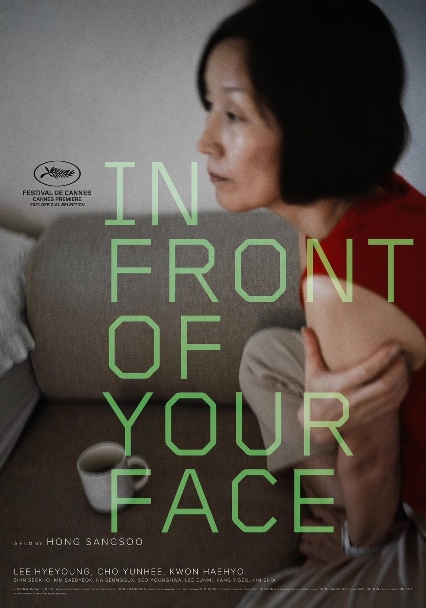
In Front of Your Face [2021]

 Hong Sang-soo, poet of the understated and the quotidian, crafted a disarmingly sublime work – delicately laced with melancholy, regrets, old memories, and impermanence – in his 26th feature, and second in 2021, In Front of Your Face. And its striking self-reflexive flourishes and sly infusions of wry, deadpan, self-deprecating humour made it an archetypal work in his prolific but understated canon. The protagonist here is Sangok (Lee Hye-young) – a middle-aged woman and one-time actress – who’s come back to Korea after many years in the US. The gently unfolding narrative captured small yet surprisingly profound moments over 1 ½ days – bittersweet reconciliation with her younger sister (Jo Yoon-hee) who clearly loves her but was left deeply hurt upon her sudden disappearance from their lives many years back; a quiet cigarette under a bridge during a walk in the gardens; bafflement at seeing Seoul’s urbanization (euphemism for relentless construction of skyscrapers) and gentrification during her absence; an elegiac visit to the house where she’d grown up; and a customary extended session of rambling conversations over endless glasses of soju at a lonely café where a garrulous and effusive filmmaker (Kwon Hae-hyo) is desperate for her to come out of her self-imposed retirement in order to star in his next movie. The film, in itself, was captivating in its evocative portrayals, formal sparseness, humane character and Hong’s continued exploration of Seoul’s locales, taverns and back-alleys. And these attributes were made even more fascinating by the fact that the lead actress – a former star in the country during the 80s – was the daughter of legendary filmmaker Lee Man-hee, with whom Hong’s mother Jeon Ok-soon – who was a movie producer – had collaborated on five films.


Director: Hong Sang-soo

Genre: Drama/Family Drama

Language: Korean

Country: South Korea

Thursday, 3 February 2022

Introduction [2021]

Hong Sang-soo’s wistful, seriocomic and episodic film Introduction was a typically droll evocation of quotidian quirks, wry encounters and confused aimlessness of existence. This summation, of course, can be easily applied to most of his filmography. That it was also a minimalist low-budget work, ephemeral in its plotting, understated, irredeemably voluble, populated with his regular actors, and made in low-key B/W – facets that might liken it to a straight-faced student film for those not sufficiently into the indefatigable Korean auteur’s oeuvre – further placed it in HSS’ eminently identifiable cinematic universe. And, as its title enigmatically alluded to, it played out as a series of uneasy, off-kilter introductions of placid youngsters to reluctant parental figures, and of nonplussed neophytes to imposed ideas and weary veterans. That said – despite the structural interconnectedness, moments of poignancy and one of the most hilarious drunken interludes in all of his filmography – it was otherwise a relatively lighter fare that lacked the formal bravura and breezy brilliance of his finest gems. The sketchily drawn characters within the short, curiously overlapping vignettes – that began in media res and ended inconclusively – included a young guy called Youngho (Shin Seokho) who impulsively dabbled in acting, his placid girlfriend Juwon (Park Miso) who’s joined a course in fashion in Berlin, Youngho’s acupuncturist father suffering from spiritual crisis, the latter’s middle-aged receptionist who Youngho had a crush on, a famous theatre actor (Ki Joo-bong) who Youngho’s mom is dating, Juwon’s protective mother (Seo Young-hwa), the latter’s friend who’s a famous artist (Kim Min-hee), and Youngho’s doting friend. Among its various episodes, the most memorable one involved a hilarious diatribe on the vocative sanctity of acting, over copious rounds of soju.


Director: Hong Sang-soo

Genre: Drama/Comedy/Slice of Life

Language: Korean

Country: South Korea

Friday, 26 March 2021

The Woman Who Ran [2020]

 The Woman Who Ran – with its meandering flow, rambling conversations, low-key style, subjective POV, and romantic relationships existing at various stages of dysfunction – possessed all the distinctive traits of Hong’s filmography. And, while it might’ve appeared to be low on meta-narrative and self-referential elements, it had a bit of that too; one of the characters absentmindedly opines about her writer husband, “If he just repeats himself, how can that be sincere?”, which didn’t just inadvertently allude to the film’s protagonist Gam-hee (Kim Min-hee) who keeps repeating to all her friends – with a deadpan air of insincere make-believe – the same story of undiminished love that she shares with her husband, but perhaps on a sardonic note to the director’s oeuvre too. The episodic narrative was loosely structured into three parts wherein Gam-hee – seemingly making use of her “me time” as her husband is apparently on a business trip – connects with her old friends. In the first chapter she visits Young-soon (Seo Young-hwa), who’s divorced and shares her apartment at a picturesque Seoul suburb with a female flatmate; in the middle chapter she visits Sou-young (Song Seon-mi), who’s having an affair with a guy who incidentally resides in the same building. And, in the final chapter, she has an unplanned reunion with an estranged friend (Kim Saebyuk) married to Gam-hee’s ex-boyfriend. The movie’s outwardly placid happenings – albeit, with gently simmering undercurrents – were often punctuated with wryly funny moments, be it a hilariously courteous argument with a man who’s wife has an aversion to cats, or Young-soon’s dramatic fight with a younger guy who keeps pursuing her; or Gam-hee sharing an awkward smoke with her visibly flustered former lover.


Director: Hong Sang-soo

Genre: Drama/Buddy Film

Language: Korean

Country: South Korea