Showing posts with label Danish Cinema. Show all posts

Saturday, 5 April 2025

The Girl with the Needle [2024]

 Magnus von Horn’s harrowing The Girl with the Needle, that transformed a real time and a true crime event into nightmarish gothic horror, walked a razor’s edge between bleak period film, intense exercise in exploitation cinema and extreme miserabilism. With a rigorous formal grammar – informed by Carl Theodor Dreyer’s spare desolation, German expressionism, Lynchian grotesquerie and von Trier’s provocative portrayals of suffering – it crafted a fervid, claustrophobic and unsparing vision of deprivation, sordidness and violence. But what made it, for me, most unsettling was its moral ambiguity and troubling representations bordering on exploitative. Set in 1919 as the devastating WW1 is culminating, and in a Copenhagen that’s a hellish mix of muck and destitution, the film’s protagonist is Karoline (Vic Carmen Sonne) whose woes and misfortunes are portrayed with ambivalence and even apathy. Living in squalid conditions and working as a lowly seamstress at a grimy factory, she’s left pregnant – which she unsuccessfully tries aborting – when her affair with her boss comes to a cruel ended. Meanwhile her husband, who she’d assumed dead, returns with debilitating war trauma and a grisly facial disfigurement that gets him employed as a circus freak. Her life takes a seemingly positive turn when she befriends Dagmar (Trine Dyrholm), who claims to illicitly arrange adoptions of unwanted babies; Karoline, in turn, becomes a wet nurse to Dagmar’s 7-year-old daughter. Unbeknownst to her – and viewers who aren’t invested in Danish history – this genial middle-aged lady is the notorious Dagmar Overbye. The film, which began with overlapping images of faces grimacing into rictuses that reminds one of Goya and Munch’s paintings, bristled with visceral terror that – complemented by its disconcerting score – remained through till the end.

p.s. Watched it at the 2025 Bangalore International Film Festival (BIFFES).


Director: Magnus von Horn

Genre: Historical Drama/Crime Drama/Psychological Horror

Language: Danish

Country: Denmark

Sunday, 15 December 2024

Festen (The Celebration) [1998]

 In the annals of excellent depictions of dysfunctional families, and how veneers of civility and respectability come undone during a fateful get-together – of which there are many incredible examples in cinema – there aren’t many that’re as scalding, portraying a family that’s as damaged, and which unravels as spectacularly on a celebratory occasion, as Thomas Vinterberg’s Festen, thereby underlining the title’s fiendish irony. The first “Dogme 95” film movement, it boldly wrapped an intensely bleak and sardonic chamber piece, and an elaborate melodrama, in the aggressive purism, low-fi aesthetics and anti-realism that were chartered by this avant-garde collective’s manifesto co-founded by Vinterberg and Lars von Trier. The occasion is the lavish 60th birthday celebration of Helge (Henning Moritzen), a wealthy hotelier and domineering patriarch, at an opulent hotel in the country. He’s joined by his flattering wife (Birthe Neumann), three children – the unassuming Christian (Ulrich Thomsen) carrying a dark trauma, the brutish Michael (Thomas Bo Larsen), and the temperamental Helene (Paprika Steen) – and his fawning circle of white, wealthy, middle-aged friends. The uncomfortable family dynamics, which is established at the outset, immediately indicated that things will end badly; but no one could’ve anticipated what a horrendous trainwreck it’d be. Disturbing revelations of sexual abuse, brooding memories of a tragic suicide, entrenched patriarchal mindsets, casual misogyny, pungently racist songs, emotional manipulations by a colluding mother, violent outbursts, and a shallow bourgeoisie ever ready to start feasting, dancing and turning a blind eye to inconvenient truths as the dinner party devolves into a Buñuelesque farce – and all of these feverishly captured through grainy film, handheld camera, diagetic sounds and shattering performances – demonstrated how brashly transgressive this film was both thematically and technically.


Director: Thomas Vinterberg

Genre: Drama/Black Comedy/Family Drama

Language: Danish

Country: Denmark

Saturday, 10 April 2021

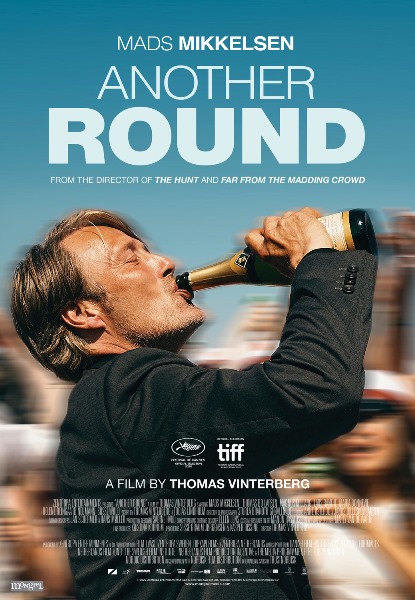
Another Round [2020]

 Thomas Vinterberg’s Another Round – alternately dreary, poignant, mellifluous and uplifting – remains as much a bittersweet ode to existential predicaments borne out of mid-life crisis as a wryly humorous commentary on alcoholism. Hence, despite its central tenet of gradually and inevitably sliding into the wrong end of the bottle – albeit, initially under the ironic and self-deluding guise of academic experimentation – and facing health, familial and professional repercussions thereof, it essentially was a tragicomic portrayal of ageing, marriage, friendship and challenging social conformity. Martin (Mads Mikkelsen), a middle-aged history teacher at a Copenhagen high school, is literally sleep-walking through his life – his marriage to his childhood sweetheart (Maria Bonnevie) has grown stale, his kids rarely interact with him anymore, and his students are bored by his lackadaisical pedagogy. Hence, when, during a celebration with his three closest buddies and fellow colleagues – English teacher Peter (Magnus Millang), music tutor Peter (Lars Ranthe) and sports instructor Tommy (Thomas Bo Larsen) – an offhand remark is made about an oddball research theory arguing that human blood is 0.05% alcohol deficient, he becomes the first person to literally take it up and surreptitiously starts taking a swig of vodka at work. However, surprisingly, the other friends too decide to undertake this hilariously absurd but melancholic experiment… things, therefore, are bound to go downhill soon even if they seem darn funny to start with, and that’s what made the film emotionally absorbing on one hand, and decidedly old-fashioned on the other. The grimy realism added an unconventional flavour to the drama which ended with a euphoric finale, and the cheeky but straightforward narrative was bolstered by terrific turns by all and an especially standout one by Mikkelsen.


Director: Thomas Vinterberg

Genre: Drama/Comedy/Buddy Film/Marriage Drama

Language: Danish

Country: Denmark

Tuesday, 1 September 2020

Giraffe [2019]

 “Progress” and globalization are inherently politically loaded terms, and hence their interpretations and repercussions are dependent on who’s evaluating them. Anna Sofie Hartman, in her gently meditative film Giraffe, explored their intertwined nature, and in turn, a subset of their multi-pronged effects inevitably leading to human displacements. She also brilliantly blurred the line between fiction and documentary filmmaking, as she imbued this ruminative work with understated political and existential inquiries, and the form of a diary film. In 2010 an ambitious plan was envisaged to build a tunnel under the Baltic Sea, in order to connect Northern Germany with the island of Lolland in Denmark; the Fehmarn Belt Fixed Link, once ready in 2028, will provide dramatically quicker alternatives to the current ferry ride. However, achieving a gargantuan vision such as this doesn’t just entail a massive financial cost, but also significant human ones – including, but certainly not limited to, the razing down of homes and vegetation, forced relocation of communities, and mobilization of affordable labour from less expensive countries. With Dara (Lisa Loven Kongsli) – an ethnologist, researcher and adoptive Berliner in her late 30s – as a stand-in for herself, Hartman covered the various thematic strands using diverse narrative choices – e.g. interview of an aged couple, shot in vérité style, who’ll need to vacate their home soon; reconstructing the life and memories of a former librarian from her diary entries and other artefacts collected at a deserted house due for demolition, where she’d lived for four decades; the socioeconomic plight of a group of Polish construction workers separated from their families; and a brief, affecting affair that she has with one such guy who’s barely out of his teens.


Director: Anna Sofie Hartmann

Genre:  Drama/Cinema Verite/Urban Drama

Language: Danish/German/Polish/English

Country: Denmark

Saturday, 27 June 2020

The House That Jack Built [2018]

It’s rather bemusing to note that Danish provocateur Lars von Trier began the 2010s with a movie as haunting, wrenching and transcendental as Melancholia and ended it with one as inflammatory, grisly and brash as The House that Jack Built (one can say the same about the 2000s too which he’d begun with the bleakly beautiful Dancer in the Dark and ended with the daringly controversial Antichrist). What has remained unchanged, however, is his irrepressible penchant for provocations and cheeky subversion. Filled with disturbing themes, unsettling violence and misogyny, wildly digressive narrative, gallows humour, flamboyant stylistic insertions and biting self-reflexive commentary, the film’s bound to mesmerize and infuriate in equal measures; no wonder, on its premiere at Cannes – which was an event in itself given that he’d been declared persona non grata 6 years back – over 100 viewers walked out, while there was also a 10-minute standing ovation at the end. It’s structured as freewheeling, mock-serious and ironic conversations – mix of self-deprecating ruminations and deadpan philosophizing – between Jack (Matt Dillon), a demented sociopath and brutal serial killer with a love for architecture, and a man  he calls Verge (Bruno Ganz), who’s either the Roman poet Virgil’s amused ghost or Jack’s exasperated psychotherapist or perhaps his delusional conscience; and, over faux-intellectual discourses ranging from rationalizing his murders and the grand artistry behind them to Glenn Gould’s music and Nazi concentration camps, Jack recounts over flashbacks 5 of his vicious crimes – a cocky woman (Uma Thurman) he bludgeoned; a gullible widow he strangled; his unwitting girlfriend and her kids he executed; a stunning hooker (Riley Keough) he massacred; and his absurd scheme to murder 5 men with a single bullet.


Director: Lars von Trier
Genre: Drama/Psychological Horror/Black Comedy
Language: English
Country: Denmark

Monday, 25 May 2020

The Look of Silence [2014]

White Terror, through anti-communist genocides by fascist governments and repressive military juntas, have happened across the globe over the 20th century, from Spain and Greece to Chile and Argentina to Korea and Taiwan, and elsewhere. However, Nazi Germany aside, few countries have perhaps experienced the kind of grisly mass killings that happened in Indonesia upon the Suharto military dictatorship’s 1965 coup d'état. With The Act of Killing, Joshua Oppenheimer had made an intensely disturbing and provocative documentary on the killing squads, who still roam the streets with elan, proudly reliving and even enacting their ghastly massacres. It formed a daring diptych with its powerful companion piece The Look of Silence in their eerily complementary themes, styles and tones – the focus here was on the victims as opposed to the perpetrators, and hence, in place of the lurid portrayals and narrative flamboyance of the former, this was restrained, brutally straightforward and exuded deep suffering. Therefore, while it might’ve been shadowed by the former’s formal ingenuity, it was ethically less troubling and more profoundly affecting for me. The docu’s principle subject is Adi Rukum, a proletarian optometrist in his 40s, whose elder brother Ramli was barbarously tortured and murdered by death squad members, many of whom were their neighbours and some have even become high-ranking officials. Hoping, albeit in futility, to sense a shred of guilt and regret in those men, and hence perhaps get some sort of closure, he engages in candid interactions with them and their families. The quiet power, silent courage and pained conviction that this mild-mannered man displays, along with the sobering reiteration of man’s infinite capacity for evil, is bound to leave one shaken and haunted.


Director: Joshua Oppenheimer
Genre: Documentary/Political Documentary
Language: Indonesian
Country: Denmark

Saturday, 4 April 2020

The Act of Killing [2012]

In 1965, a gruesome coup d'état was carried out by the Indonesian armed forces that led to the fall of the Sukarno government and establishment of Suharto’s military dictatorship. This was accompanied by genocide and mass killings – along with tortures, rapes, disappearances – of grotesque proportions, carried out against Communists and Communist sympathizers, and in turn extended to intellectuals, ethnic Chinese and essentially anyone construed as “anti-nationals”, by the army, paramilitary forces and death squads. In his acutely harrowing, formally daring, hugely provocative, and extraordinary documentary The Act of Killing – made over 6 years, and executive produced by the likes of Warner Herzog and Errol Morris – Joshua Oppenheimer powerfully tackled this ghastly chapter in a manner that blurred the lines of documentary film-making, and crafted “a supreme testament to the cinema’s capacity for inquiry, confrontation, and remembrance”, the potential ethical trappings notwithstanding. In an outrageous artistic choice, he managed to get former perpetrators of extrajudicial massacres – members of death squads fashioned along the lines of Hollywood gangster cinema and the country’s noxious right-wing paramilitary organization Pancasila Youth – enact their horrible acts from half a century back in the form of lurid film sequences. The slender Anwar Congo, who alone killed over a thousand people, and the rotund Herman Koto, formed the key real-life antagonists here, coaxing perplexed civilians to participate, revealing their preferred murder tools and gloating over their revolting pasts. Yet, in unforgettable candid captures, these stagings – despite being mock enactments – end up having intense impacts on people, as evidenced by the profusely crying kids post the hideous performances, and on the seemingly cool Anwar too, whose dreadful retching at the scene of his brutalities the docu ends with.


Director: Joshua Oppenheimer & Christine Cynn
Genre: Documentary/Political Documentary/Agitprop
Language: Indonesian
Country: Denmark