 Arthur Conan Doyle’s Sherlock Holmes continues to remain one of the most enduring literary creations and perhaps the single most famous sleuth ever created in the world of literature. The legendary resident of 221B Baker Street has been adapted to cinema and TV numerous times, but never has he received such a wacky image makeover as in Guy Ritchie’s Sherlock Holmes. Here, not only does Holmes have superior intellectual and deductive abilities, he is also a martial arts expert, and he requires all his faculties at full force to combat his antagonist. Robert Downey Jr., who seems to be “in the zone” so to speak, has given a sterling performance as the arrogant, cynical and brilliant Holmes, while Jude Law is decent enough as Dr. Watson. The film’s art-direction is excellent, especially in its recreation of Victorian-era London. Though it has a serpentine plot and delivers a number of twists on its way, it essentially remains a quintessential illustration of “style over substance”; at the end of the day, though immensely entertaining and darkly funny, the same can not be said about its impact or lasting value.
 Director: Guy Ritchie
Genre: Thriller/Action/Mystery
Language: English
Country: UK
 A number of makers of film noirs had a special fascination with the journalism industry it seems. However, though in The Big Clock, the protagonist works for a media corporation owned by the film’s scheming and megalomaniac antagonist, unlike Ace in the Hole or Sweet Smell of Success, its focus was not to provide a searing critique of the industry; rather, what the movie remains in essence is a superb and ingenious thriller. The film boasts of a labyrinthine plot that would require pages to fully describe, so suffice it to say, it’s about a guy who ends up leading a murder investigation with the irony being that the guy who’s been narrowed down as the prime suspect is he himself. He therefore doesn’t just need to conduct a parallel investigation of his own to find the real criminal, but also must stay one step ahead of those part of the investigation team. The brilliant script filled the deliriously convoluted cat-and-mouse storyline with great suspense buildup coupled with exemplary pacing, thus providing us with a nail-biting, thrill-a-minute ride. Ray Milland was excellent as a good man caught in a hellish situation, but the show-stealer performance was given by Charles Laughton – his turn as the tyrannical and power-wielding media mogul with a bizarre fascination for watches, was tour de force stuff to say the least.
 Director: John Farrow
Genre: Thriller/Film Noir
Language: English
Country: US
 West Indies during the 70’s and 80’s dominated cricket like rarely any team has in not just cricket but team-sports in general. The team was led by the imperturbable Clive Lloyd and boasted of some great batsmen, led by the imperious Sir Viv Richards. But at the heart of the team lied its battery of some of the most devastating fast-bowlers the game has seen - Malcolm Marshall, Joel Garner, Michael Holding, Andy Roberts et al. Thus Fire in Babylon, which chronicles the rise of this all-conquering side, is a goldmine for any cricket aficionado; but, like any good documentary, it has managed to be much more than that. The documentary has covered a slew of socio-political topics, including the likes of how a group of small island-countries (Jamaica, Antigua & Barbuda, Trinidad & Tobago, etc.), despite their different cultural backgrounds, had a commonality in the form of the severe oppression faced by their forefathers. Thus, when their juggernaut begun, it transcended the confines of the sport and became something far bigger than just victories on the field. The film comprises of a number of impassioned interviews, and has been regularly punctuated by fine reggae tracks. Though the film could have done with a few more match footages, but that for me was just a minor glitch in this otherwise well-researched and very well made film on one of the most incredible success stories of modern sports.
 Director: Stevan Riley
Genre: Documentary/Sport Documentary
Language: English
Country: UK
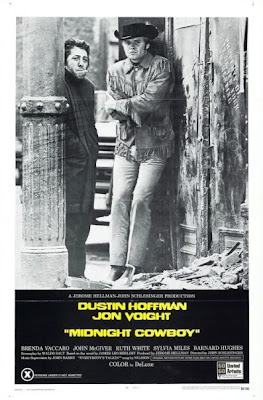 Midnight Cowboy, British filmmaker John Schlesinger’s first foray across the Atlantic Ocean, remains a cornerstone in American cinema. It became a part of the country’s collective conscience and the voice of a generation for its brilliant portrayal of angst, lost hopes. loneliness, decadence and urban alienation. Joe Buck (John Voigt), a naïve Texan with dreams in his eyes, arrives at New York to earn easy bucks as a gigolo. It doesn’t take long for his dreams to vaporize, but he ends up getting an endearing friend in Rico “Ratso” Rizzo (Dustin Hoffman), a chain-smoking fellow-hustler afflicted with tuberculosis, whose American Dreams had been shattered long back. Their squalid and desperate existences form a fascinating counterpoint to the razzle-dazzle and lure of the Big Apple, the metropolis where all the two drifters strive for is to survive another day. Yet, for all its then-controversial depiction of drugs and sex, the film has a deep sense of pain and poignancy at its core, beautifully brought forth through the unforgettable friendship of the two outsiders. Dustin Hoffman, who had kick-started his career with The Graduate, gave a breathtaking performance as the tragic modern-day Tramp. The then-unknown John Voigt too shined as the film’s placid anti-hero. The excellent script and freewheeling structure, combined with arresting camerawork and sounds, added to the movie’s elevation into the pantheon of great films on friendship and bohemianism.
 Director: John Schlesinger
Genre: Urban Drama/Buddy Film/Avante-Garde Film
Language: English
Country: US
 British enfant terrible Ken Russell’s Altered States was an adaptation of a book of the same name by Paddy Chayefsky, but the author (who was also the screenwriter for the movie) disowned it after he saw the final cut. The movie starred William Hurt as an eccentric underground scientist who is obsessed with his experiments on altered states of human consciousness and human evolution – so much so that he starts resorting his bizarre experiments on himself. Suffice it to say, the consequences of his spending hours in an enclosed chamber and self-infliction of hallucinogenic drugs, are grotesque to say the least. Accompanying him on this fantastical journey are his loving wife, his ever-loyal friend, and a disbelieving doctor. The director juxtaposed the ominous tone with prolonged usage of psychedelic lights, imageries and sounds, to present us a movie that does a decent job in treading the fine line between a disturbing, visceral experience on one hand, and silliness and ludicrosity on the other. Russell’s overt self-indulgence would be evident to anyone who has watched the film, yet there’s also a strangely engaging quality about the disorienting visual fest, outlandish psycho-babble, and especially the excellently crafted sequences with the ape-man that he dished us in this “body horror”. The acting too was good if not great.
 Director: Ken Russell
Genre: Psychological Horror/Sci-Fi
Language: English
Country: US
 Vietnam War was a watershed event for all of America, and rarely has something as serious as that was made to look so utterly farcical as in Joseph Heller’s brilliant book Catch-22. M*A*S*H, the pointed satire that catapulted Robert Altman to the highest echelons of critical acclaim and popularity, could perhaps be qualified as the cinematic counterpart of the groundbreaking novel. Controversial, anti-establishmentarian and unapologetically in-your-face, this superb black comedy gleefully mocked at the utter ludicrosity of not just the Vietnam War but all wars in general. The irreverent and iconoclastic movie chronicles the acts of blasphemous defiance by the doctors and nurses of a Mobile Army Surgical Hospital during the Korean War, led by the brazenly rebellious duo of Hawkeye Pierce (Donald Sutherland) and Trapper John McIntyre (Elliott Gould). The film is filled with loads of jokes and innuendoes that might seem crass, offensive, politically incorrect and sexist to many; but to think of it, the total dismissal of anything to do with morality, religion, bureaucracy and authority with such impudence and nonchalance was perhaps Altman’s intent to begin with – and in turn one of the principal reasons for its seamless entry into the collective consciousness of its age. And, at the end of the day, all the socio-political ramifications aside, the movie sure was hilarious. Each of the series of eccentric characters were incredibly sketched and superbly performed by the ensemble cast, with improvisation playing a key role in the film’s success.
 Director: Robert Altman
Genre: Black Comedy/Political Satire/Social Satire/Ensemble Film/War Film
Language: English
Country: US
 Terry Gilliam is renowned for his incredible sci-fi satire Brazil. 12 Monkeys, though not of the same caliber, nonetheless remains a competent sci-fi set in a dystopian timeframe. A dark and intense examination of the meaning of “madness” and how its definition varies from person to person, the movie is about time-traveller James Cole (Bruce Willis), a prisoner in the future, being sent to the past to unravel the origin of and possibly thwart the virus attack that has wiped out nearly the entire humanity. Upon his journey to past he befriends a sympathetic psychiatrist (Madeleine Stowe) who, initially reluctantly and later willingly, becomes his only ally, and also the mad, rabble-rousing son (Brad Pitt) of a world-famous biochemist. The film delivers the goods in creating an atmosphere that is filled to its brim with grime and grunge, which in turns helps in holding our attention despite the plot not being its biggest strength. Bruce Willis, as the time-traveller on the verge of insanity and perpetually plagued by a sense of déjà vu (through his recurring dreams), gave a solid performance, as did the beautiful Madeleine Stowe; the show however was befittingly stolen by Brad Pitt for his gleefully over-the-top supporting turn. Though not a great film per se, over the years it has managed to gain considerable cult following.
 Director: Terry Gilliam
Genre: Thriller/Sci-Fi
Language: English
Country: US


