Saturday, 19 December 2020

Bay of Angels [1963]

 Demy’s marvelous second feature Bay of Angels was an engrossing concoction of blasts of ecstasy and lingering fatalism, the kind that one may associate with tremendous, unshakeable and self-destructive frenzy of addiction; gambling, no wonder, can be as viscerally intoxicating as drugs, religion and nationalism, and that formed the central thread for this bleakly beautiful film. Understandably, the two people that this hypnotic thread connects are lost souls – one who’s slowly getting lost and the other who’s irretrievably lost beyond hope; the seemingly doomed romance that brews between them, connected by their shared addiction to high-stakes roulette, imbued the movie with a melancholic tone and flavour that elevated it beyond any didactic social commentary. Jean (Claude Mann) is a young salaried employee who has his first taste of blood, so to speak, when he ends up winning a lot of money upon being coaxed by a colleague (Paul Guers) to visit a casino in Paris. With a new sense of liberation and defiance, he decides on a whim to go on a solo week-long vacation to Nice. There he meets, gets entranced by and ultimately falls in love with the impetuous and alluring Jackie (Jeanne Moreau), a much older divorced woman who lives her life on the edge on account of her impossible passion for and enslavement to gambling. Moreau, with her shocking platinum blond hair, fierce sense of freedom and self-destructive abandon – a beguiling mix of femme fatale and tragic heroine – was absolutely irresistible. And their turbulent days together – from the French Riviera to Monte Carlo and back – was memorably accompanied by moody B/W photography and glorious jazz-based score that alternated between moody trumpets and euphoric piano chords.


Director: Jacques Demy

Genre: Drama/Romantic Drama/Psychological Drama

Language: French

Country: France

Thursday, 17 December 2020

Lola [1961]

 Lola, the celebrated debut feature of Jacques Demy – much lesser discoursed vis-à-vis his Nouvelle Vague compatriots, perhaps on account of ostensibly being least radical of the lot – is a wistful and evocative work that was memorably anachronistic in a decade marked by an explosion of formal and thematic audacity. This was, after all, the year of Antonioni’s La Notte, Bergman’s Through A Glass Darkly, Bunuel’s Viridiana, Imamura’s Pigs and Battleships, Resnais’s Last Year at Marienbad, etc.; hence this, with its muted delicacy, poetic realism and straight-up storytelling, might appear almost conventional in their midst. It nevertheless had a curious mix of tonal variances and stylistic choices – viz/., on one hand, the strikingly moody B/W photography by Raoul Coutard, infusion of jazz riffs and the immediacy of on-location shoots; while, on the other, overt sentimentality and a narrative almost exclusively propelled by coincidences. The film is set in Nantes where, over the course of a couple of days, we meet a series of intersecting characters who’re all dreaming of love and an elusive happiness in their dreary existences. Its two central characters are Lola (Anouk Aimée), a lovelorn cabaret dancer and single mother who’s still waiting for her fiancé who’d left her 7 years back; and Roland (Marc Michel), a young guy laced with ennui and aimlessness who decides to take a shady job, until he suddenly bumps into Lola who he’s silent held a torch for many years. Throw in a mournful American sailor, a 13-year old girl who keeps crossing paths with both guys, and her pensive mother, and what you have is a movie with a plot ridden with contrivances but also possessing moments of quiet melancholy.


Director: Jacques Demy

Genre: Drama/Urban Drama/Romantic Drama

Language: French

Country: France

Tuesday, 15 December 2020

The Trial [1962]

 Discussions on Orson Welles’ greatest works usually always center on his universally canonized, viz. Citizen Kane, Touch of Evil, Chimes at Midnight, and to a slightly lesser extent, The Magnificent Ambersons. It’s a shame, therefore, that his extraordinarily brilliant but strangely underrated masterpiece The Trial is rarely accorded similar shelf space. The novel by Kafka – one of the seminal literary works of the 20th century – had portrayed relentless bureaucratic machinery which, like the tentacles of an infinite octopus, gradually sucks a person into its vortex. Welles, in his virtuoso and spellbinding adaptation – he made alterations to the text, including freely rearranging the narrative and mordernizing certain aspects, and filmed in cities across Europe, though ironically not in Prague – dazzlingly captured the nightmarish, surrealistic, and, well, Kafkaesque world of the book! The resultant work, therefore, was as delicious a black comedy as it was a mesmerizing audiovidual tour de force. The story, at its most elemental, is about Joseph K (Anthony Perkins), a young, arrogant, mid-level bureaucrat, who wakes up one morning to realize that he’s under arrest; while his scenario becomes increasingly more precarious with each passing day, he never gets to know what crime he’s charged with. Perkins was excellent, as was the support cast comprising of Jeanne Moreau as a seductress K is attracted to, Romy Schneider as a coquettish maid, and Welles as a rotund and domineering advocate. The film’s most striking aspect, however, were its hypnotic production designs that evoked oppression, alienation, absurdism and bleak nihilism through enthralling expressionist visuals filled with feverish chiaroscuro and canted camera angles; labyrinthine set designs and disorienting locales; and a score that alternated between high-tempo jazz and fatalistic mournful.


Director: Orson Welles

Genre: Black Comedy/Social Satire

Language: English

Country: France

Saturday, 12 December 2020

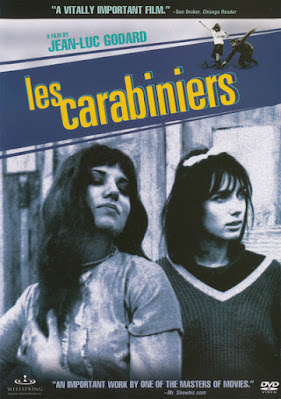
Les Carabiniers [1963]

 Les Carabiniers’ spare, linear narrative was stunningly atypical of Godard, what with it’s having not just a beginning, a middle and an end, but also – ironically – in that order too. And his scathing anti-war satire – with sharp jabs also aimed at rampant commoditization in a capitalist, consumerist social structure – was also among his most brazen, acrid, anarchic and satiric; its droll mix of dreary realism and darkly funny absurdism, in fact, felt closer to the Czech New Wave. And these aspects made this such a radical departure in Godard’s filmography; no wonder, it was received with hostility upon release, and perhaps remains the least watched among his 15 Nouvelle Vague features. In the deadpan first act, two poor, gullible dolts – cigar-smoking Ulysses (Marino Mase) and leery Michelangelo (Albert Juross), married to glibly saucy and fashion-obsessed wives (Catherine Ribeiro and Geneviève Galéa) – are fooled by a couple of soldiers into going off to war, by telling them that the king himself has asked of this favour, and promising them of free-for-all riches – from permission to steal cars and slot-machines to committing pillage, rape and massacre. The discomfiting middle act portrayed the two dim-wits having a grand time amidst the devastating war raging across Europe; interestingly, their letters back home, chronicling the banality of violence, murders and mayhem, were composed of actual war-time correspondences; and, in a wry, self-reflexive moment, we see a hilariously failed attempt to break into the cinematic realm while watching a movie à la Keaton. And, in the farcical final act, they present their prized stash of war loots to their wives, viz. postcards on everything from Rin Tin Tin and the Pyramids to Cleopatra and Bardot.


Director: Jean-Luc Godard

Genre: Black Comedy/Political Satire/War

Language: French

Country: France

Wednesday, 9 December 2020

A Married Woman [1964]

During his flamboyant, freewheeling and eclectic Nouvelle Vague phase, alongside his dizzying pastiches on, homages to and subversion of Hollywood’s genre cinema, he also made a string of brilliantly provocative sociopolitical commentaries – both overt and covert – through a diverse mix of themes and forms. One memorable subset of the latter were ones delectably centered on women protagonists; like the enormously amusing Une Femme est une Femme and the marvelously rigorous Vivre Sa Vie, Une Femme Mariée falls emphatically in that subcategory, even if it often gets lost amidst the two dazzling films that this was sandwiched between, viz. Bande à Part and Alphaville. That’s not too say that this wasn’t lively or adventurous; in fact, despite its stunning restraint – somber pacing, elegant B/W picturization, elaborate fade outs, hushed tones – this was quintessentially Godard in his sardonic portrayal of rabid consumerism, a culture of superficiality through bombardment of advertisements on TV and fashion magazines (satirized through wry pseudo and surrogate ads), social prudishness vis-à-vis casual adultery, and general apathy to ongoing Auschwitz trials (in an indication of shallow political memory and how people had already moved on from WW2 and the Holocaust). And thus, despite not being openly provocative, like say Le Petit Soldat or Pierrot Le Fou, it still earned the displeasure of censors, resulting initially in a ban, and thereafter a release only upon a change in its title (viz. changing of ‘La’ to ‘Une’). The plot – deliciously filled with ambiguities, wry asides, rambling conversations and seductive montages that the movie begins and ends with – revolved around Charlotte (Macha Méril), the eponymous married woman, who’s entangled in a ménage à trois with her affluent husband and extramarital boyfriend.


Director: Jean-Luc Godard

Genre: Drama/Marriage Drama/Romantic Drama

Language: French

Country: France