Showing posts with label 1940s. Show all posts

Thursday, 19 March 2026

Bicycle Thieves (Ladri di Biciclette) [1948]

 Visconti pioneered neorealist cinema and Rossellini took it to exalted heights; but it was Vittorio De Sica who gave this profoundly influential movement – that redefined a filmmaker’s gaze by foregrounding it on gritty, authentic stories of working-class struggles, shorn of artifice and embellishments – arguably its most emblematic monument with Bicycle Thieves. It was remarkable when it was made in 1948, for its vivid portrayal of post-war Italian society – plagued by poverty, unemployment, corruption and disillusionment – through understated and deceptively unassuming brushstrokes; that it has retained its modernity and impact even seven decades later reconfirms its enduring legacy. This was the quietly devastating story of Antonio (Lamberto Maggiorani), a simple and impoverished man, whose life takes a hopeful turn when he lands the job of pasting advertisement bills, and his wife (Lianella Carell) gets his bicycle – a prerequisite for the profession – released from the pawnshop. His luck, however, promptly takes a nosedive when the cycle gets stolen while he’s busy affixing the poster of a Rita Hayworth movie. The remaining film captured his desperate and futile search, with his son Bruno in tow. During his Roman odyssey, co-written by Cesare Zavattini from a Luigi Bartolini novel, he visits the city’s black market, finds himself in a church as well as a brothel, ambles through thoroughfares and alleys, walks by piazzas and the riverfront, visits a fancy restaurant, and ends up in a rough neighbourhood; shot on location with throbbing immediacy, this was, consequently, a great city symphony too. Along the way he encounters camaraderie and empathy, hostility and hopelessness, and a society in a complex state of flux, with Antonio’s existence both persuasively standing out and eloquently representing the collective.

p.s. This is a revisit. My earlier review of this film can be found here.


Director: Vittorio De Sica

Genre: Drama/Urban Drama

Language: Italian

Country: Italy

Thursday, 18 December 2025

La Terra Trema [1948]

 Luchino Visconti, whose superb debut film Ossessione launched Italian Neorealism, made perhaps that movement’s purest expression with his second film La Terra Trema. Intending to adapt Giovanni Verga's novel I Malavoglia, he travelled to the impoverished Sicilian coastal village of Aci Trezza, and shot, over a staggering seven months in company of cinematographer G. R. Aldo, a slightly reworked version of the book. What made this desolate and exceedingly moving film an especially rare expression of authenticity and empathy was that, Visconti cast real fishermen in this story examining their daily struggles and their terrible exploitation by price-gouging wholesalers. That also made this the “Red Count’s” most enduring expression of his Marxist sympathies and therefore a eloquent political manifesto. Initially planned as the first chapter of a trilogy on the plight of the rural working-class – the next two would’ve focussed on peasants and miners, but unfortunately never got made – it portrayed their life through the story of a courageous, but ultimately crushed, rebellion led by Ntoni (Antonio Arcidiacono), the Valastro family’s firebrand eldest son, who wants to break free of the wholesalers and rouse his comrades from the fishing community. His journey back to down south, after his war duties, counterpointed the Parondi family’s journey up north in the masterful Rocco and His Brothers twelve years later, as well as that of Ntoni’s younger brother who, upon the family’s plunge into utter despair after a brief sliver of hope, joins a shady gang and moves out. The fabulously shot wide-angled B/W images took the viewers right into the gritty life of the defeated hero that ended on a tragic note of resignation while carrying memories of what could’ve been.


Director: Luchino Visconti

Genre: Drama/Rural Drama

Language: Italian/Sicilian

Country: Italy

Saturday, 24 February 2024

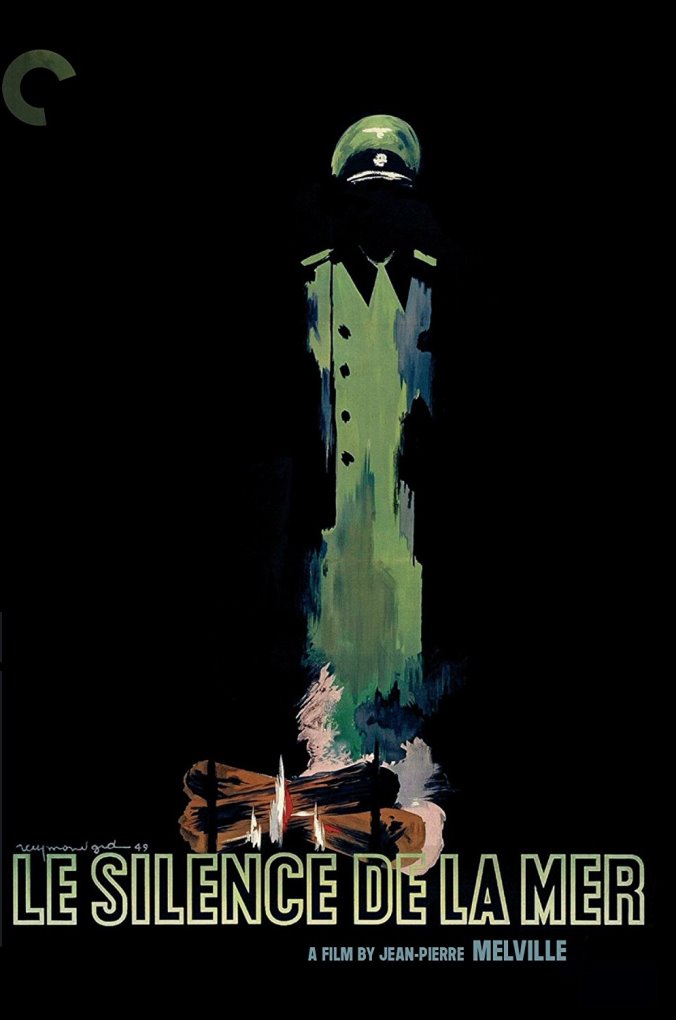
The Silence of the Sea [1949]

 It was only appropriate that Jean-Pierre Melville, who belonged to a left-wing family and adopted this nom de guerre during his involvement with the French Resistance, made his filmmaking debut with Le Silence de la Mer, an adaptation of the book by Vercors (nom de plume of Jean Bruller), who too was a member of the Resistance during the Nazi occupation of France. The book was secretly published and distributed, and became an influential underground text, which Melville eloquently acknowledged in several ways – the opening scene indicated its clandestine and dissident nature; he filmed in the same house in which it was written; and he’d agreed to pull the plug on the film, including destroying the negatives, if Bruller refused approval for release. This Bressonian film – that is to say, spare, austere, minimalist and poetic parable with a deep moral core – clearly presaged Melvelle’s formal and aesthetic signatures that he’d take to bravura heights in subsequent years. In what he’d ironically quipped an “anti-film”, it focused on verbose one-way exchanges – brilliantly shot indoors in heavily expressionistic B/W by Henri Decaë – involving just three characters. A German officer (Howard Vernon), with a gushing love for French literature, is stationed in a house inhabited by an ageing French man (Jean-Marie Robain) and his young niece (Nicole Stéphane). Over the next few months, the naïve lieutenant indulges in sentimental monologues every evening, while the French pair refuses to acknowledge his presence, leading to a solemn meditation on political naïveté and passive resistance. It ended with a powerful line, which is the uncle’s sole response to the German during his departure, “It’s a noble thing for a soldier to disobey a criminal order.”


Director: Jean-Pierre Melville

Genre: Drama/Political Drama/War

Language: French

Country: France

Friday, 3 February 2023

It's a Wonderful Life [1946]

 Frank Capra – arguably one of the most beloved Old Hollywood filmmakers – was, according to the popular line of thinking, a socially conscious man who empathized with the little people; however, according to another school of thought, he was a moralist, populist and closet conservative. It’s A Wonderful Life, being perhaps his most enduring work, was interlaced with both these seemingly irreconcilable facets, and that’s what made this such an interesting film; hence, to just typify it as a heart-warming Christmas classic, is to take a simplistic stance. The first production of Liberty Films – which Capra co-founded with William Wyler and George Stevens – this quintessential Dickensian fable with both religious and political overtones was centred on George Bailey (James Stewart) who, despite his desire to complete college and travel the world, is compelled to put his dreams on permanent hold when his father suddenly dies, in order to defiantly keep afloat his family-run business – aimed at providing affordable housing loans to the town’s working class folks – against all possible oppositions thrown in by the slimy, avaricious and Scrooge-like business man Henry Potter (Lionel Barrymore) who wants to gobble up all the land and properties in the town. However, when he’s finally pushed to the brink and contemplates suicide on a Christmas Eve, a guardian angel (Henry Travers) is sent from the heavens to intervene. The film’s sentimentality, contrivances, simplistic religious morality and bathos were among its weakest aspects, while its evocation of the changing American landscape from Depression-era pessimism to Post-War hope, Stewart’s tremendous turn and the nightmarish, Dante-esque alternate reality that Bailey briefly experiences – arguably the film’s most fascinating and problematic segment – saved it from its own overt sincerity.


Director: Frank Capra

Genre: Drama/Romantic Drama

Language: English

Country: US

Wednesday, 3 February 2021

Lorna's Silence [2008]

 Coming right after their devastating portraiture of the nadir of desperation in L’Enfant, the Dardenne brothers – the proletarian chroniclers of the voiceless, the marginalized and the working-class, with their distinctive brand of gritty social realism – once again treaded on dark waters in the bleak and tragic Lorna’s Silence. With its thematic focus on lonely illegal immigrants who’re pushed to live outside the edges, and in its evocation of overpowering guilt – for inability to prevent an avoidable death, even if the death is neither mourned nor regretted by anyone except by the protagonist – reminded me of their fabulous and heart-breaking recent film The Unknown Girl. Lorna (Arta Dobroshi) is a striking Albanian woman who – coaxed by her boyfriend (Alban Ukaj) with whom she dreams of opening a café, and orchestrated by the shady, ruthless Fabio (Fabrizio Rongione) – has entered into a sham marriage with Claudy (Jérémie Renier), a junkie in need of money, in order to get Belgian citizenship. The plan’s to bump the pitiful Claudy off with drug overdose, as that would allow her to keep her citizenship and get hitched to a wealthy Russian in another fake marriage; however, upon seeing his desire to quit, she starts developing a soft corner for him; and her impassive existence is thrown off balance when she ends up sharing an unplanned moment of passion with him borne out of this growing tenderness. Some of the plot contrivances and the allegorical climax felt tad unlike the Dardennes; however, Doroshi’s superlative turn, her defiance to exit the inexorable cycle of exploitation she’s stuck in even if that may cost her everything, and all portrayed through steadfast minimalism, definitely made it a poignant watch.


Directors: Jean-Pierre & Luc Dardenne

Genre: Drama/Social Drama/Urban Drama/Psychological Drama

Language: French/Albanian

Country: Belgium

Tuesday, 3 February 2015

The Woman in the Window [1944]


The Woman in the Window might not rank very high in fame in the Fritz Lang pantheon, but its facile mix of a gripping noir with a cheeky prank on audience expectations makes this an interesting work in his oeuvre. Further, its central tale of doomed romantic obsession of a docile middle-aged man and the way the quicksand of his own hapless making slowly devours him, formed a key stepping stone to the devastating and deeply fatalistic romantic noir he followed this up with, viz. Scarlet Street. Richard Wanley (Edward G. Robinson) is a professor of criminology leading an average, unspectacular life comprising of his college lectures, his family and quiet evenings over drinks and cigar at a private club with two old friends. One fateful evening, he spots a portrait of a beautiful woman and starts developing an obsession towards it like the brilliant Laura released in the same year. Later in the evening, while fixated on the striking painting, he ends up meeting Alice (Joan Bennett), the lady in the painting. Breaking his disciplined life he agrees to have a few drinks with her, and what follows is, as can expected from a classic noir tale, a bleak account of bad choices, murder, blackmail and complete disintegration of ordered existence. Robinson gave an effortless turn as the naïve and bumbling older man whose boredom and subconscious want of reversing his clock, despite what he proclaims to his friends, leads to his slow downfall, while Dan Duryea was also noteworthy as a sleazy blackmailer. And, most notably, the film comprised of not one, but two twists, with the second one imbuing it with chuckling prank on the ironic world of noir.


Director: Fritz Lang
Genre: Drama/Crime Drama/Film Noir
Language: English
Country: US

Friday, 19 December 2014

The Third Man [1949]


Carol Reed created an instant masterpiece with The Third Man, which ranks, along with Dassin’s nightmarish Night and the City, as the greatest instance of British Noir. The signature of celebrated British author Graham Greene, who wrote the screenplay and also published it as a novel, was palpable from the murky Cold War era climate, moody doom-laden atmosphere, moral corruption and bankruptcy, tussle between idealism and cynicism, wry humour and pervading sense of melancholia, fatalism and heartbreak. The film begins with Holly Martins (Joseph Cotton), an American writer of pulpy Westerns, arriving at the political hotbed of Vienna, which is occupied by Allied forces, in order to respond to a job offer that had been shared by an old friend of his, Harry Lime (Orson Welles). Upon arrival he’s informed that Harry has mysteriously died in a road accident; however, the more he delves into the matter, the more he gets sucked into an elaborate and seedy netherworld of lies, betrayals and black-market racketeering that Harry was allegedly a mastermind of. He becomes acquainted to the opposing forces of Major Calloway (Trevor Howard), who’s relentlessly pursuing after Lime, and Anna Schmidt (Alida Valli), an beautiful, sad-faced illegal refugee who works as a bit-actress, is besotted with Lime, and who Martins starts falling for. The excellent cinematography, with the striking chiaroscuro and frenetic camerawork, was memorably juxtaposed by the iconic zither score that added a dose of irony and an air of lamentation to the proceedings; on the acting front Welles was particularly unforgettable despite his brief screen-time; and these culminated into a feverish crescendo at Vienna’s dank, grimy and labyrinthine underground sewer system.

p.s. My earlier review of the film can be found here.


Director: Carol Reed
Genre: Thriller/Crime Thriller/Film Noir
Language: English
Country: UK

Sunday, 9 November 2014

Somewhere in the Night [1946]

Somewhere in the Night was one of those lesser-known noirs that, nevertheless, had the necessary wherewithal to keep one engaged through infusion of noir archetypes with a script that was never short of dramatic moments. Its intriguing tale of an amnesiac, who may or may not have committed crimes in his past, putting together the various jigsaw pieces of his lost memories, reminded me a little bit of Nolan’s Memento. George Taylor (John Hodiak), a cynical war veteran and a quintessential noir protagonist who has just woken up from a coma, remembers nothing of himself and his past. A handsome but cryptic some of money left by a mysterious Mr Larry Cravat, who no one knows well but everyone seems to be after, forms the starting clue in his labyrinthine journey to unearth his past, his identity and possibly a huge stash of money with links to Nazi Germany. Along the way he becomes acquainted with beautiful nightclub singer Christy (Nancy Guild), Christy’s overly philanthropic boss (Richard Conte), a slippery and unctuous thug (Fritz Kortner), a surprisingly even-natured cop (Lloyd Nolan), among others. The film painted a downbeat picture of the seedy underbelly of post-War America, with the socio-political context providing a relevant undercurrent to the tale of deceit, double crossings and crime. The excellent B/W photography, with a heavy dose of static expressionism, added to its moody atmosphere, which compensated for the rather lackluster lead performances. Even though the premise asked for an unpredictable storyline, it felt tad too serpentine at times. The length, too, could have been made crisper. On the whole it was a decent thriller served straight up.


Director: Joseph L. Mankeiwicz
Genre: Film Noir/Crime Thriller
Language: English
Country: US