Showing posts with label Italian Cinema. Show all posts

Sunday, 2 August 2026

Mussolini: Son of the Century [2025]

 It often takes distance to relook at an infamous tyrant’s hideous rise, along with the toxic idea of fascism (or its codification, to be more appropriate), and that’s what one senses while watching the biopic miniseries on Benito Mussolini’s surge from a relative nobody to two decades’ reign as an ultra-right-wing dictator of Italy. Adapted from Antonio Scurati’s novel, this was directed by British filmmaker Joe Wright – best known for his fine 2007 film Atonement and having never made anything outside the English language, leave alone in Italian – and produced while conscious that populist right-wing nationalism has once again been raising its ugly head across continental Europe, including in Italy. The brutal, power-hungry and self-serving strongman’s ascent – from founding the ‘Fasci Italiani di Combattimento’ in 1919 and stoking pent-up frustrations from WW1, through establishing the savage ‘Blackshirts’ militia, exponential growth in political clout and snatching the Prime Ministerial chair, and up until the cynical assassination of socialist leader Giacomo Matteotti by his bloodthirsty thugs in 1924, culminating with a chilling speech in the Parliament on 3rd January 1925 which effectively signalled the advent of totalitarianism – has been presented in the form of a punk, stylized and tar black satire that made it a volatile fusion of political history with gleeful formal experimentation, punched with the ethos and machinations of a gangster movie. The deliberately grotesque, hideous, hyper-violent and vulgar tone and palette – composed with compelling exactitude over 8 episodes of an hour each – were accompanied by a techno score, contemporary self-awareness, and a fiery – and frequently fourth-wall breaching – performance by Luca Marinelli as the smug, insecure, uncouth, self-serving and cunning despot who embodied the absolute corruptibility of absolute power.


Director: Joe Wright

Genre: Biopic/Black Comedy/Historical Drama/Political Satire/TV Miniseries

Language: Italian

Country: Italy

Sunday, 21 June 2026

La Grazia (Grace) [2025]

 Paolo Sorrentino’s La Grazia, on paper, shouldn’t work, as at its most elemental it’s about a white, ageing, well-off, conservative, heteronormative man in a position of power and beset with moral dilemmas, religious inhibitions and political indecisiveness. It, however, harboured a mischievous coexistence of austere tones and solemn themes with punkish undercurrents and a subversive streak, and this interplay between seemingly incongruous elements made this a surprisingly enthralling experience. Predominantly an exercise in narrative minimalism and weighty themes, it comprised of exquisitely restrained performances by a small cast led by an exceptional Toni Servillo as fictitious Italian president and renowned former jurist Mariano De Santis (incidentally, he played real-life Italian premiers twice in earlier Sorrentino films); judicial debates with his exasperated lawyer-daughter (Anna Ferzetti); mulling on a new bill legalizing euthanasia awaiting his ratification and proposed presidential pardons for two people in jail for having committed murders (Linda Messerkliger was especially riveting as a striking woman who’s brutally killed her abusive husband); being haunted by the memories of his dead wife who he loved immensely, while also consumed by her infidelity from four decades back; and ample moments of silent introspection, solitary smokes and inaction. Further, set mostly inside the Quirinal Palace, its grand visual compositions were dominated by vast, empty spaces. In parallel, it occasionally cut loose with idiosyncratic bursts – a Rastafarian, moped-riding Pope; an electrifying contemporary dance sequence that reminded me of Pablo LarraĆ­n’s dazzling film Ema; a disastrous walk through torrential rains by a superannuated Portuguese President, shot in stylized slo-mo; acerbic jabs by Mariano’s close friend and nonconformist art critic (Milvia Marigliano); sardonic undertones frequently cloaking the melancholic airs; and a terrific, sparingly-used techno score.


Director: Paolo Sorrentino

Genre: Drama/Psychological Drama/Political Satire

Language: Italian

Country: Italy

Sunday, 22 March 2026

Umberto D. [1952]

 Umberto D. – Italian Neorealist movement’s final definitive film and Vittorio De Sica’s personal favourite – alternated between extreme desolation and sentimentalist tendencies. The former led to it being attacked by the then conservative government for demeaning Italy’s image abroad, and was rejected by domestic viewers who wanted to ignore their plights for rosier images. The latter, conversely, has slightly diluted the film’s standing today in some quarters. To the remarkable credit of De Sica and his frequent collaborator, the great screenwriter Cesare Zavattini, it continues to remain a revered classic for its eloquent invocation of their conception of “collective actions” – viz. how “no story is ever truly individual” – as the primary lens for neorealism. Tellingly, therefore, it begins with a street demonstration – strikingly shot by G. R. Aldo as if straight out of a newsreel – of retired elderly men, demanding a raise in their pensions. As their protest gets broken with utter apathy by the cops, Umberto Domenico Ferrari (septuagenarian Carlo Battisti in his first and only role), emerges from the crowd of bitter, hapless men as one out of many. A former civil servant having to live a life of penury and indignity on account of his measly pension and mounting debts, he’s on the verge of being evicted from his accommodation by his cold-hearted landlady for overdue rent. Umberto is profoundly attached to his dog Flike, and makes a rare human connect with a sympathetic maid (Maria-Pia Casilio), in a world that has discarded compassion, empathy and human decency as meaningless liabilities. Despite the occasional propensity for titillating the tear-buds, the film tackled its bleak themes – societal indifference, loneliness, suicidal impulses – with equanimity, immediacy, irony and deep humanism.


Director: Vittorio De Sica

Genre: Drama/Urban Drama

Language: Italian

Country: Italy

Thursday, 19 March 2026

Bicycle Thieves (Ladri di Biciclette) [1948]

 Visconti pioneered neorealist cinema and Rossellini took it to exalted heights; but it was Vittorio De Sica who gave this profoundly influential movement – that redefined a filmmaker’s gaze by foregrounding it on gritty, authentic stories of working-class struggles, shorn of artifice and embellishments – arguably its most emblematic monument with Bicycle Thieves. It was remarkable when it was made in 1948, for its vivid portrayal of post-war Italian society – plagued by poverty, unemployment, corruption and disillusionment – through understated and deceptively unassuming brushstrokes; that it has retained its modernity and impact even seven decades later reconfirms its enduring legacy. This was the quietly devastating story of Antonio (Lamberto Maggiorani), a simple and impoverished man, whose life takes a hopeful turn when he lands the job of pasting advertisement bills, and his wife (Lianella Carell) gets his bicycle – a prerequisite for the profession – released from the pawnshop. His luck, however, promptly takes a nosedive when the cycle gets stolen while he’s busy affixing the poster of a Rita Hayworth movie. The remaining film captured his desperate and futile search, with his son Bruno in tow. During his Roman odyssey, co-written by Cesare Zavattini from a Luigi Bartolini novel, he visits the city’s black market, finds himself in a church as well as a brothel, ambles through thoroughfares and alleys, walks by piazzas and the riverfront, visits a fancy restaurant, and ends up in a rough neighbourhood; shot on location with throbbing immediacy, this was, consequently, a great city symphony too. Along the way he encounters camaraderie and empathy, hostility and hopelessness, and a society in a complex state of flux, with Antonio’s existence both persuasively standing out and eloquently representing the collective.

p.s. This is a revisit. My earlier review of this film can be found here.


Director: Vittorio De Sica

Genre: Drama/Urban Drama

Language: Italian

Country: Italy

Friday, 26 December 2025

Ludwig [1973]

 Luchino Visconti’s ambitious opus Ludwig – butchered by distributers during its release and restored to its mammoth original runtime of 4 hours four years after the director’s demise – was a sprawling and operatic study on doomed idealism, extravagant folly, and obsessions bordering on madness. The final chapter in the Italian maestro’s formally dazzling and thematically complex ‘German Trilogy’ – following the unhinged brilliance of The Damned and the smouldering melancholy of Death in Venice, with all three ending with images of death – reminds one of his towering masterpiece The Leopard for its elegy to lavish opulence and Senso for its paean to self-destructive passions. Ludwig II, the “Mad King” of Bavaria, was an inveterate romantic, aesthete and nonconformist who was besotted with Richard Wagner (Trevor Howard), splurged extravagantly to appease the temperamental and opportunistic composer’s egotistic whims, hosted ostentatious operas, and constructed spectacular castles and palaces; he was heartbroken by his unrequited love for his vivacious older cousin sister Elisabeth (whose enigmatic beauty was gloriously evoked by Romy Schneider, having portrayed “Sissi” thrice in the past), pursued his repressed homosexuality as he grew older, and refused to either marry or partake in politics or fight wars. Covering his tormented life from his coronation in 1864 until his mysterious death shortly after his deposition in 1886, the film – in a fascinating narrative choice – was set mostly indoors, largely avoiding any explicit historical depictions and resorting to verbal citations instead, and the proceedings were interspersed with sombre talking-head witnesses by his ministers and inner coterie at a tribunal to judge his mental fitness. Ludwig’s androgynous grace, tormented loneliness, conflicted sexuality, and descent into lunacy was magnetically portrayed by Visconti’s then lover Helmut Berger.


Director: Luchino Visconti

Genre: Drama/Biopic/Historical Biopic

Language: German/Italian

Country: Italy

Tuesday, 23 December 2025

Death in Venice [1971]

 Luchino Visconti adapted Death in Venice from Thomas Mann’s novella – the vaunted central chapter in his ‘German Trilogy’, sandwiched between The Damned’s pungent provocations and Ludwig’s sprawling ambitions – with meticulous rigour and controlled audacity. He both accentuated the book’s sensual and disconcerting queer undercurrents borne out of a middle-aged man’s forbidden infatuation with a teenage boy, and tampered that with solemnity of tone, a pervading air of melancholy, the anxiety of a choleric outbreak, and Venice’s decaying grandeur gorgeously photographed by Pasqualino De Santis, for a bristling meditation on art, beauty, self-destructive longings and mortality. Gustav von Aschenbach (Dirk Bogarde), an allusion to Austrian composer Gustav Mahler, has come over to Venice for rest and self-exile in order to recover from debilitating health concerns and a dreadful concert. While staying in the luxurious Grand Hotel des Bains in Venice Lido, he notices the pubescent Polish boy Tadzio (Bjƶrn AndrĆ©sen), who comes to embody for him the epitome of physical beauty, and becomes obsessed with him to the detriment of his own wellbeing. The fastidious composer, ironically, had earlier preferred form over aesthetics, as indicated through the flashbacks, which were a tad jarring vis-Ć -vis the “present” captured through limpid, deliberately-paced and exceptionally composed mise-en-scĆØne. He silently follows Tadzio, as if hypnotized, in the hotel’s dining room, at the adjacent beach, and through the city’s winding alleys, who in turn starts subtly responding to the attention. Accompanied by Mahler’s music, this film was led by Bograde’s magnificent turn – the muted passions and tragic vulnerability that he brought in reminded me heavily of Gian Maria VolontĆ© in Francesco Rosi’s Christ Stopped at Eboli – and closed with one of cinema’s bleakest on-screen deaths.


Director: Luchino Visconti

Genre: Drama/Historical Drama/Romantic Drama

Language: English

Country: Italy

Sunday, 21 December 2025

The Damned [1969]

 The Damned was a scintillating outlier in Luchino Visconti’s oeuvre. Daringly provocative and subversive, packed with outrĆ© plot developments, shot in lurid colours, and driven by the unholy tussle between decadence and depravity, it bore the undercurrents of an exploitation movie, and was therefore radically removed from the Italian trailblazer’s customary stately forms and elegant compositions. The first chapter in his acclaimed “German Trilogy” – it was followed by Death in Venice and Ludwig – told the contrapuntal story of the disintegration of the aristocratic von Essenbeck family that owns a massive steel corporation, and Hitler’s consolidation of power. The family patriarch Joachim (Albrecht Schƶnhals) hates the Nazis, as does Herbert (Umberto Orsini) who’s married to Joachim’s niece (Charlotte Rampling). Not surprisingly, the former is murdered and the latter falsely framed over the course of an elaborately staged opening segment featuring a family gathering during Joachim’s birthday. Those present, a microcosm of the country, include the brutish Konstantin (Reinhard Kolldehoff), a member of the SA that enabled Hitler’s rise but would soon fall out of his favour; Joachim’s crafty and cunning daughter-in-law Sophie (Ingrid Thulin); her slimy social climber fiancĆ© Friedrich (Dirk Bogarde); his cold and ruthless friend Aschenbach (Helmut Griem), who’s part of the SS and pits one family faction against another; Sophie’s paedophilic, incestuous and easily manipulated viper of a son Martin (Helmut Berger); and Konstantin’s artistically-inclined son. Over the course of the turbulent narrative that unfolds, the violent machinations within the family paralleled the corruption, moral rot and grotesquerie that the Nazis embodied, while its showpiece segment – that divided the film into two halves – graphically recreated ‘The Night of the Long Knives’ when the SS massacred the “Brownshirts”.


Director: Luchino Visconti

Genre: Drama/Historical Drama/Political Drama/Family Drama

Language: Italian

Country: Italy

Thursday, 18 December 2025

La Terra Trema [1948]

 Luchino Visconti, whose superb debut film Ossessione launched Italian Neorealism, made perhaps that movement’s purest expression with his second film La Terra Trema. Intending to adapt Giovanni Verga's novel I Malavoglia, he travelled to the impoverished Sicilian coastal village of Aci Trezza, and shot, over a staggering seven months in company of cinematographer G. R. Aldo, a slightly reworked version of the book. What made this desolate and exceedingly moving film an especially rare expression of authenticity and empathy was that, Visconti cast real fishermen in this story examining their daily struggles and their terrible exploitation by price-gouging wholesalers. That also made this the “Red Count’s” most enduring expression of his Marxist sympathies and therefore a eloquent political manifesto. Initially planned as the first chapter of a trilogy on the plight of the rural working-class – the next two would’ve focussed on peasants and miners, but unfortunately never got made – it portrayed their life through the story of a courageous, but ultimately crushed, rebellion led by Ntoni (Antonio Arcidiacono), the Valastro family’s firebrand eldest son, who wants to break free of the wholesalers and rouse his comrades from the fishing community. His journey back to down south, after his war duties, counterpointed the Parondi family’s journey up north in the masterful Rocco and His Brothers twelve years later, as well as that of Ntoni’s younger brother who, upon the family’s plunge into utter despair after a brief sliver of hope, joins a shady gang and moves out. The fabulously shot wide-angled B/W images took the viewers right into the gritty life of the defeated hero that ended on a tragic note of resignation while carrying memories of what could’ve been.


Director: Luchino Visconti

Genre: Drama/Rural Drama

Language: Italian/Sicilian

Country: Italy

Tuesday, 9 December 2025

The Hawks and the Sparrows [1966]

 The Hawks and the Sparrows ingeniously harboured parallel tracks, as it was both informed by the austere aesthetics and social commitment of neorealist cinema that Pier Paolo Pasolini had a strong background in, and was expressive of the radical, modernist, and asinine aspects of his subsequent filmography. This picaresque road movie, Marxist parable, and darkly funny commentary on social inequality demonstrated that pivot. Its farcical, eccentric and subversive whimsy were evident from the get-go as it began with an amusing song, accompanying the opening title credits and introducing the cast and the crew, including how producer Alfredo Bini might’ve “endangered his position and reputation” by backing this work. An idiosyncratic father-son duo – played by the celebrated thespian Totò as the elderly, droopy-eyed, Chaplinesque dad, and Ninetto Davoli, Pasolini’s lover and frequent collaborator, as the goofy, curly-haired, skirt-chasing son – are on an ambling walk through the gritty countryside of Rome, albeit going nowhere, and meeting oddball characters and having offbeat encounters along the way. They’re joined in their peregrinations by the Crow, a talking raven and left-wing intellectual. He spouts gentle advices, wry reflections, and philosophical musings, and chronicles an allegorical tale involving two monks (also played by Totò and Davoli) who’re asked by St. Francis – presented as a Marxist cleric keenly conscious of class conflicts, and reminiscent of Pasolini’s celebrated preceding narrative feature The Gospel According to St. Matthew – to preach the gospel to the haughty, powerful hawks and the humble, vulnerable sparrows. Filmed in sparkling B/W and irreverently scored by Ennio Moricone, it interplayed between political satire and dialectical analysis, and contained an homage to just-deceased Italian Communist leader Palmiro Togliatti through a stirring montage of news footage.


Director: Pier Paolo Pasolini

Genre: Black Comedy/Social Satire/Political Satire/Road Movie/Fantasy

Language: Italian

Country: Italy

Monday, 8 September 2025

Love Meetings [1964]

 Taking inspiration from Jean Rouch and Edgar Morin’s landmark cinĆ©ma vĆ©ritĆ© documentary Chronicle of a Summer, Pasolini crisscrossed Italy – from the industrialized north to the impoverished south, from bustling urban locales to relaxing beaches, from prestigious universities to crowded factories, from charming cafĆ©s to working-class neighbourhoods – accompanied by his camera, interviewing vast swathes of people, freely inserting himself into the frames, and shaping the conversations. Love Meetings, however, wasn’t just an Italian response to a pioneering French work. Pasolini, being the radical, interrogative and profoundly political intellectual that he was, brought in his uncompromising and insolent self into the mix, as he went about composing a fascinating essay about his fellow citizens’ complicated, conflicted and reactionary attitudes and mores related to sex in everyday life, and branching off to gender equality, homosexuality, prostitution and divorce (which was illegal at that time in Italy). What must’ve been deeply disappointing to Pasolini, nearly every male person he interviewed – old and young, well-off and poor, educated and not – expressed different shades of conservative and regressive mindsets; but what must’ve provided him cause to cheer, the women were oftentimes more liberal and open-minded. He therefore interspersed his indefatigable investigations with weary meditations with fellow intellectuals – celebrated novelist Alberto Moravia, psychologist Cesare Musatti, journalist Oriana Fallaci, actress Antonella Lualdi – on trying to make sense of what he heard, engaging in Marxist interpretations of social prejudices, and quipping on how the middle-class steadfastly refused to participate. That this was the 1960s – when Italy was rocked by social protests and political rebelliousness – made this a particularly ironic time capsule of that period. Curiously and amusingly, he followed this up with The Gospel According to St. Matthew.


Director: Pier Paolo Pasolini

Genre: Documentary/Cinema Verite/Reportage

Language: Italian

Country: Italy

Wednesday, 6 August 2025

Accattone [1961]

 Pier Paolo Pasolini – who was already an acclaimed poet, established writer and prolific editor by then, and had also dabbled in cinema, having assisted Fellini in the screenplays of Nights of Cabiria and La Dolce Vita – made a fierce and persuasive filmmaking debut with Accattone. As a firebrand Marxist with a deeply conflicting relationship with his Catholic background, and possessing radical empathy for those who belonged to the “urban underclass”, it was only apposite that his first two films – this and his furious follow-up Mamma Roma – were both harsh portrayals and poetic paeans to pimps, prostitutes and lowlifes, with religious undertones. The film, interestingly, ostensibly bore neorealism’s social, formal and moral commitments – emphasis on everyday struggles, “real” locations, non-professional actors and gritty authenticity – while also being deliberately mannered, expressionistic and with a stirring allegiance towards an existential choice that’s fundamentally opposed to societal expectations and middle-class aspirations, which steadfastly placed it beyond neorealist boundaries; this dichotomy made this lyrical and edgy film a strikingly modernist work, despite its seemingly classical faƧade. Vittorio (Franco Citti, the younger brother of the film’s co-writer Sergio Citti, in his acting debut), who prefers to go by the eponymous name which means “bum”, is a pimp who lives in the working-class suburbs of Rome, and like his destitute pals, he’s proud that he doesn’t work. When the woman who supports him through prostitution gets jailed, his life becomes increasingly tough, desperate and even doomed, and more so when he becomes smitten with a naĆÆve young woman. That said, one might say that the life of this “saint of the gutter”, like that of his fellow marginalized and delinquent drifters, was doomed to start with.


Director: Pier Paolo Pasolini

Genre: Drama/Urban Drama

Language: Italian

Country: Italy

Saturday, 2 August 2025

The Garden of the Finzi-Continis [1970]

 Giorgio Bassini’s semi-autobiographical masterpiece The Garden of Finzi-Continis was as much a haunting Holocaust novel as a stirring ode to unrequited love, and through the titular Finzi-Continis – a wealthy, aristocratic and intellectual family who lived a life of cultured seclusion and went to their deaths without any resistance – a lamentation on the passage of a certain way of life. Vittorio De Sica’s adaptation echoed, with a touch at once tender and wistful, the book’s understated tone, melancholy, personal heartbreak, collective loss and doomed atmosphere. The narrative began in 1938, just as Mussolini’s fascist government starts enacting oppressive and restrictive laws against Jewish-Italian citizens, and ended in 1943 when the Jews started getting rounded up and herded to death camps. That fateful stretch was evoked through the Finzi-Continis family – with their huge mansion, refined manners, sprawling gardens, and cloistered existence within large walls – and especially the enigmatic Micòl (Dominique Sanda). They’re portrayed through the eyes of Giorgio (Lino Capolicchio), a studious middle-class guy, who’s hopelessly in love with the strikingly beautiful Micòl and enamoured with the family. When Jews are banned from the local tennis club, the family’s private tennis court is opened to them – though the ones who join include non-Jews too, like the left-wing Malnate (Fabio Testi) – and when the public library becomes off-limit, Giorgio finds refuge in the family’s huge personal library. Things, unfortunately, go further downhill rapidly, as he finds Micòl becoming ever more aloof and beyond reach, and the Jewish community in Ferrara being pushed towards annihilation. Beautifully photographed in soft-focus and washed-out colours, the film – initially supposed to be directed by Valerio Zurlini – became a late-career revival for the once pioneer of Italian neorealism.


Director: Vittorio De Sica

Genre: Drama/War Drama/Romantic Drama/Holocaust Movie

Language: Italian

Country: Italy

Friday, 1 August 2025

Il Posto [1961]

 Ermanno Olmi’s tender, low-key, delicately strung and achingly beautiful masterpiece Il Posto – shaped from his personal experiences – remains such an acutely evocative and vividly realized work despite hardly much happening during its runtime. Though it carried the legacy of neorealism – with its humanist story, on-location filming and non-actors – its exploration of urban loneliness in the backdrop of a rapid post-war societal shifts towards giant corporations and social mobility possibly placed it closer to similar examinations by Antonioni, Godard and Tati, even if this stood apart on account of its hushed, understated and bittersweet tone. I, instead, found it profoundly reminiscent of two Jiří Menzel masterworks – Closely Watched Trains and Larks on a String – in their shared poetic restraints while dwelling on mundane moments, blend of wry humour and absurdist irony with pathos, critiques of conformism, and muted comings-of-age of gauche, soft-spoken young guys. The said protagonist is Domenico (Sandro Panseri, whose perplexed demeanour, in turn, mirrored VĆ”clav NeckÔř from the two Menzel films), who follows his parents’ advice for a job at a big nameless organization. He travels from his cramped apartment in the outskirts to Milan, becomes besotted with the ethereal Antonietta (Loredana Detto, Olmi’s future wife), gets hired, is initially posted as a messenger and finally becomes a junior clerk in this vast bureaucratic setup. Gorgeously shot in grainy B/W – imbued with intimacy and melancholy – the film’s two most unforgettable segments featured the fleeting relationship between the two youngsters during the job interview, and a New Year’s Eve office event that transitioned from pensive to exuberant through droll humour and staging, and which reminded me of another Czech New Wave jewel, viz. MiloÅ” Forman’s The Firemen’s Ball.


Director: Ermanno Olmi

Genre: Comedy-Drama/Coming-of-Age/Romantic Comedy/Social Satire

Language: Italian

Country: Italy

Wednesday, 30 July 2025

Ogro (Operación Ogro) [1979]

 Gillo Pontecovro – former chemistry student, anti-fascist partisan during WW2 and Marxist journalist after the war who was catalysed into filmmaking upon seeing Rossellini’s seminal neorealist work Paisan – is perennially associated with his blazing masterpiece The Battle of Algiers, that remains both landmark political cinema and formally daring exercise. Operación Ogro – his largely overlooked final feature – might’ve lacked in pulsating ferocity, but was no less a cinema of resistance that straddled between rigorous documentation of the eponymous operation and ideological discourse on revolutionary actions, and a compelling political thriller too. Shot in washed-out colours, it’s structured along two interweaving strands, thus covering the divergent routes taken by two comrades-in-arms due to deep dialectical divergences despite their shared love for Basque identity and detestation of Franco; this aspect – and how the death of the one whose choices were underpinned by a more violent method represented the end of a chapter – heavily reminded me of Ken Loach’s powerful IRA film The Wind That Shakes the Barley. The primary track, set in 1973, chronicles in riveting details the mission undertaken by four men and two women belonging to the far-left separatist group ETA – the methodical cell leader Izarra (Gian Maria VolontĆØ), the hot-headed former priest Txabi (Eusebio Poncela), Txabi’s wife (Ɓngela Molina) and the rest – who relocate to Madrid with the plans of kidnapping Franco’s Deputy PM Carrero Blanco (aka ‘ochre’), but changes that to assassination when he becomes the PM. In the melancholic parallel tract, set few years after Franco’s death, ETA has come to the negotiating table led by Izarra, while Txabi continues to be a radical separatist. The music was scored by Morricone while Ana Torrent featured in a cameo.


Director: Gillo Pontecorvo

Genre: Thriller/Political Thriller/Docufiction/Historical Thriller

Language: Spanish/Basque

Country: Italy/Spain

Wednesday, 16 July 2025

Todo Modo [1976]

 Elio Petri’s agitational and subversive cinema – and in turn Italian political cinema from its “years of lead” period, of which he was a leading force – reached a fever pitch with Todo Modo. This was a blistering and ferocious assault on the then political establishment – especially the Christian Democratic Party –, the Vatican’s ability to ensure their religious stranglehold through crafty manoeuvrings, and wealthy oligopolistic industrialists. In Petri’s hands – who could blend bravura experimental style with fearless left-wing lens – it was also a chilling examination of power, opportunism, hypocrisy, corruption and fascist tendencies, and the parasitic and chameleonic natures of the aforementioned troika. Adapted from Leonardo Sciascia’s novel of the same name, the feral satire is nearly completely set inside a stunningly conceived and designed Brutalist bunker – the cold, modernist and claustrophobic set design by Dante Ferretti gave the film an expressionistic and even sci-fi look, while enhancing its macabre tone – where the country’s most influential men have assembled for a few days, while a mysterious epidemic rages outside. They’re ostensibly there for a monastic retreat and spiritual cleansing; however, soon enough it’s clear that cunning machinations to further entrench their positions are what’s uppermost in their minds. Two men take centre-stage in this arrestingly orchestrated chaos – “il Presidente” (Gian Maria VolontĆ©), a clear stand-in for Aldo Moro, whose religious fervour and sexual repressions are matched by his hunger for further consolidating his political position; and a creepy, hell-raising priest (Marcello Mastroianni) with skeletons in his closet – and this hilariously grotesque and anarchic setup attained surreal proportions as the men start facing violent deaths. Ennio Morricone composed the film’s score while the exceptional cast featured Michel Piccoli in a cameo.


Director: Elio Petri

Genre: Black Comedy/Political Satire/Ensemble Film

Language: Italy

Country: Italy

Saturday, 12 July 2025

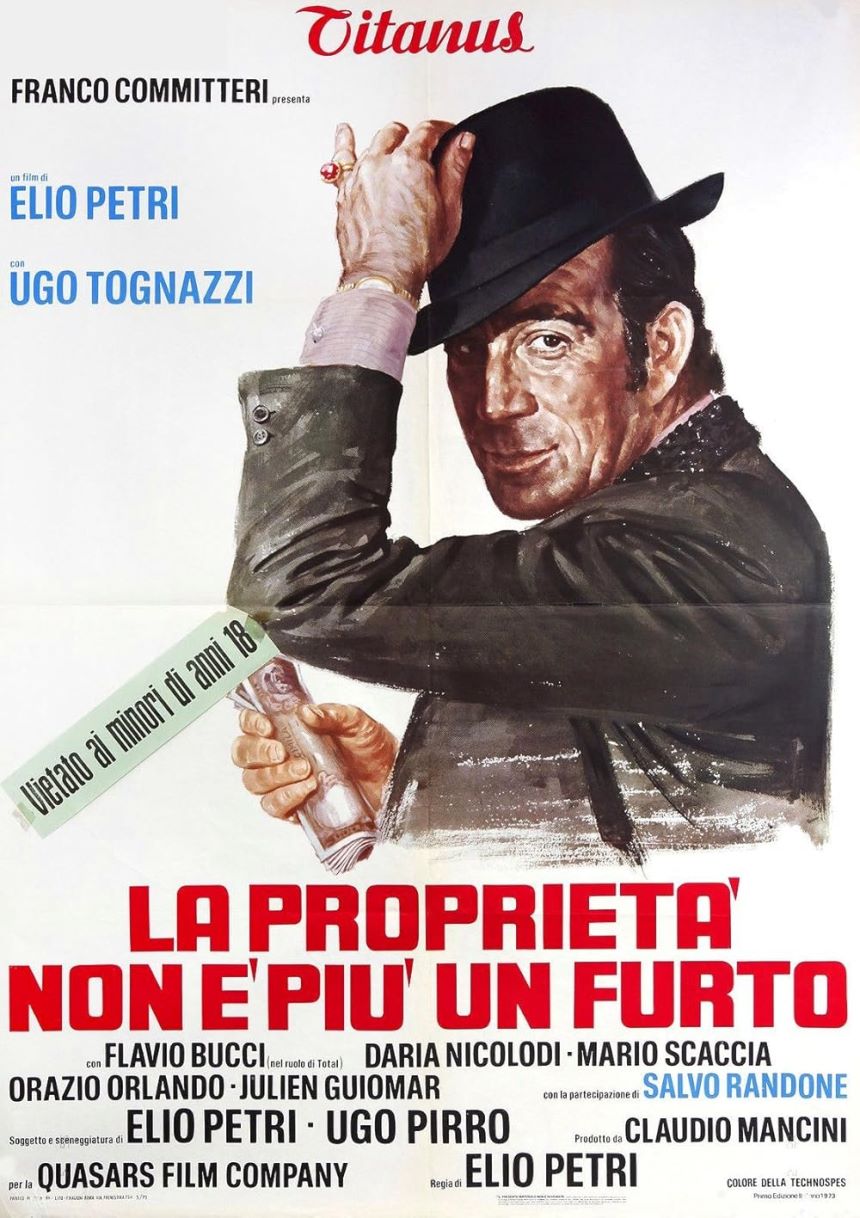
Property Is No Longer a Theft [1973]

 The title for Elio Petri’s blistering comedy Property Is No Longer A Theft can be taken both at face value and with a heavy dose of irony; that, and the droll ingenuity of its phrasing, readily recall the two preceding films in his ‘Trilogy of Neurosis’, viz. the blazing masterpiece Investigation of a Citizen Above Suspicion and the abrasive agitprop The Working Class Goes to Heaven. Though considerably underrated, it remains an unequivocally brilliant work thanks to the interplay of aesthetic ferocity and intellectual dare that the iconoclastic filmmaker brought in while blending radical politics and ferocious polemics with deliciously gonzo, sleazy, provocative B-movie aesthetics and even Brechtian splashes. The narrative is built around a farcical war of attrition between Total (Flavio Bucci), a young bank cashier who’s literally allergic to money and calls himself “Mandrakian Marxist”, and a wealthy, corrupt and glibly offensive businessman called “The Butcher” (Ugo Tognazzi). Upon witnessing the bank manager’s sycophancy towards the latter, Total quits his job, begins stalking Butcher – the very embodiment of the evils of capitalism for him – and starts stealing his belongings – inane things at first, before progressing to expensive objects and even his mistress (Daria Nicolodi). The Butcher, meanwhile, avoids reporting Total to the maniacal investigating cop (Orazio Orlando), as he’s massively over-reported his loss to the insurance. This anarchic film’s script was as unhinged as its characters, which also comprised of a vaudeville master thief (Mario Scaccia) and Total’s bemused father (Salvo Randone), and is bookended by three riotous sequences – a chaotic bank robbery where the clerks unleash vicious dogs upon the robbers; a salesman’s hilarious demo of anti-theft devices; and an amusing paean to thieves and robbers.


Director: Elio Petri

Genre: Crime Comedy/Black Comedy/Social Satire/Political Satire

Language: Italian

Country: Italy

Thursday, 10 July 2025

We Still Kill the Old Way [1967]

 Elio Petri’s filmography can be roughly divided into two categories – relatively restrained films (albeit, not completely bereft of stylistic flourishes) during the first half of his career, and formally exuberant and politically outspoken works subsequently – with We Still Kill the Old Way squarely belonging to the former camp. This muted and moody political conspiracy thriller reminded me of the tone, build-up and oblique storytelling of Francesco Rosi’s superb film Illustrious Corpses. No surprises, perhaps, that both were adapted from Leonardo Sciascia’s novels, this one being from To Each His Own. It began with an audacious long-take – with a “flying” camera providing panoramic views of the Sicilian town in which it’s set – before dramatically diving into the narrative as an oddball Tati-esque postman, while on the way to delivering a letter, discusses about it with the town’s laidback but curious residents. The said letter is an anonymous threat to a womanizing pharmacist, which soon materializes into his murder by unknown assailants during a hunting trip with his friend Antonio. While this is treated as an open-and-shut case of honour killing, a mild-mannered but dogged leftist Professor (Gian Maria VolontĆ© in a fine atypical casting) starts suspecting that Antonio was the real target instead, rather than an unlucky collateral. Sparked by his identification of the newspaper – read by political and religious conservatives – that’s used for composing the threat mails, he starts obsessively digging into the death that’s bound to be detrimental to his physical wellbeing. Along the way he finds himself falling for his dead friend’s widowed wife (a delectably inscrutable Irena Papas), as the plot increasingly thickens. Vivid cinematography and Luis Bacalov’s idiosyncratic score added to the film’s captivating atmosphere.


Director: Elio Petri

Genre: Crime Thriller/Political Thriller

Language: Italian

Country: Italy

Sunday, 6 July 2025

The Assassin (L'Assassino) [1961]

 L'Assassino, Elio Petri’s solid if underrated debut, combined three aspects of his filmmaking that’d manifest more markedly in his later, better-known films. It introduced his love for genre cinema, B-movies and gonzo aesthetics; it underscored his disdain for unchecked consumerism and moral rot in contemporary Italian society (a theme in multiple landmark Italian films of the 1960s); and it provided teasing glimpses into how his left-wing politics was inseparable from his craft (he formerly wrote Marxist film criticisms for L'UnitĆ ). Then matinee idol Marcello Mastroianni, who Petri scored for the lead role (they’d collaborate thrice more), retained a soft corner for this film, even though he starred in some of the most seminal Italian films of that period. He was excellent as Alfredo, an antiques dealer of dubious standing, a lothario, a bon vivant and a scoundrel, who’s arrested from his posh apartment in Rome on suspicions of murdering his older ex-mistress Adalgisa (Micheline Presle), a wealthy socialite who was also his business sponsor and partner until recently. He owed her money, was one of the last persons to see her alive and had just switched to a younger girlfriend who’s a moneyed heiress, and therefore the suspicion. Additionally, the Commissario (Salvo Randone) – who’s heading the case and hopes to wear him down with interminable waiting and interrogations – hates his “type”. Scripted by the great Tonino Guerra, the film alternated the “present” – which occurs over 1 ½ days – with frequent flashbacks into Alfredo’s chequered past, thus making this as much an investigation into the protagonist as one into the case at hand. The sparkling B/W cinematography and smooth jazz score added to the fatalist atmosphere of this “anti-realist thriller”.


Director: Elio Petri

Genre: Crime Thriller/Mystery

Language: Italian

Country: Italy

Tuesday, 1 July 2025

The Eyes, the Mouth [1982]

 Expressions of grief and guilt evoked a feverish pitch and guttural howl in Marco Bellocchio’s emotionally turbulent and nakedly personal film The Eyes, the Mouth. His twin brother Camillo had committed suicide in 1969, which left a lasting impact on him. Made 13 years after that tragedy, it served as a means to reconcile with that traumatic memory. Giovanni (Lou Castel, serving as Bellocchio’s stand-in) is a washed-out actor – his unhinged turn in the director’s ferocious debut feature Fists in the Pocket is referenced as a past glory – who’s reluctantly returned to his hometown upon the suicide of his twin brother Pippo. Once actively involved in radical politics, he’s now disillusioned, self-hating and deeply troubled, forced to reconnect with his patronizing uncle (Michel Piccoli) and his devout mother (Emmanuella Riva) who’s been made to believe that Pippo died accidentally. Meanwhile he starts developing complicated feelings for Vanda (Ɓngela Molina) – the promiscuous and seemingly carefree daughter of an exasperated South American immigrant (Antonio Piovanelli) – as she refuses to display any grief for Pippo’s death, despite having been his fiancĆ©e. He gets drawn into a sordid and scabrous affair with her, and spinning a web of deceit for his tormented mother, as he must confront the anger and pain that he feels for his dead brother who, ironically, was considered the saner and the more grounded of the two. Castel and Molina were both astonishing and fearless in the way they physically and emotionally bared themselves in this tumultuous and melancholic work that was powerfully co-written by Catherine Breillat, sumptuously photographed in washed-out colours, and hauntingly scored. Bellocchio returned to his memories of Camillo 40 years later in Marx Can Wait.


Director: Marco Bellocchio

Genre: Drama/Psychological Drama

Language: Italian

Country: Italy

Saturday, 28 June 2025

Slap the Monster on Page One [1972]

 Marco Bellocchio’s tour de force media satire Slap the Monster on Page One was a confluence of thrilling genre cinema and radical political filmmaking, with the pulpy title splendidly mirroring the film’s biting tone, incendiary theme and hardboiled form. Written by Sergio Donati who’s best-known for his collaborations with Sergio Leone, the film continued – with cutting fury – Bellocchio’s blazing and subversive streak from Fists in the Pocket and China Is Near, albeit with the polemic turned up a notch along the lines of Rosi, Pontecorvo and Petri. It began on a throbbing note as documentary footage – including a reactionary speech being delivered by Ignazio La Russa, a right-wing politician who’s presently Italy’s President of the Senate, to vilify surging left-wing rallies and anti-government demonstrations – segued into the narrative as a group of young rebels is seen pelting stones into the office of Il Giornale, a newspaper that peddles fascist agenda to its conservative readers. Its powerful and sleazy editor-in-chief Bizanti (Gian Maria VolontĆ©) injects news items with nefarious slants and insinuations with aims of “indirect propaganda” aligned to the business interests of his odious boss (John Steiner); the sequence where he coaches a young reporter, while “fixing” his write-up, was both disturbingly prescient and savagely funny. When a beautiful college student belonging to a bourgeoise family is found raped and murdered, Bizanti laps up this “golden opportunity” to concoct a false narrative – and clinically frame a left-wing activist for the violent crime – to further the political machinations of his power-seeking boss ahead of upcoming elections. VolontĆ© was frighteningly brilliant as the kind of rotten, self-serving and manipulative dealer in disinformation and fake news that’s infested today’s reactionary mainstream journalism.


Director: Marco Bellocchio

Genre: Black Comedy/Political Thriller/Political Satire/Social Satire/Media Satire

Language: Italian

Country: Italy