Showing posts with label 2000s. Show all posts

Wednesday, 19 November 2025

Ten [2002]

 Ten – Abbas Kiarostami’s first film shot entirely in digital – formed a clear companion piece to his much-lauded Taste of Cherry from a structural standpoint, as both films comprised only of conversations inside a moving car between a person driving the vehicle and various people joining in the front passenger’s seat, and eschewed conventional narrative arcs in favour of fly-on-the-wall approaches. However, while the earlier film was a sombre dive into existential inquiries and moral quandaries, the latter may well remain the Iranian maestro’s sharpest political expression, as well as his most radically stripped-down tableaux. This engrossing and episodic docufiction set in Tehran – a chamber drama, if you will, in how it’s rigorously confined within a car and shot using two dashboard-mounted cameras – captured, through ten vignettes, the interactions between a beautiful, confident and fiercely modern woman (played with irresistible self-assurance by Mania Akbari), who’s always seen driving, and five different passengers, viz. her petulant son (played by Akbari’s real-life child Amina Maher) who’s angry with her for having divorced his father, her elder sister facing marital crisis, a delicate young woman jilted by her fiancé, a prostitute who uninhibitedly shares her opinions on the hypocrisy of men and idiocy of their wives, and a religious old woman. Kiarstoma’s belated answer to an Iranian critic’s question to him on the possibility of making films on independent and working Iranian women – repurposed from an earlier idea of a psychologist conducting her sessions in a car on account of renovations at her workplace – blurred the lines between private and public spaces through these nakedly intimate and free-flowing conversations that touched upon patriarchal norms, gender identities, cultural mores, societal impositions, and feminist assertions.


Director: Abbas Kiarostami

Genre: Drama/Road Movie/Experimental Film

Language: Persian

Country: Iran

Wednesday, 15 October 2025

As I Was Moving Ahead Occasionally I Saw Brief Glimpses of Beauty [2000]

 Jonas Mekas’ magnum opus – with a title that mirrored its achingly intimate self-expression, moving tone and expansive length – both underpinned and subverted the idea of experimental filmmaking. At close to 5 hours runtime, it was his longest film; that, along with its fragmentary, loosely-strung, collage-like nature, bereft of any narrative patterns or pay-offs, and unhurriedly paced, emphasized its alternative form. Covering a staggering 30 years – from 1970 to 1999 – it was also the most monumental diary film of his career. That said, it was plaintive, lyrical, effervescent and self-effacing – a “masterpiece of nothing” in his words – which imbued it with joyous simplicity and accessibility. Forming an unintended New York triptych along with Walden and Lost, Lost, Lost – and ‘Diary of an Exile’ tetralogy of sorts when one also includes Reminiscences of a Journey to Lithuania – this was a home movie in the purest sense as it captured moments that weren’t just autobiographical but also profoundly personal. Composed of a vibrant flurry of 16mm footage shot primarily in New York City but also elsewhere in the US and Europe – which he then assembled in a randomized order (as opposed to chronologically) – it’s lovingly centred on his vivacious wife Hollis, their cherubic daughter Oona and their son Sebastian. These three individuals and the memories they shared – daily life in their Manhattan apartment and outside, lazy Sundays at Central Park, noticing his children’s first steps, celebrating birthdays, loving moments with his wife, playing with his pet, experiencing new places, observing seasons change – represented paradise for him. These laced this exquisitely poetic memoir and most unassuming epic – accompanied by Mekas’ lilting narration and a wistful score – with radiance, melancholy and a gossamer-like delicacy.


Director: Jonas Mekas

Genre: Documentary/Diary Film/Essay Film/Experimental Film

Language: English

Country: US

Wednesday, 24 September 2025

Prison Images [2000]

 If seeing, prying and witnessing were the running motifs in Harun Farocki’s filmography, then his analytic video montage Prison Images can well be his most emblematic work. Through this hour-long essay, he delved into a pointed examination of the carceral society through images of prisons from two parallel streams – viz. representation of prisons in cinema, interspersed with actual camera footage from American prisons. While he sourced sequences from multiple films for the former, two particularly stood out in their imagery – Jean Genet’s unnerving Un Chant d’Amour, where the prisoners adopt performative roles for the gratification of guards peeping into their cells, and Robert Bresson’s masterful A Man Escaped, where the protagonist meticulously stages an escape – as these two thematic tropes have recurred in countless films. These were juxtaposed with CCTV camera footage, and the message underpinning them was one of power, control, and the transformation of societies into surveillance states. In a mordant comparative analysis, Farocki posited that prisons, departmental stores and shopfloors are bound by their shared obsession with endless surveillance both as a means and an end. We therefore see how inmates are made to wear tracking devices so that their every movement can be monitored and inspected. In the essay’s most disturbing sequences, we see footage of how the authorities deliberately instigate prison fights – e.g. by placing antagonistic groups or inmates in closed spaces – and then stopping them through violent means. Through these, the Marxist director’s disdain for what prisons embody was unequivocally evoked. Hence, though not expressed in as many words, the underlying tenor was emphatically analogous to Joan Baez’s battle cry “raze the prisons to the ground” in her powerful protest song ‘Prison Trilogy’.


Director: Harun Farocki

Genre: Documentary/Essay Film

Language: German

Country: Germany

Monday, 21 July 2025

Wolfsburg [2003]

 Christian Petzold’s spare and chilling psychological thriller Wolfsberg carried the weight of Germany’s political history, even if that wasn’t explicitly laid out; the titular city’s past is intertwined with the Nazi era as, founded by Hitler in 1938 as the seat for Volkswagen’s massive automotive factory, it became a military-industrial complex during WW2 during which it produced armaments and freely utilized slave labour. Car as a symbol of modernity, class hierarchy and commodity capitalism, unsurprisingly, played a pivotal role, and the film’s themes of grief, guilt and moral crisis hinged around it. Additionally, like The State I Am In which preceded it and Yella couple of films later, it also culminated with a shattering car crash. The film began with an unsettling hit-and-run incident as Philipp (Benno Fürmann), an auto salesman having an argument with his fiancée over the phone while driving his luxury car, accidentally hits a kid on a bicycle. He leads an entitled life, but at the cost of tolerating his domineering boss – the owner of the auto dealership where he works – and his self-obsessed girlfriend who’s his boss’ pampered sister. The kid’s mother Laura (Nina Hoss), meanwhile, is a single mom and exploited supermarket worker. While Philipp is silently racked with contrition upon being unable to confess – more so when the kid dies – Laura is crushed to the point of contemplating suicide as well as seeking vengeance. Guilt, grief, secrecy and wrath make for a messy cocktail; consequently, when these two lost souls get drawn into a tender romantic relationship, it’s bound to lead to damaging repercussions. Hoss and Fürmann were both magnetic in Petzold’s icy portrayal of dread, three-way class conflict and societal alienation.


Director: Christian Petzold

Genre: Crime Thriller/Romantic Drama

Language: German

Country: Germany

Sunday, 20 July 2025

Ghosts (Gespenster) [2005]

 Christian Petzold delivered haunting inquiries into the questions of individual and collective identity in reunified Germany, and underlying unresolved political and social fault-lines, in his remarkable ‘Ghosts Trilogy’. The trilogy delved into that through estranged outsiders who were left in the margins during this assimilation exercise. Ghosts, the trilogy’s moving central chapter – and much more loosely-strung vis-à-vis the two films it’s bookended by, viz. The State I Am In and Yella – had a particularly spectral and disenfranchised protagonist in Nina (Julia Hummer), an orphaned, alienated and pathologically shy teenaged girl whose job as a trash collector and stay at a public home are contingent on her ability to fit in. The isolated life of this intensely lost and lonely girl is briefly upended by two dramatic encounters. On one hand she befriends Toni (Sabine Timoteo) – a slightly older brash, impetuous and rebellious girl who snatches what she needs and lives outside the law – upon accidentally witnessing a violent attack on her by a couple of guys; they form a tender relationship as Toni temporarily takes Nina under her wings, while Nina becomes profoundly entranced by Toni. Meanwhile, Françoise (Marianne Basler), a beautiful, upper-class and grief-stricken middle-aged woman – who’s just been released from a mental hospital, as she’s been struggling with the trauma of losing her daughter who’d been stolen as a toddler many years back – starts aimlessly wandering across Berlin while her husband is tied up in business matters, and is convinced that Nina is her long-lost daughter upon bumping into her. Hummer and Timoteo were superb in revealing their emotional vulnerabilities and scars as social misfits in this bleak and melancholic tale co-written by the great Harun Farocki.


Director: Christian Petzold

Genre: Drama/Psychological Drama

Language: German

Country: Germany

Friday, 18 July 2025

The State I Am In [2000]

 Christian Petzold, having earlier made three TV features, made a striking theatrical debut with The State I Am In. With this first chapter in his “Ghosts Trilogy” – it was followed by Ghosts and Yella, two similarly glacial and elliptical inquiries into Germany’s complex and asymmetric reunification process – he boldly combined political cinema, formal exactitude and genre exercise wherein each informed the others. It began on a languid note as teenager Jeanne (Julia Hummer) selects Tim Hardin’s plaintive song “How Can We Hang On to a Dream” on the jukebox at a seaside café and sits down for a smoke; young surfer Heinrich (Bilge Bingül) approaches her for a cigarette, joins for a chat, and the two lonely souls strike a mutual chord. What seems like a coming-of-age love story gets a genre spin when we meet her edgy and secretive parents – Hans (Richy Müller) and Clara (Barbara Auer) – who embody archetypal lovers-on-the-lam. However, as we gather – even though the script was shrouded in ambiguity – the couple are former Red Army Faction members, the disbanded left-wing group which’d dreamt of violently reshaping Germany during the 1960s and 70s; they’ve been hiding under false identities for years now, hoping to escape to Brazil. When their covers are blown at a small Portuguese town, they decide to return to Germany with hopes of cajoling and coercing help from old comrades. Jeanne, however, craves for a different escape – hanging out with Heinrich and listening to pop music – increasingly oblivious of the fatal risks that pose for her parents. Co-written with influential political film essayist Harun Farocki, it delivered a wry jab at fading political memory through Resnais’ powerful Holocaust documentary Night and Fog.


Director: Christian Petzold

Genre: Drama/Political Thriller/Road Movie

Language: German

Country: Germany

Tuesday, 24 June 2025

Good Morning, Night [2003]

 The kidnapping and assassination of former Italian Prime Minister Aldo Moro has been such an epochal moment for Italy and emblematic of its ‘Years of Lead’ that multiple directors, from Elio Petri to Giuseppe Ferrara to John Frankenheimer, have touched upon it. Marco Bellocchio stands out as he made two works on it twenty years apart, viz. the brooding and deeply elegiac feature-length film Good Morning, Night – where he delved into a semi-fictionalized interpretation of the episode through the psychological unravelling of one of the kidnappers – and the ambitious miniseries Esterno Notte, where he expanded the scope and chronicled that event from multiple perspectives. It began with a young couple appraising and renting a lovely, spacious apartment in Rome. As it turns out, they’re Red Brigades revolutionaries and part of the four-member team – led by a firebrand doctor – that kidnaps Moro (Roberto Herlitzka), hides him there for many days, and takes the terrible ultimate step when they realize that the government has no plans to negotiate Moro’s release. The occurrences are portrayed from the POV of Chiara (Maya Sansa), a luminously beautiful and emotionally conflicted young woman. She works as a librarian, is haunted by the memories of her late father who was a Communist partisan during WW2 – evoked through found footage – and is increasingly troubled by their kidnapping of the mild-mannered Moro. Bellocchio blended bleak realism with moral inquiries, and made seductive use of Pink Floyd’s songs, while Sansa stood out for her immersive turn. In the film’s most memorable sequence, aged comrades from the Old European Left gather over an alfresco lunch and rousing “partigiano” songs to remember Chiara’s father and celebrate their days as anti-fascist partisans.


Director: Marco Bellocchio

Genre: Drama/Political Drama/Film a Clef

Language: Italian

Country: Italy

Friday, 18 October 2024

All or Nothing [2002]

 In All or Nothing, Mike Leigh constructed a multilayered, kaleidoscopic and Dickensian slice-of-life on working-class Brits residing in a sprawling but dreary London council estate. With its nuanced and compassionate portrayal of the desolate, hardscrabble lives of the proletarian apartment complex’s residents, who’re shorn of any silver lining in their grey horizons, it provided a trenchant depiction of Thatcher’s damaging legacy, and thereby vividly recalled Leigh’s remarkable earlier Thatcher-era films like Meantime, Four Days in July, High Hopes and Life Is Sweet. Yet, despite the overarching bleakness, Leigh never basked in miserabilism; rather, he developed his characters and their stories from a place of deep empathy for the human condition, and infused his script with touches of levity, camaraderie and warmth; the film, consequently, was absorbing and lyrical amidst the melancholy and hopelessness. The  exceptional ensemble’s primary focus was on Phil (Timothy Spall), a lost, soft-spoken taxi driver; his common law wife Penny (Lesley Manville), who’s become inwardly bitter for having to hold together their family both economically – the wages from her job as a departmental store cashier is their primary source of sustenance – and through her housework; their cranky, obese son; and their withdrawn, lonely daughter (Alison Garland) who buries herself in books when she’s not working at a home for the elderly. Their neighbours comprise of Maureen (Ruth Sheen), an effervescent single mother; her troubled teenage daughter Donna who’s in an abusive relationship; temperamental taxi driver Ron (Paul Jesson); his dazed, alcoholic wife; and their conflicted teenage daughter (Sally Hawkins), who’s smitten with Donna’s boyfriend and craved by a hapless stalker. Marvellous performances abound, as do immaculately conceived moments, in this delicately strung tapestry on everyday survival.


Director: Mike Leigh

Genre: Drama/Marital Drama/Urban Drama/Slice-of-Life/Ensemble Film

Language: English

Country: UK

Friday, 4 October 2024

Comedy of Power [2006]

 Comedy of Power opens with a virtuoso tracking shot. Over the course of 2 ½ minutes, a deliciously fluid camera follows Michel Humeau (François Berléand), the powerful head of a major state-owned French company, as he interacts with his assistants, walks through the office corridor, travels down by an elevator, and then, upon exiting the building, gets arrested.  The man, who simply can’t fathom that someone in his position can get so easily arrested and thrown into jail without any prior warnings, eventually finds himself face-to-face with powerful magistrate Jeanne Charmant-Killman in her tiny office. Isabelle Huppert – in her seventh and final collaboration with Chabrol, making this one of the most incredible director-actor partnerships in world cinema – was captivating as this fearless, wily, defiant and self-assured prosecutor, who’s arrested Humeau on charges of fraudulence and using state funds for personal gratification, and uses that as springboard to aggressively go after other corrupt honchos and dealmakers. As she becomes ever more obsessed in her quest that shakes up the French system, she finds her marriage collapsing, her boss trying to derail her, and facing attacks to scare her into submission, only for every personal and professional hurdle further fortifying her resolve to ruthlessly pursue her valiant crusade. The wry cynicism and relaxed nature of her nephew, with whom she shares a close camaraderie, provided an interesting counterpoint to Jeanne’s obstinacy, workaholism and fearless belligerence. While it didn’t possess the sardonic undercurrents distinctive to Chabrol’s filmography, it spotlighted on his derision for power and capital in this reworking of the real-life financial scandal involving former French oil company Elf Aquitaine and the investigations into it by anti-corruption judicial activist Eva Joly.


Director: Claude Chabrol

Genre: Thriller/Political Thriller/Film a Clef

Language: French

Country: France

Tuesday, 24 September 2024

Merci pour le Chocolat (Nightcap) [2000]

 Liszt’s rapturous classical composition ‘Funerailles’ attained edgy and sinister undertones in Chabrol’s Merci pour le Chocolat. Music, therefore, was simultaneously ravishing and unsettling, with extended passages devoted to it as a means for both organically progressing the narrative and marvellously shaping the mood, and thereby playing a sensuous role in defining the film’s tone and atmosphere. Isabelle Huppert, in her penultimate collaboration with Chabrol, made it even more enticing and delicious with a stunningly slippery performance laced with just the right mix of sweetness, sharpness, straight-faced sinfulness and impish layers of delightful perversity of a well-made Swiss chocolate. This being a quintessential French noir, it was draped in sunshine and laced with understated elegance; and, being a quintessential Chabrol, it savoured the slow unravelling of the fractured underbelly of an upper-class bourgeois family. The film begins with the rebound marriage between Mika (Huppert), the well-off owner of a chocolate company, and André (Jacques Dutronc), a virtuoso pianist. They were married 18 years back – André’s second wife, with whom he’s had a son, died under mysterious circumstances – and they live in Mika’s stately mansion in Lausanne. When Jeanne (Anna Mouglalis), a talented young pianist who might be André’s daughter, makes an impulse visit to their place and forms a deep bond with him, Mika’s underlying sociopathic tendencies get ruffled, despite receiving Jeanne with outward effusiveness. Huppert’s striking turn as a treacherous person – the kind that she’s made her own over her illustrious career – was meticulously synchronized with the film’s musical crescendo and complemented the sardonic themes of control, obsession and dysfunction. The interplay between music and menace, incidentally, was re-invoked the following year by Huppert in Haneke’s The Piano Teacher.


Director: Claude Chabrol

Genre: Thriller/Crime Drama/Psychological Thriller/Marital Drama/Post-Noir

Language: French

Country: France

Sunday, 1 September 2024

The Wind That Shakes the Barley [2006]

 The Wind that Shakes the Barley was equal parts poetic and political, as evidenced by its deeply elegiac title that referenced a revolutionary Irish folk ballad written by Robert Dwyer Joyce. A rare foray by Ken Loach into a complex, sprawling and historical canvas – that, and its fearless dive into a bloody civil war from which no one comes out either physically or morally unscathed made it a splendid companion piece to his magnificent Spanish Civil War saga Land and Freedom – it focused first on the Irish War of Independence and then the Irish Civil War over a turbulent couple of years, viz. 1920-22. Beginning on a tranquil note, we see a group of young guys playing “hurling” against an enchanting background. The game, unfortunately, becomes a tipping point, as they’re rounded up by the vicious “Black and Tans” – British soldiers stationed in Ireland to crush the IRA’s rebellion – and a youngster is executed for refusing to speak in English. Damien (Cillian Murphy), a studious, soft-spoken and pacifist doctor, does a radical volte face upon witnessing this and another act of mindless thuggery, and joins the IRA outfit led by his elder brother Teddy (Pádraic Delaney). Structured roughly into two halves, we first see them fighting as comrades-in-arms against British imperialism; but, upon formation of “Irish Free State”, they become profoundly opposed as Teddy decides to forcibly support the compromise struck with Britain while Damien continues his struggle for complete independence and socialist state. Beautifully shot in sombre palettes, filled with murky moral intransigencies that bloody conflicts invariably elicit, and led by riveting turns, this film was at once furious, bleak and melancholic… just like a revolutionary folk ballad.


Director: Ken Loach

Genre: War/Historical Epic

Language: English

Country: Ireland/UK

Thursday, 16 November 2023

Jenin, Jenin [2002]

Jenin, Jenin, as cinema of resistance, was at once powerful, defiant and lucid in how Palestinian actor and filmmaker Mohammed Bakri used a series of interviews – shorn of peripheral contexts and expositions; disquieting in its recording of blazing emotions; and providing rare agency to the voiceless – to craft a polyphonic memorialization of the oppressed, the dispossessed and the persecuted. The radical treatise, despite its brevity, exhibited a harrowing reminder of repressive settler colonialism being faced by the Palestinian people ever since the occupation, through the devastating crackdown and violence that the impoverished residents of Jenin’s refugee camp – located in West Bank – faced at the hands of Israel’s military during “Operation Defensive Shield” in 2002. It, therefore, emphatically evoked the broader picture through its intense specificity, and, in turn, fiercely chronicled the inseparability of the personal and the political for Palestinians, irrespective of whether they’re rebels, partisans, activists or regular civilians. Bakri’s camera unwaveringly captured the rage, despair and sorrow of the survivors – a broken aged man; a livid grandmother; a bitter middle-aged man; a feisty doctor; a helpless father; a heartbroken mother; a disoriented disabled guy; and an unforgettably furious adolescent girl representing the next generation of resistance – through their testimony of what unfolded. Their stirring refusal to capitulate, even at the face of apartheid and tyranny, powerfully stood out. This therefore served as one of many brutal examples of collective punishment that Palestine have faced in the past, thus making it especially pertinent to the gargantuan monstrosity that’s taking place today. Unsurprisingly, the documentary was censored and banned in Israel, while Bakri faced harassments and became a pariah for his courage and dissidence in challenging the mainstream narrative.


Director: Mohammed Bakri

Genre: Documentary/Essay Film

Language: Arabic

Country: Palestine

Saturday, 6 May 2023

The Headless Woman [2008]

 Lucrecia Martel’s magnificent ‘Salta Trilogy’, over the course of the films that it comprised of, transitioned from the broad to the particular in their narrative focus – starting with the rapturously dizzying La Ciénaga which encompassed an array of extended relatives, followed by the wickedly provocative The Holy Girl which covered a smaller family, and finally the psychologically chilling, haunting and deeply unnerving The Headless Woman which largely centred on one character. Formal audacity – avoidance of establishing shots that compels viewers to situate characters and discern relationships themselves, complex audio-visual compositions, deliciously elliptical narratives, etc. –, feminist gaze, and caustic political critiques that’ve informed her works, were fiercely exhibited in this oblique hit-and-run tale and its discomfiting aftermaths. The said incident happens when Verónica (María Onetto, in a superb, nuanced performance) – a wealthy, middle-aged dentist whose class privilege is discernible through her coiffured blond hair, chic sunglasses, assured body language, and politely distanced and condescending interactions with native servants and workers – inadvertently hits something… or someone, while driving along a country road. She gets into an incredibly dazed and disoriented state, and, thereafter, starts thinking that she may have killed an Indian boy – the dog in the rear-view mirror potentially indicative of her subjective perspective – which her husband, lover and friends are keen to convince her otherwise, forget and bury. The way she ultimately shook herself out of her stupor – and guilt – was especially shattering. The film, therefore, served as a stunning – albeit, allegorical – indictment of the Argentine bourgeoisie’s clinical self-preservation and all-too-eager disavowal of the estimated 30,000 who were disappeared during the military dictatorship, and how they so easily expunged themselves of guilt and moral culpability through wilful denial.


p.s. My earlier review of the film can be found here.


Director: Lucrecia Martel

Genre: Drama/Psychological Drama

Language: Spanish

Country: Argentina

Wednesday, 3 May 2023

The Holy Girl (La Niña Santa) [2004]

 If Lucrecia Martel’s stunning debut feature La Ciénaga – with its intoxicating cocktail of chaos, malaise, torpor, vacuousness, fault-lines and undercurrents – was a dazzling piece of diamond, her sophomore feature The Holy Girl – the middle instalment in her masterful ‘Salta Trilogy’, and followed by the magnificent The Headless Woman – was like a cold, metallic razor that clinically sliced through the skin. This brilliant, cutting, provocative, unsettling, sensuous and languid work – which’re Martel’s authorial signatures – focused with wry detachment on how religious frenzy and sexual curiosity can feed into each other for a young, naïve and intensely conflicted teenager. The film’s lurid and devilish subject bore Almodóvar’s influence – he was, incidentally, the film’s executive producer – but this was Martel’s film through and through, with its ambivalent gestures, tonal ambiguities, narrative restraint, unhurried style, flirtatious compositions, and leaving things open to extrapolations. It kickstarted when a middle-aged man takes advantage of a crowd to casually press his groin against a teenage girl, in what is clearly a secret sexual perversion for him. The man happens to be Dr. Jano (Carlos Belloso), a respected and married physician, who’s attending a medical congress at an impressive hotel, and during which time he finds himself getting drawn to Helena (Mercedes Morán), the hotel’s striking owner and a divorcee in a state of emotional dilemmas. And the girl is Amalia (María Alché), a paradoxical, mischievous and pubescent teenager who’s become enamoured by Catholic faith, experiments on her burgeoning sexuality with her friend (Julieta Zylberberg) and starts stalking Jano to cure him of his sins. She, coincidentally, also happens to be Amalia’s daughter, and the ensuing ménage à trois is therefore bound to end badly for all.


Director: Lucrecia Martel

Genre: Drama/Psychological Drama/Religious Drama

Language: Spanish

Country: Argentina

Sunday, 5 March 2023

La Ciénaga [2001]

 The stunning opening sequence of La Ciénaga – the spellbinding debut by Lucrecia Martel, one of the most original voices in contemporary cinema – began with a viscerally arresting depiction of torpor, ennui and vacuousness, wherein a group of flabby, lethargic, inebriated middle-aged adults – idling in sweltering weather, beside a pool filled with putrid, brackish water – are in such a stupor that when one of them slips, falls and cuts herself, others barely react. By putting us in the middle of this messy, ambiguous scene, Martel made it clear that the viewers will need to figure out the characters and their inter-dynamics themselves as the intricately orchestrated narrative unfolded, and in turn marvellously set the stage for the film’s brooding, clammy, chaotic, sensuous and hypnotic atmosphere ominously seething with violence. Martel trained her lens on the extended, cash-strapped, upper-middle-class families of the slothful, alcoholic Mecha (Graciela Borges) – comprising of her dazed husband, pubescent daughter (Sofia Bertolotto) who’s homoerotically enamoured by the family’s Indian servant girl who Mecha verbally abuses, handsome adult son whose playful frolicking with his cousin sister is borderline incestuous, and a one-eyed son addicted to hunting – and Mecha’s saner but acquiescent sister Tali (Mercedes Morán) – comprising of her patronizing husband and three kids, including a little son led to believe in phantom cat-eating African dog-rats. Mecha and Tali make vague plans of visiting Bolivia, their kids indulge in meaningless pursuits verging on disaster, and the television relentlessly covers a Catholic miracle. Simmering socio-political critique – bourgeois self-centredness, racial prejudices, class boundaries, religious frenzy, sexual undercurrents and familial malaise – were, therefore, enmeshed into the desultory proceedings, interlaced with terrific use of diagetic sounds, including captivating lo-fi music playing on stereos.


Director: Lucrecia Martel

Genre: Drama/Family Drama

Language: Spanish

Country: Argentina

Friday, 3 March 2023

The Pinochet Case [2001]

 Like his haunting homecoming essay Chile, Obstinate Memory – which powerfully foregrounded the theme of political memory and amnesia that would profoundly inform his filmography thereon – Patricio Guzmán’s The Pinochet Case too served as a coda to his monumental documentary trilogy The Battle of Chile. This brilliant and harrowing docu dispassionately articulated the belated addressal of Pinochet’s violent overthrow of Allende’s socialist government in 1973 and establishment of military dictatorship, which Guzmán had recorded in his electrifying opus. Pinochet, despite “relinquishing” his presidency in 1990, had retained military powers till his retirement when he appointed himself “senator-for-life”, lived with state-conferred privileges, and holidayed regularly in London, thanks to the preposterous 1978 Amnesty Law through which the army had absolved itself. However, Madrid-based prosecutor Carlos Castresana – a tireless advocate of international justice who’d witnessed the outrageous clemency accorded to Franco in Spain – had tenaciously built a case over 2 years on Pinochet’s crimes against humanity, which judge Baltasar Garzón upheld and the Scotland Yard enforced by putting Pinochet under house arrest in 1998. Using that as hinge, it solemnly covered two interconnected strands – the sensational political discourse that ensued in the UK which stripped him of his diplomatic impunity while also stalling tangible punishments; and poignant first-hand witnesses of tortures, rapes and disappearances that Pinochet’s enforcers had meted out to left-wing dissenters and activists, which Guzmán would expand upon in his masterful ‘Chile Trilogy’. Despite support from odious right-wing apologists and his triumphant return to Chile 1 ½ years later, Pinochet finally found his immunity stripped there too by judge Juan Guzmán. Its indelible parting shot, showing the unveiling of an Allende statue in Santiago, emphasized the ironic circle of life.


Director: Patricio Guzman

Genre: Documentary/Political History

Language: Spanish/English

Country: Chile

Sunday, 11 December 2022

The Son's Room [2001]

 Loss and grief, as subjects, can be both oppressive and liberating, and different directors, therefore, have tackled them in remarkably diverse ways. Nanni Moretti, in his Palm d’Or winning film The Son’s Room – which transformed his position from a maker of cult, idiosyncratic movies to more mainstream recognition – covered these with nuance, simplicity, and a delicate mix of levity and solemnity, while steadfastly side-stepping sentimentality. The film, interestingly, can be roughly broken into two very tonally divergent halves. It commenced with a charmingly joyous family – Giovanni (Moretti), a well-off psychotherapist, is happily married to the loving and lovely Paola (Laura Morante), and has two loving and lively teenage kids, son Andrea (Giuseppe Sanfelice) and daughter Irene (Jasmine Trinca). The easy-going camaraderie that they share is immediately evidenced when we see the parents supporting Andrea – and even joking about it – upon his suspension for allegedly stealing a fossil from the school’s chemistry lab, and that’s accompanied by vignettes of Giovanni’s deadpan counselling of his neurotic patients. Their perfectly balanced world, however, collapses when a devastating tragedy strikes, and everything starts going recklessly haywire – Giovanni becomes beset with severe guilt, his calm deneanour starts crumbling, and he starts becoming disinterested in his job; the vivacious Paola becomes crushed and distant by grief; and the spunky Irene becomes angry and helpless. The disintegration of this perfect family, fortunately, gets a sliver of hope when they become aware of a girl (Sofia Vigliar) with whom Andrea had begun a platonic friendship. Moretti deftly donned dual hats – like he’s done throughout his filmography – in this superbly acted drama where a therapist and his family, ironically, end up in a bad need for therapy themselves.


Director: Nanni Moretti

Genre: Drama/Family Drama

Language: Italian

Country: Italy

Wednesday, 21 September 2022

Down There (Là-bas) [2006]

 Chantal Akerman made an intensely personal exploration of her fragile mind – filled with existential dilemmas, psychological ambivalence and political inquiries – in her spare, solemn and minimalist diary film Down There. Its formally rigorous focus on constricted physical spaces, expressions of displacements, and melancholic silences remind one of her fearlessly naked early work Je Tu Il Elle, albeit with the bold foregrounding of her body in that film replaced with her monologues here. Her reflections on the Holocaust, her family and her Jewishness, in turn, presaged her final work No Home Movie where she discussed these topics with her mother who was a Holocaust survivor. It was made during the month that she spent in Tel Aviv as a guest lecturer in a university there, during which she stayed in an apartment lent by a friend. Set almost completely indoors and in a manner that was disarmingly voyeuristic, we see long stretches capturing an ageing couple residing in a house opposite to hers – he’s seen spending his time either tending to his plants or having coffee along with his wife in their balcony – captured through a static camera and shot in grainy visuals through the blinds on her windows. And these sparse, extended and strangely hypnotic long-takes were sparingly accompanied with Akerman’s distinctive voice covering a mix of thoughts, memories and musings on such aspects as suicide – her aunt who was once a very gregarious woman had killed herself as did Amos Oz’s mother –, if it would’ve been better to settle in Israel vis-à-vis Belgium after the WW2, and the troubling present day realities of Israel’s settler colonialism that’s manifested by a bombing that takes place in the neighbourhood.


Director: Chantal Akerman

Genre: Documentary/Essay Film/Diary Film

Language: French

Country: French
Saturday, 11 December 2021

About Elly [2009]

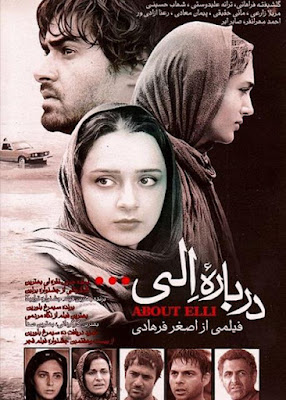
 Upper middle-class morality, entitlement and hypocrisy – and the social capital they possess which allows them to conveniently switch between casually liberal and conservative dismay, and from self-centeredness to self-preservation – formed the crux of Asghar Farhadi’s brilliant, gripping, and fiercely cutting About Elly. In this superb reimagining of Antonioni’s arthouse existential classic L’Avventura – a premise that involved the ripple effects produced by a person’s mysterious disappearance during a trip – Farhadi provided as much a lashing commentary on the bourgeoisie as he did on the Iranian society, through a compact tale composed, constructed and delineated with striking formal and emotional precision. It began on a lively note with an exuberant group of upwardly mobile families from Tehran – old-time friends, their spouses and kids – who’ve come for a short vacation. Sapideh (Golshifteh Farahani) – who loves organizing and troubleshooting – has taken the lead in arranging the gate-away, including getting hold of a beach-side house on the Caspian Sea through some smart maneuvering. The carefree bonhomie aside, she also intends to use this opportunity to hook up her friend (Shahab Hosseini), who’s recently got divorced and is on a short visit from Germany – with shy, stunningly beautiful and quietly vulnerable kindergarten teacher Elly (Taraneh Alidoosti) who belongs to a lower social rung. This initiative is progressed, however, without either trying to properly know Elly or taking her fully into confidence, and hence when she suddenly disappears amidst the frolic, what was playful fun turns harrowing and devastating to the point of even potentially shattering some of the familial bonds. Tightly knit, marvelously enacted and bereft of non-diagetic sound, the way the film’s tone, mood and dynamics imploded was akin to an exquisitely crafted thriller.


Director: Asghar Farhadi

Genre: Drama/Psychological Drama

Language: Persian

Country: Iran