Friday, 14 October 2022

Pierrot le Fou [1965]

 The anarchist, non-conformist, prankster, satirist, cynic, romantic and mad genius residing within Godard were all on dazzling display in Pierrot Le Fou – his exuberant, impudent, goofy and crazy gem. He took the template of outlaw lovers – or, in his words, the “the last romantic couple” – on crime spree, and deliriously punched into that pop-art aesthetics, wacky humour, comic-book violence, idiosyncratic genre subversion, sardonic class commentary, hilarious satire on consumerism, lacerating indictment on militarism, and a whole lot of manic fun, thus making this a dizzying mosaic packed with political, cultural, cinematic and literary references. That his marriage to Anna Karina was falling apart, added a poignant touch to their fifth and penultimate collaboration. Ferdinand (Jean-Paul Belmondo) – a media exec leading an unfulfilled bourgeois existence filled with ennui, domesticity and shallow social circles, and married to a well-off wife (Graziella Galvani) who’s consumed by vacuous consumerism – takes off on a whim with Marianne (Karina), his ex-girlfriend and member of an underground racket on the run from OAS gangsters. They steal cars, commit murders, swindle, and engage in subterfuge as they ride drive Paris to Côte d’Azur in search of escape and idyll. Along the way they encounter dwarf criminals, perform a couple of infectious musical sequences, make buffoons of American GI’s through a parodic agitprop street theatre on the Vietnam War, etc. Belmondo as the deadpan and philosophical Ferdinand, and Karina as the enchanting and impulsive Marianne, made for an unforgettable pair in this zany work flamboyantly photographed by Coutard. American filmmaker Samuel Fuller, in an ironic cameo, mentions “cinema is like a battleground”… Godard emphatically espoused that maxim here, and made it his raison d'être over his radical career.

Note: My earlier review of the film can be found here.


Director: Jean-Luc Godard

Genre: Drama/Black Comedy/Satire/Road Movie/Musical/Avant-Garde

Language: French

Country: France

Wednesday, 12 October 2022

Vivre sa Vie (My Life to Live) [1962]

 Vivre Sa Vie – with its desolate realism, melancholy and pathos – possibly ranks among Godard’s most solemn, understated and restrained works. Yet, it was also splendidly suffused with wry ironies, socio-political jabs, Brechtian technique, metatextuality, detours and dazzling narrative ingenuity – and this interplay between aesthetics, form, structure, themes and political undercurrents made this a work of rare beauty, depth and bravado. Broken into twelve tableaux – each beginning with an intertitle reminiscent of pre-20th century literature – it chronicled the life of the lovely and lost Nana (anagram of Godard’s muse and the film’s effervescent heroine Anna Karina), who wishes to escape from her dreary existence. She therefore breaks off her marriage and quits her job in a record store, dreaming of becoming a movie actress, but ends up as a prostitute on the streets of Paris. Godard interspersed her poignant, edgy and doomed journey with sublime moments, droll interludes, rich literary allusions and bravura filmmaking. In an iconic scene Nana is captured in a heart-breaking close-up as she watches Falconetti in Dreyer’s The Passion ofJoan of Arc; in another unforgettable sequence, she lets herself loose through a carefree dance to a pulsating jazz score in a pool room; the murder of an Algerian protestor being shot at by the French police is juxtaposed with a bravura jump-cut montage; the film’s elegiac score is often stopped without a cue; French prostitution laws are detailed in a deadpan voice akin to an educational newsreel; Truffaut’s Jules and Jim is shown playing at a Paris cinema; Baudelaire’s translation of Poe’s writing being read out by Godard’s voiceover; a long sequence where renowned philosopher Brice Parain answers Nana’s questions on language, love and whatnot.

Note: My earlier review of the film can be found here.


Director: Jean-Luc Godard

Genre: Drama/Psychological Drama/Urban Drama/Avant-Garde

Language: French

Country: France

Sunday, 9 October 2022

Le Mépris (Contempt) [1963]

 Godard’s breathtaking, sensuous and fierce masterpiece Le Mépris was packed with cinematic references and straddled multiple dichotomous facets. Adapted from Moravia’s commanding and ferocious novel Il Disprezzo, this smouldering examination of marital disintegration, artistic integrity, and filmmaking was simultaneously suffused with decadent classicism and blazing modernism – aesthetically, thematically and formally – while positing commentaries on modernist interpretations of classical texts, cinematic grammar – interlacing the lush, sensorial and opulent melodrama of Old Hollywood with deconstructive, subversive and radical avant-garde elements –, and overlaps between truth and artifice. Coutard’s resplendent cinematography – delineated with bold primary colours, interplays between intimate close-ups and sumptuous wide-angled frames, and glorious tracking shots –, Georges Delerue’s deeply elegiac score, and co-existence of immaculate mise-en-scène with montages, likened it to the Greek tragedy that formed here – as in the source novel – the focal point for both the plot and broader thematic explorations. Paul (Michel Piccoli), once an independent playwright, has been lured by easy money from writing movie screenplays – ostensibly to provide a luxurious life for his ravishing wife Camille (Brigitte Bardot), but essentially manifesting his self-delusion, hypocrisy and artistic decomposition. Things get dramatically complicated when he takes a job from vulgar, overbearing American producer Prokosch (Jack Palance) to rework the great Fritz Lang’s allegorical adaptation of Homer’s Odyssey into a mainstream costume drama. Meanwhile, the couple’s marriage unravels over the three-act structure, as the underlying malaise and disaffection reaches irreconcilable proportions during the brilliant mid-section staged within their apartment, and gets sealed during their trip to Capri where the filming is underway. This mesmeric work – right from the voyeuristic opening sequence drooling over Bardot’s body to the fatalistic climax – was therefore at once exultant, ponderous and disquieting.

Note: My earlier review of the film can be found here.



Director: Jean-Luc Godard

Genre: Drama/Marriage Drama/Showbiz Satire/Avant-Garde

Language: French/English

Country: France

Friday, 7 October 2022

Band of Outsiders (Bande à Part) [1964]

 Godard made a euphoric return to the world of B-movies – the palette for his seminal debut feature Breathless – with Band of Outsiders, his 6th film in 4 years. This quirky, funny, playful and irresistibly infectious work – filled with ingenious interludes and asides, and wry pastiche to American genre cinema – formed a lovely companion piece to Truffaut’s dazzling sophomore film Shoot the Piano Player, in that both were eccentric adaptations of pulpy hardboiled novels – Dolores Hitchens’ Fools’ Gold and David Goodis’ Down There, respectively –, and they effortlessly juxtaposed bleak and downbeat poetic realism with remarkable stylistic bravado and nonchalance. This slacker crime caper revolved around two guys – the sincere and straightforward Franz (Sami Frey), and his cynical and raffish buddy Arthur (Claude Brasseur) – vying for the same girl, viz. the vivacious, coquettish and doe-eyed Odile (Anna Karina), who they’re trying to have as a partner-in-crime in their plan to rob the large stash of cash which, as per her information, can be found in the building in a grimy Parisian suburb where she resides. Things, unsurprisingly, don’t go as planned, which was twice over here on account of its post-noir sensibilities and its maverick director. The latter aspect was especially noteworthy thanks to inspired sequences which’ve become part of cinematic folklore – Franz and Arthur’s faux recreation of Pat Garrett shooting Billy the Kid; the troika’s seductive and melancholic “Madison dance” in a nondescript café; their celebrated mad dash through the Louvre – and myriad other irreverent interjections, like the minute of silence, Karina breaking the fourth wall with the rhetorical question, “why a plot?”, etc. Michel Legrand’s terrific jazz score and Coutard’s melancholic B/W photography added to its roguish charm.

Note: My earlier review of this film can be found here.


Director: Jean-Luc Godard

Genre: Crime Thriller/Crime Comedy/Buddy Film/Avant-Garde

Language: French

Country: France

Wednesday, 5 October 2022

Breathless (À Bout de Souffle) [1960]

 Like someone once eloquently surmised Godard’s scintillating debut – which became the Nouvelle Vague’s manifesto and, alongside The 400 Blows, its most influential work – “there was before Breathless, and there was after Breathless.” Free-form, improvisational, impudent, iconoclastic, exhilarating, and a stunning volte-face to conventions, it heralded its defiant and non-conformist auteur’s transition from theory to action. It was based on a story by his former Cashiers du Cinema comrades Truffaut and Chabrol, which he radically reworked and wrote the script on the fly, even feeding lines to his actors from behind the camera; this was his first of many unforgettable collaborations with Raoul Coutard who made extraordinary cinematographic innovations during its making, and shot a number of remarkable single takes, including an astonishing double full camera rotations in a cramped interior space while following two people from the streets to inside, and the famous climactic tracking shot; the film’s initial cut clocked two hours, prompting Godard to slice between scenes, thus leading to its legendary jump-cuts… anecdotes about the film remain as spellbinding as the film itself. Godard took French cinema to the streets of Paris, and displayed his love for American B-movies – gangsters and noirs – in this jazzy romantic noir with a fine score by Martial Solal, involving Michel (Jean-Paul Belmondo), an insouciant car thief who loves emulating Bogart and is on the lam after killing a cop, and Patricia (Jean Seberg), an alluring and enigmatic girl-woman whose introduction – hawking New York Herald Tribune on Champs-Élysées – remains one of the most recognizable sequences in cinema. Melville, in a deadpan cameo, ironically quipped that his greatest ambition was “to be immortal, and then die” … well, Godard achieved exactly that.

Note: My earlier review of the film can be found here.


Director: Jean-Luc Godard

Genre: Crime Drama/Post-Noir/Romantic Noir

Language: French

Country: France

Sunday, 2 October 2022

Crimes of the Future [2022]

 While watching Julia Ducournau’s gloriously seductive body-horror film Titane, one hoped for one last hurray from Cronenberg who’d once made this sub-genre his personal fiefdom and engendered the Cronenbergian grammar. Hence the Canadian auteur’s fabulous new film Crimes of the Future – albeit, conceived and written in the late-90s and was slated to go into production in early-2000s, before it got shelved for the next two decades – and his first in 8 years, felt especially exhilarating for its gleeful, provocative and ballsy evocation of his quintessential brand of outrageous, discomfiting, visceral and caustic social, cultural and biological commentaries in the veins of Videodrome, The Fly, Dead Ringers and Crash. Bearing the same title as his sophomore film but without any resemblances otherwise, it captures a dystopian future when human bodily evolution has moved into uncharted territories where pain and infection are a thing of the past; new human organs are spouting out of nowhere and “surgery is the new sex”, leading to both edgy performance art and increased body control by the state; dietary habits have got radically altered – with an underground anarchist cult feeding on industrial plastic –; and the society has shaped into a battleground between the surveillance state and subversive non-conformists. In this disturbingly allegorical milieu, the story focussed on the tantalizing ménage à trois between a renowned performance artist couple – Saul Tenser (Viggo Mortensen), a brooding man having “accelerated evolution syndrome” and his sensual partner Caprice (Léa Seydoux), who performs “live” surgeries on him – and saucy National Organ Registry bureaucrat Timlin (Kirsten Stewert) who’s secretly enamoured with Saul. The boldly grotesque visuals, hallucinatory atmosphere, and pulsating techno-classical score brilliantly complemented Cronenberg’s prescient, subversive and satirical vision.


Director: David Cronenberg

Genre: Thriller/Science Fiction/Body Horror

Language: English

Country: Canada

Tuesday, 27 September 2022

Better Call Saul [2015-2022]

 Breaking Bad, which earned immense fandom, plaudits and awards, was undeniably gripping; however, its spin-off prequel Better Call Saul – to let the cat out of the bag at the very outset – was even better. The creators, in an excellent creative decision, focussed here on the backstories of two secondary characters from the previous show – the hustling, loquacious and amoral lawyer Saul Goodman (Bob Odenkirk) in particular, and to a lesser degree the taciturn ex-cop turned enforcer Mike Ehrmantraut (Jonathan Banks) – and dramatically reworked the mood and scope while retaining elements which were at the forefront there. The resultant work was more psychologically nuanced, morally ambiguous, stylistically ambitious, and sprawling in its narrative arc. Odenkirk gave a truly outstanding performance as Jimmy McGill, former con-man and struggling lawyer who, over 6 marvellous seasons, transforms into a wealthy, crafty and flourishing lawyer through a mix of sheer will, ingenuity, impudence, street-smartness and willingness to cut corners. Banks evoked a droll persona, juxtaposing fierce loyalty, albeit for Gus Fring (Giancarlo Esposito) – the ruthless Chilean drug distributor for the cartel – with an indeterminate moral compass. Kim Wexler (magnificently played by the stunning Rhea Seehorn) – a virtuoso lawyer and a complex, enigmatic woman – formed a fascinating counterpoint to Saul. Among other memorable characters, Saul’s elder brother Chuck (Michael McKean), a renowned lawyer with psychological troubles; Lalo Salamanca (Tony Dalton), a conniving and charismatic Mexican drug lord; and Nacho (Michael Mando), a foot-soldier in the Salamanca gang, stood out. The series became darker, murkier and more engrossing as it progressed, reaching its apotheosis in the final season – set “after” Breaking Bad’s events and shot in bleak monochromes – which portrayed a lonely, broken and hunted Saul struggling to contain his natural instincts.


Creators: Vince Gilligan & Peter Gould

Genre: Drama/Crime Drama/Legal Drama/Black Comedy

Language: English

Country: US

Friday, 23 September 2022

The Meetings of Anna [1978]

 Disaffection, displacement, loneliness, rootlessness, and emotional ambivalence were the defining attributes of Chantal Akerman’s autofiction film The Meetings of Anna. Made right after her monumental masterpiece Jeanne Dielman and during a phase when she was crafting one sublime, muted, nuanced, decidedly political and profoundly personal work after another, it formed a compelling companion piece to Je Tu Il Elle in particular and so much of her cinema in general, given her striking explorations of feminism, identity, queerness, memories, existential crises and living in a state of flux. Made with customary formal rigour – narrative minimalism, sparseness, empty spaces, melancholic hues, and bold use of silences – it presaged her magnificent mosaic film Toute Une Nuit, in the way they were both foregrounded on fragmented and momentary relationships.  Anna (Aurore Clément) – striking stand-in for Akerman herself – is a Belgian filmmaker who’s on a movie screening tour through various cities across Europe – Cologne, Brussels, Paris, etc. And, while putting up at different cold, impersonal hotels – small and shabby, big and elegant, discreet and modernist – she engages with diverse people and for a myriad reason, viz. impersonal one-night-stands with strangers, clandestine sleep-over with an old lover (Jean-Pierre Cassel), attempts at reconciliation with a bitter former friend, candid reconnect with her mother (Lea Massari) with whom she can easily shed all her physical and emotional inhibitions. Alongside these, she’s continuously trying to get in touch with a woman with whom she had a brief but intense affair. The cyclicity of her existence was brilliantly underscored when, finally on her own bed in her apartment, she listens to a series of telephonic messages which end with plans being spelled out for her next move screening tour.


Director: Chantal Akerman

Genre: Drama/Semi-Autobiographical Film

Language: French

Country: Belgium

Wednesday, 21 September 2022

Down There (Là-bas) [2006]

 Chantal Akerman made an intensely personal exploration of her fragile mind – filled with existential dilemmas, psychological ambivalence and political inquiries – in her spare, solemn and minimalist diary film Down There. Its formally rigorous focus on constricted physical spaces, expressions of displacements, and melancholic silences remind one of her fearlessly naked early work Je Tu Il Elle, albeit with the bold foregrounding of her body in that film replaced with her monologues here. Her reflections on the Holocaust, her family and her Jewishness, in turn, presaged her final work No Home Movie where she discussed these topics with her mother who was a Holocaust survivor. It was made during the month that she spent in Tel Aviv as a guest lecturer in a university there, during which she stayed in an apartment lent by a friend. Set almost completely indoors and in a manner that was disarmingly voyeuristic, we see long stretches capturing an ageing couple residing in a house opposite to hers – he’s seen spending his time either tending to his plants or having coffee along with his wife in their balcony – captured through a static camera and shot in grainy visuals through the blinds on her windows. And these sparse, extended and strangely hypnotic long-takes were sparingly accompanied with Akerman’s distinctive voice covering a mix of thoughts, memories and musings on such aspects as suicide – her aunt who was once a very gregarious woman had killed herself as did Amos Oz’s mother –, if it would’ve been better to settle in Israel vis-à-vis Belgium after the WW2, and the troubling present day realities of Israel’s settler colonialism that’s manifested by a bombing that takes place in the neighbourhood.


Director: Chantal Akerman

Genre: Documentary/Essay Film/Diary Film

Language: French

Country: French

Sunday, 18 September 2022

Portrait of a Young Girl at the End of the 60s in Brussels [1994]

 Made as part of Arte’s influential “Tous les garçons et les filles de leur âge…” series where French filmmakers were asked to contribute recollections from their adolescence days, this might well place among Chantal Akerman’s most tender and playful films despite its aesthetic sparseness… and, alongside The Meetings of Anna, among her most autobiographical fictional works. This delightfully understated and freewheeling film portrayed a day in the life of the 15-year-old Michelle (Circe Lethem) who’s rebelling against her bourgeoise upbringing and experiencing deep existential crisis. It begins with her decision to quit school – she writes fake letters of absence where the reason ranges from an uncle’s illness to her own death, thereafter followed by dramatically tearing off her report card – which she shares with her bosom friend Danielle (Joelle Marlier); she then goes to the cinema where she meets Paul (Julien Rassam) – a young army deserter from Paris – and the two lost souls aimlessly amble along the city before getting into the vacant apartment of her cousin who’s on a holiday; and she ends the day by going to a dance party with Danielle that continues till dawn. Over the course of this lovely, leisurely day she becomes intimate with Paul – as a mix of teenage curiosity and defiance – while also expressing palpable signals of her deep attachment with Danielle, thus making this such an evocative coming-of-age movie. It had two memorable uses of music – Michelle dancing with Paul to Leonard Cohen’s mellifluous Suzanne and later with Danielle to the lively La Bamba – while the proceedings, in a cheeky disregard for temporal conventions, were anachronistically filmed with artefacts indicating the 90s even if the title pointed to the 60s.


Director: Chantal Akerman

Genre: Drama/Coming-of-Age

Language: French

Country: France

Tuesday, 13 September 2022

Dis-Moi [1980]

 The Holocaust had formed an integral part of Chantal Akerman’s lived experience, artistic voice, and being, and it was with Dis-Moi – also referred to as Aujourd’hui, Dis-Moi – that she confronted this devastating subject for the first time in her cinema. Made as part of a series on “Grandmothers” commissioned by French TV, this delicate, nuanced, melancholic, profoundly affecting and surprisingly powerful work – alternately heart-warming and heart-breaking, winsome and bleak, unassuming and eloquent – reiterated her prowess at capturing closed spaces (which she’d displayed in her marvellous silent docu Hotel Monterey) and her propensity for extracting broader personal meanings, feminist subtexts and political contexts through conversational voices (which she’d so magnificently evoked in her masterful essay film News from Home). She met and interviewed three elderly Jewish women in their Paris flats – packed with charming curios amidst an air of loneliness – who faced horrors, irreparable personal loss and forced exiles on account of Nazi occupations during the “Shoah”. And yet – perhaps on account of the passage of time – they shared their memories of their families and days of growing up with a mix of longing, tenderness, equanimity and poignant reconciliation, while coaxing Akerman with grandmotherly love to have the cakes, cookies and coffees if she wants hear their stories. Their digressive oral histories were juxtaposed with the lilting voice of Akerman’s mother Natalia – her letters formed a key strand in the aforementioned essay film and she’d be the central subject in her final film No Home Movie – who, like these women, was a Holocaust survivor (nearly everyone in her family was murdered in the Auschwitz death camps), and was trapped in memories of her idyllic closely-knit world before the Final Solution.


Director: Chantal Akerman

Genre: Documentary/Holocaust Film

Language: French

Country: France

Saturday, 10 September 2022

25 Favourite Films from 2021

  1. Mr. Bachmann and His Class | Maria Speth | Germany
  2. The Lost Daughter | Maggie Gyllenhaal | US
  3. Getting Away with Murder(s) | David Wilkinson | UK
  4. Parallel Mothers | Pedro Almodovar | Spain
  5. The Hand of God | Paolo Sorrentino | Italy
  6. Azor | Andreas Fontana | Argentina
  7. Petite Mamman | Celine Sciamma | France
  8. Babi Yar. Context | Sergey Loznitsa | Ukraine
  9. Titane | Julia Ducournau | France
  10. Bad Luck Banging or Loony Porn| Radu Jude | Romania
  11. Bergman Island | Mia Hansen-Love | France
  12. Vortex | Gaspar Noe | France
  13. Writing with Fire | Rintu Thomas & Sushmit Ghosh | India
  14. Memoria | Apichatpong Weerasethakul | Colombia
  15. History of Ha | Lav Diaz | Philippines
  16. Petrov's Flu | Kirill Serebrennikov | Russia
  17. The Souvenir Part II | Joanna Hogg | UK
  18. The Great Indian Kitchen | Jeo Baby | India
  19. Judas and the Black Messiah | Shaka King | US
  20. In Front of Your Face | Hong Sang-soo | South Korea
  21. 21. Benedetta | Paul Verhoeven | France
  22. 22. Landscapes of Resistance | Marta Popivoda | Serbia
  23. 23. The Worst Person in the World | Joachim Trier | Norway
  24. 24. The Card Counter | Paul Schrader | US
  25. 25. Intregalde | Radu Muntean | Romania & Drive My Car | Ryusuke Hamaguchi | Japan [TIE]

Tuesday, 30 August 2022

Taming the Garden [2021]

 In his dry and disturbing documentary Safari, Ulrich Seidl had portrayed “trophy hunting”, wherein wealthy tourists kill exotic animals in the African jungles for fun and souvenirs. In Taming the Garden – whose wry and deadpan tableaux, incidentally, reminded me of Seidl’s aesthetic palette – we’re presented with “trophy trees”. Salomé Jashi’s spare, reflective and quietly caustic documentary elucidated the fact that human folly, entitlement and megalomania truly know no bounds, and that the super-rich can desire even the most ludicrous possessions simply because they can have it. Georgian billionaire and former prime minister Bidzina Ivanishvili has one such hobby that nearly beats everything in its staggering absurdity; he gets specialized teams – at enormous cost and extraordinary inconvenience – to uproot massive, magnificent and ancient trees from both private lands and public spaces, and relocate them across great distances – over land and sea – in order to plant them in his personal, artificially constructed and meticulously manicured garden. Jashi covered the process approximately chronologically, albeit captured over unspecified durations and different locations – complex extractions of the majestic giants, oftentimes at night-time to possibly avert protests; equally complicated transportations using trailers and barges, with ethereally shot vistas of the trees gliding over the Black Sea being the ones that stuck most to my mind; and finally ending with a peek into Ivanishvili’s faux park, even if its owner is never seen. These were accompanied with contrasting responses of poor villagers to this anomalous act – while they accepted the money offered for their trees and acknowledged the roads constructed in their villages to enable logistics, they also expressed a wide array of emotions – from amusement and bewilderment to dismay and outrage – at this Faustian transaction.


Director: Salome Jashi

Genre: Documentary

Language: Georgian

Country: Georgia

Saturday, 27 August 2022

Judas and the Black Messiah [2021]

 There’s a constant interplay between scalding anger and understated melancholy running through Shaka King’s furious, electrifying, fiercely evoked, meticulously researched and marvellously told feature debut Judas and the Black Messiah, and rightly so. It captured the grotesquery that the establishment committed under the guise of “threat to internal security of the country” – in essence a manifestation of systemic racism and systematized governmental overreach – through the real story of incessant intimidations, false arrests and ultimately murder of Fred Hampton, Chairman of the Illinois chapter of the Black Panther Party, by the FBI. And, ironically, they achieved their nefarious objective by planting William O’Neal, a car thief turned FBI informant, in their midst in order to rat on Hampton and the Panthers, and thereafter betray him, in lieu of money and protection from prosecution. Daniel Kaluuya who played the charismatic, indefatigable and extraordinarily progressive 21-year-old revolutionary Hampton – who believed in social welfare, justice for black communities, and raising political consciousness of the working class, and could deliver rousing speeches – with superb panache, vigour and power, and Lakeith Stanfield who played the shifty, slippery and conflicted O’Neal with the cunning charm of a chameleon, were both excellent in this gripping work laced with political prescience, moments of tenderness and vulnerability, and exquisitely composed atmosphere. Jesse Plemons as O’Neal’s FBI handler and Dominique Fishback as Hampton’s girlfriend and fellow BPP activist Deborah Johnson provided noteworthy supporting turns, as did others. That King, instead of taking a straightjacketed approach, structured the film like a thriller – even if it’s tragically predestined – and chronicled it through the dual perspectives of its two dramatically divergent men, made this so much more layered, complex, authentic, dismaying and compelling.


Director: Shaka King

Genre: Drama/Political Drama/Biopic

Language: English

Country: US

Tuesday, 23 August 2022

Getting Away With Murder(s) [2021]

 Released on the 75th anniversary of the end of the Nuremberg trials that were conducted by the Allies at the end of WW2, it’s a biting irony that David Wilkinson’s appropriately titled documentary Getting Away with Murder(s) dealt with the fact that the vast majority of Nazi perpetrators – politicians, death squad leaders, concentration camp guards, SS enforcers, bureaucrats, doctors, industrialists, etc. – who participated in the ghastly massacres unprecedented in modern human history, either escaped trials or went scot-free, many were freely absorbed back into their former positions and professions by the Adenauer government in West Germany, and numerous others lived long, comfortable lives in Germany, UK, Austria and elsewhere. Clocking at around three hours, this downbeat, serious, powerful, intensely distressing, rigorously researched and undeniably formidable work – funded to a large extent by the filmmaker himself and his wife – must surely place in the pantheon of essential cinematic dissertations on the Holocaust. Wilkinson criss-crossed across the Auschwitz-Birkenau (in Poland), Germany, Lithuania, Latvia, Czech Republic, the US and his native UK covering Nazis who so easily escaped punishment despite the enormity of their crimes, through a vast array of stories, scholarly researches, personal testimonies,  evidences, archival documents and other historical artefacts, along with solemn and reflective conversations with renowned historian Mary Fulbrook, centenarian Benjamin B Ferencz who’s the last living prosecutor from the Nuremberg trials, tireless Nazi hunters, disillusioned members of British and German war crime departments who’ve been unable to accomplish much on account of governmental apathy despite possessing enough information to prosecute surviving Nazis, etc. The resultant work, therefore, was sombre, harrowing, bitter, mournful and troubling, with its impact amplified by intensely disturbing images, blunt assessments and journalistic matter-of-factness.


Director: David Wilkinson

Genre: Documentary/Political History/Holocaust Film

Language: English

Country: UK

Sunday, 21 August 2022

Everything Went Fine [2021]

 It’s really something to marvel at that a film, on subjects as heavy, brooding and serious as old age, mortality and assisted suicide, could so refreshing, humorous and bereft of sentimentality, and more so, considering François Ozon’s penchant for bleak and unsettling movies. Adapted from the Emmanuèle Bernheim’s memoir who’d earlier written screenplays for Ozon’s Swimming Pool and the especially downbeat 5x2, Everything Went Fine – the wry and deadpan irony of the title becomes clear only at the end – seamlessly laced grief, pain and loss with disarming levity into a bittersweet work. The wealthy and retired businessman André (André Dussollier) – very well connected socially on account of being an art collector, but having complicated relationships with his dementia-stricken and separated sculptress wife (Charlotte Rampling), and his two daughters Emmanuèle (Sophie Marceau) and Pascale (Géraldine Pailhas) on account of his acid-tongued nature and homosexuality – finds his life turned into shambles upon suffering a debilitating stroke. Unable to bear such an existence, he literally demands his favourite Emmanuèle – who, in turn, has always had a complex love-hate bond with him – to help him die. That isn’t just an emotionally wrenching ask, but a legally challenging one too as they need to surreptitiously take help of an expensive Swiss facility administered by a soft-speaking lady (legendary German actress Hanna Schygulla in a cameo) to avoid getting arrested by the police. Marceau was both striking and brilliant as the conflicted woman who as a kid wished for her dad to die and now, ironically, must facilitate that – not because she wants to, but because she can’t say no to him – while Dussollier was surprisingly effective as the obstinate, difficult, mercurial and entitled father.


Director: Francois Ozon

Genre: Drama/Family Drama/Biopic

Language: French

Country: France
Friday, 19 August 2022

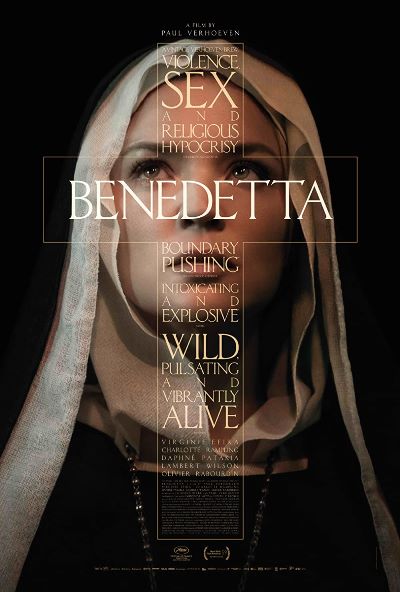
Benedetta [2021]

 Deliriously provocative, gloriously lurid, gleefully profane, riotously scandalous and unabashedly hyper-violent, Benedetta possessed all the archetypes associated with Paul Verhoeven’s best-known works. That his ability to shock, cause outrage, and smash the boundaries of sexual morality remains so spectacularly undiminished even at the age of 82, should be enough of put many to shame. Loosely adapted from a non-fiction with an incendiary title that must’ve made Verhoeven chuckle with delight, viz. Immodest Acts: The Life of a Lesbian Nun in Renaissance Italy by Judith C. Brown, it followed the extraordinarily turbulent and controversial life of 17th century Catholic nun, mystic and abbess Benedetta Carlini. Virginie Efira, who’d featured in a supporting turn in the filmmaker’s outstanding last movie Elle, gave a stunning performance – through terrific interplay between controlled precision and explosive bursts – as an overly devout twenty-something nun in a convent in Pescia run by the weary Felicita (Charlotte Rampling). Benedetta believes that she has a special connect with Jesus – bordering on the psycho-sexual, and sparked by bursts of disturbing, hallucinatory, grotesquely campy visions – and therefore the ability to perform miracles which’re often manifested through unsettling personality changes. And things become further unhinged when she embarks on a torrid affair with Bartolomea (Daphné Patakia), a feisty young newcomer with an abusive past. Facing charges of being a heretic and sexual deviant on one hand by the brazenly patriarchal church, and the distressing onslaught of the plague on the other, the irrepressible heroine becomes even more valiant – bolstered by her zealotry and flamboyant performative abilities – thus taking this fearlessly blasphemous, richly melodramatic and sumptuously photographed film, with charged feminist overtones and ferocious critique of religious hypocrisy, to a feverish pitch.


Director: Paul Verhoeven

Genre: Drama/Religious Drama/Biopic

Language: French

Country: France

Sunday, 14 August 2022

Writing with Fire [2021]

 Khabar Lahariya (literally, “News Waves”) is a rare beacon of hope for journalism in the country – in a landscape otherwise cluttered with jingoism, populist propaganda, bigotry, sensationalism, disinformation and cacophony – in that it speaks truth to power with courage, doesn’t shy away from topics which are inconvenient to the establishment, and covers unsavoury ground realities. But it’s even more than that, as it’s run by rural women from disadvantaged and marginalized communities – necessitating them to operate in an environment dominated by entrenched patriarchy, caste violence and religious discrimination, while also battling economic and domestic impediments – thus imbuing their work with stirring social and feminist contexts. Co-directed by Sushmit Ghosh and Rintu Thomas, Writing with Fire is a terrific documentary on this incredible newspaper, and, in turn, a disarmingly powerful work of reportage laced with grit, socio-political conviction and understated eloquence. At its centre-stage were two remarkable Dalit women – Meera, the group’s seasoned Chief Reporter who takes charge of politically volatile stories while also providing mentorship to those needing guidance, and Sunita, a gutsy and self-assured young reporter who’s started covering difficult topics – who are covering such issues as murder of union leaders and activists by the coal mafia, apathy shown by the police towards an impoverished Dalit woman who’s faced sexual violence, and the obnoxious rise of muscular nationalism and cow vigilantism at the backdrop of the ominous 2017 state elections in the violent, chauvinistic and polarized quagmire that Uttar Pradesh represents. Filmed in spare, grainy and compelling visuals, these serious subjects were deftly juxtaposed with the bonding of these heroic comrades including their exuberant trip to Kashmir, their valiant attempts at going digital, and their incredible personal conviction.


Directors: Sushmit Ghosh & Rintu Thomas

Genre: Documentary/Reportage

Language: Hindi

Country: India

Wednesday, 10 August 2022

The Girl and the Spider [2021]

 Ramon Zürcher and Silvan Zürcher’s sophomore film The Girl and the Spider – and their first in 8 long years since their debut film The Strange Little Cat – was permeated with such a brooding and engulfing sense of melancholy, that one might almost ignore the sly, seductive and entrancing ambiguity, and delicate formal precision, with which it was so meticulously composed. It was an alternately haunting, droll and beguiling tale of longing, separation, lonely individuals, cryptic relationships, sexual gamesmanship, momentary reconciliations, and the various interlinkages between. The premise was simple – Lisa (Liliane Amuat) is moving out of her apartment in Berlin – which she shared with her roommate Mara (Henriette Confurius) – to another one in the city. This seemingly routine act of movement foregrounded a myriad emotions, and underlying intricate equations, that are laid nakedly threadbare over a couple of days. The strikingly beautiful, psychologically complex, impulsive, enigmatic, lonesome, deeply vulnerable and oftentimes unpredictable Mara formed the centre-point in the directors’ vivaciously crafted canvas where a host of people – family, friends, neighbours, workers and even strangers – move in and out of the frame like a meticulously orchestrated stage-play. We therefore see Lisa’s mother who strikes a bond with an ageing carpenter, a couple of girls who stay downstairs, a taciturn guy who pines for Mara, a shaggy bloke who cares for a neighbour’s dog, an old and intensely lonely lady, a former housemaid who’s left her piano behind, etc. Realism was often subverted with flights of imagination, fantasy and memories in this tight yet freewheeling work –photographed and scored with warmth, and with the mood switching between cold and tender – where catharsis loomed just round the corner like a missing cat.


Directors: Silver & Ramon Zucher

Genre: Drama/Psychological Drama/Existential Drama

Language: German

Country: Switzerland

Thursday, 4 August 2022

Paris, 13th District (Les Olympiades) [2021]

 Jacques Audiard’s adaptation of three acclaimed graphic novellas by American cartoonist Adrian Tomine – albeit, transplanted to Paris with surprising elan – is a beguiling and sensual amalgamation of old and new sensibilities – a tale of kinship and quest for love amidst the loneliness and existential isolation of an impersonal, hypermodern urbanscape. Audiard accomplished this dichotomy – based on a screenplay jointly written with none other than Céline Sciamma – through use of luminous B/W photography and melancholic palette on one hand, and the cold setting of the skyscraper-filled 13th arrondissement of Les Olympiades and candid depiction of lust, intimacy and sexuality on the other. It followed an emotionally fraught ménage à trois between three lost, demographically divided millennials craving for romance and companionship. Émilie (Lucie Zhang), who stays in an apartment that belongs to her senile grandmother and works at a shabby call centre, takes in Camille (Makita Samba), an erudite high school teacher working on doctoral degree, as her roommate. The two become lovers for a while; however, when he ends their brief fling with casual impassivity, the promiscuous Émilie finds herself falling for him. Meanwhile, Nora (Noémie Merlant), who’s moved to Paris to get back to college after many years, faces public humiliation on being mistaken for cam sex worker Amber Sweet (Jehnny Beth), upon which she begins a surprisingly affecting and deeply personal camaraderie with Amber, alongside an affair with Camille who she partners with in a small real estate company. The volatile and intertwining relationships were brought forth through fine performances, but none as fascinating as Zhang’s who expressed a volley of emotions and stirring vulnerability throughout the film’s length. The electronic theme score was an added bonus.


Director: Jacques Audiard

Genre: Drama/Romantic Drama/Urban Drama

Language: French

Country: France

