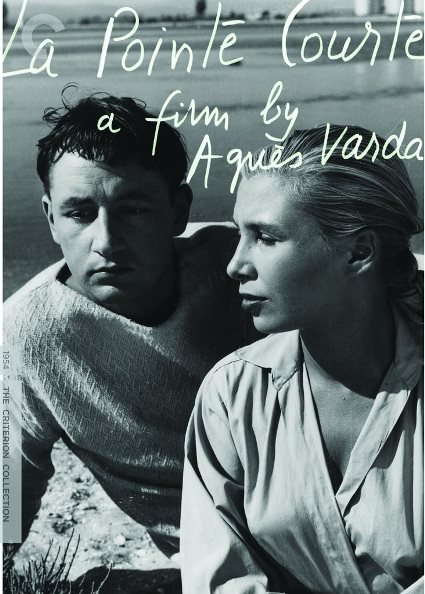
Agnès Varda’s remarkably assured and exquisitely
shot directorial debut La Pointe Courte
straddled across two iconoclastic film movements, without consciously aiming
for that, though its two loosely connected narratives. The affecting 1st
narrative portrayed, with humour, warmth, exuberance and lyricism, the life of
a tightly-knit, impoverished fishing community in the eponymous French coastal village;
the authorities are trying to clamp down as they believe the shellfish are contaminated
by industrial effluents, which propels the fishermen to find new ways of
dodging the city guys who they clearly disdain, while also enjoying their lives
despite the meagre means at their disposal. The other narrative covered an
unnamed Parisian couple (Philippe Noiret and Silvia Monfort) who’ve come there to
spend a few days together; they roam around the fields, river banks and discarded
boats discussing about their crumbling marriage, and hoping if there’s a way to
save it yet. The only instance where the two narratives coincided was during the
end when the couple is finally seen enjoying while attending an annual revelry that
the village hosts. The infectious former narrative had all the distinctive elements
of Italian Neorealism, including a non-professional cast, on-location shooting
and delightful naturalism. The latter narrative, on the other hand, was
discursive, self-reflexive and stylized – the arresting close-up shots of the
profile of one cutting in half the face of the other, would reappear more
famously in Bergman’s Persona. Though
I found the latter stilted and artsy, it did bear early signs of the Nouvelle
Vague movement, even if it would still be around half a decade before Truffaut would debut
with The 400 Blows, Resnais (who
edited this film) with Hiroshima Mon Amour, and Godard with Breathless.

Director: Agnes Varda
Genre: Drama/Rural Drama/Marital Drama
Language: French
Country: France
Jean-Pierre Melville, the French Poet of Lowlife, created a quintessential hardboiled crime thriller with Le Doulos, filled with such archetypal noir elements as laconic
men, duplicitous women, honour among thieves, double crosses, unfortunate
coincidences and comeuppance. That Melville would go increasingly existential
with his subsequent masterworks made this, on hindsight, especially
interesting. The film kicks off with a fabulous opening sequence wherein
recently discharged career-criminal Maurice (Serge Reggiani), in trench coat
and fedora, dripping with weariness, and engulfed by deep shadows, walks to a
house in the Parisian outskirts, bumps off a former accomplice as punishment
for betrayal, and leaves with a stash of cash. As it turns out he’s planning
one final heist before calling it quits, and takes the help of the shadowy Silien
(Jean-Paul Belmondo) – the film’s key protagonist / antagonist – a steadfast
loner, cynic and tough guy with dubitable moral standing, and, as many suspect,
perhaps even a police stooge. The suspicion gets enhanced exponentially when the
heist goes awry, and Maurice somehow escapes with a bullet, albeit leaving his
dead comrade behind, vowing revenge against Silien. But things aren’t of course
that straightforward in the brooding and wonderfully paced narrative filled
with twists, surprising revelations and a whole lot of compelling ambiguities.
The psychological duel between the two disparate anti-heroes, wonderfully played
by Reggiani and Belmondo, took the film – filled with moody B/W photography and
low-key jazz score – to a finale that, expectedly, ends badly for all; the
adage, “In this business you either wind up a bum… or full of lead”, mused by
Silian over his double whiskey, therefore neatly summed up the central motif
for not just Melville, but film noir itself.
p.s. This is a revisit. My earlier review of the film can be found here.
Director: Jean-Pierre Melville
Genre: Thriller/Crime Thriller/Gangster Film/Film Noir
Language: French
Country: France

If the euphoric filmmaking in Holy Motors – with which he made a
triumphant return after a hiatus of 13 years – was anything to go by, Leos
Carax is truly an unclassifiable filmmaker. His penchant for stylized mise-en-scéne and self-conscious cinematic
deconstructions – no wonder he’s heavily influenced by Godard – is evident even
as early as his acclaimed second feature Mauvais
Sang. The film may be, technically, neo-noir, gangster film, sci-fi pulp
and romantic drama, and yet it’s really neither of the above while still being
all of them – and that’s what makes it difficult to develop a pat liking for,
but, for a cinéaste, easy to be in thrall of. Ageing criminal Marc (Michel
Piccoli) has a debt to pay to a powerful woman (Carroll Brooks), and hence he’s
planned an elaborate heist to get hold of a drug that potentially is the cure for
a mysterious AIDS-like virus – which spreads upon making love without being in
love –sweeping across the country. So, when the man who was supposed to help
him suddenly dies, he enlists the latter’s son Alex (Carax’s regular
collaborator and alter-ego Denis Levant), a young loner with dexterous hands.
Meanwhile Alex, who’s left his loving girlfriend (Julie Delpy) to start afresh,
becomes obsessed with Marc’s lover Anna (Juliette Binoche). Sparse yet
flamboyant, muted yet vibrant, and filled with discursive dialogues and
deliberately theatrical set-pieces that go everywhere and nowhere, the film’s language
is unique. And yes, the exuberant sequence, shot in a glorious single take,
where the feral Levant runs, hops, and cartwheels in frenzy to David Bowie’s ‘Modern
Love’, has become part of cinematic folklore, as the unforgettable accordion
break in Holy Motors.

Director: Leos Carax
Genre: Avant-Garde/Neo Noir/Gangster Film/Romantic Drama
Language: French
Country: France

In the Last Days of the City, the long gestating debut feature of Egyptian
filmmaker Tamer El Said which he’d started in 2009, is laced with beguiling
formalism, ambiguity and meta-elements. It didn’t just blur, to the point of
being indistinguishable, the line between documentary and fiction, it also self-reflexively
traversed in and out of a film within the film, and had multiple sections shot
in and around Cairo’s Tahrir Square just as Arab Spring, that would end with
the overthrow of Hosni Mubarak, was about to sweep across Egypt (though, ironically,
things became even worse thereafter). The film’s protagonist (Khalid Abdalla)
is a documentarian trying to capture the city’s essence and its myriad facets,
by interviewing people he knows and capturing moments and events like a
guerilla filmmaker. Unfortunately, in a curious parallel, his work is going
nowhere just like his life seems to be stuck in a stasis – his mother is
unwell, his girlfriend has decided to move on, and he keeps visiting one place
after another with an increasingly frustrated broker in a seemingly endless
apartment-hunt. When he has a catch-up with a few of his politically conscious filmmaker
friends from the troubled cities of Beirut and Baghdad, does he finally seem to
start finding a sense of direction and perhaps a way out from his artistic
block. The film, filled with striking and visceral images of the city,
comprises of a few memorable moments – the demolition of a dilapidated building
with strong metaphorical connotations, political protests getting a brief
reprieve upon the Egyptian football team’s success in the African Cup of
Nations, and candid displays of daily violence inadvertently caught on camera.

Director: Tamer El Said
Genre: Drama/Existential Drama/Experimental Film
Language: Arabic
Country: Egypt

Pawel Pawlikowski’s Cold War is at once monumental and deeply personal, seemingly detached
and yet deftly affecting, and with a scope that’s both bombastic and intensely focused,
thus justifying the film’s adventurous title while also subtly critiquing the
folly of grand politicking. The filmmaker’s parents, both of whom died just as
the Velvet Revolution was about to kick-in, had a complicated relationship; inspired
by their tale, he retained their names but fictionalized their journeys by
concocting an exhilarating, tumultuous love story that cut across national borders,
political ideologies, and the complex and volatile Cold War era during which it’s
set. The brooding, laconic, chain-smoking Wictor (Tomasz Kot) is a musician extraordinaire
who, along with a musicologist and a would-be apparatchik, founds a folk song-and-dance
troupe, where he meets and falls for Zula (Joanna Kulig), a vivacious,
temperamental and enigmatic lady with a silken voice. As the troupe starts
touring, at the backdrop of a rapidly evolving political climate, one might be
reminded of Angelopoulos’ pièce de résistance The Traveling Players or Zhang-ke’s masterful Zhantai. The film, however, brilliantly changed its trajectory from
the epic to the intimate when Wictor, upon deciding to defect to the West, isn’t
joined by Zula as she decides to stay back. Their fascinating tale of love and
lust, constantly alternating between separations and reunions, toggles between
Communist Poland and jazz-soaked Paris, with a bit of East Berlin and Yugoslavia
thrown in. Music in its myriad shades in general, and an incredibly haunting
central song in particular, formed the central motif for the film’s circuitous
narrative, and were wonderfully complemented by enthralling B/W photography, absorbingly
moody atmosphere, and a tour de force performance by the dazzling Kulig in
particular.

Director: Pawel Pawlikowski
Genre: Drama/Romantic Drama/Political Drama
Language: Polish/French
Country: Poland