Sunday, 18 April 2021

The Year of the Discovery [2020]

 1992 was a watershed year in Spain’s contemporary political history. On one hand its “thriving democracy” and “booming economy” were flamboyantly announced – 17 years after its fascist Generalissimo’s death – by hosting two spectacular international events, viz. Sevilla Expo and Barcelona Olympics; and yet, unbeknownst even to most Spaniards, this year also witnessed the devastating culmination of its neoliberal policies, which especially manifested in Cartagena through closure of national industries, massive job losses and seething collective anger among the disaffected working class, which exploded in the form of tremendous street protests and ultimately burning of the region’s autonomous parliament. Luis López Carrasco’s radically brilliant, politically trenchant, formally audacious and magnificently crafted documentary The Year of the Discovery examined – through memories and cutting dialectics – the other side of that tumultuous year… and in turn, a host of troubling episodes from Spain’s past, from the repressive and odious Francoist dictatorship years to the crippling 2008 recession. Through enthralling free-flowing discussions and interviews – in a semi-staged setting partly reminiscent of the Ross’ intoxicating Bloody Nose, Empty Pockets, real people selected from Cartagena’s working-class neighbourhoods were deliberately assembled at a tavern there, and the interactions and stories over cigarettes and drinks, which were fiercely real but elicited through planned interventions, were shot over a couple of months – Carrasco captured a complex mosaic interlacing the personal with the political. In further extraordinary stylistic choices, this 3 ½ hour work was shot using analog Hi8 which imbued it with amateur home video looks, the conversations were presented using intricate split-screen compositions, and the proceedings were often inter-cut with real footage from the ferocious unrest, news clippings and even, ironically, cheesy official ads from the period.


Director: Luis Lopez Carrasco

Genre: Documentary/Political History

Language: Spanish

Country: Spain

Saturday, 17 April 2021

Undine [2020]

 Anyone acquainted with Petzold’s filmography would be aware of his penchant for interpreting and chronicling German sociopolitical history – covering WW2, Cold War and present day – through tense, compelling and classical narratives. However, while his previous movies were predominantly situated in specific contexts, albeit transfused with allegorical portrayals, he made a dramatic formal detour – resorting to magic realism and overt metaphors – in his serene, immaculate, restrained and involving, but also at times thematically distracting and symbolism laden, Undine. Its enigmatic titular heroine Undine (Paula Beer), a Berlin historian and public guide at the Märkisches Museum, has an eerily mysterious – and, possibly, supernatural – background, and that’s alluded to at the outset where she coldly berates her fiancé – who’s possibly fallen for another woman – that she’ll have to kill him if he doesn’t return to her. Though the guy still goes ahead and leaves her for his new lover, she gets temporarily distracted upon a chance encounter with Christoph (Franz Rogowski), an industrial diver who was magnetized by her latest lecture – around the evolution of Berlin’s architectural landscape over the ages – which he attended out of happenstance; and that quickly blossoms into a romance that engulfs the two loners. Their shared tranquility, however, gets shattered before long, as is wont to happen in a brooding, tacitly ominous work such as this. Petzold intriguingly positioned the film beyond a dark fairy tale by imbuing mundane realism into the proceedings, and more so, through invigorating politico-historical discourses wherein intricate models of Berlin formed key components. The latter aspect added underlying allegory into the tragic and mythological love story; and that, in turn, was aided by the impending sense of doom and Beer’s striking turn.


Director: Christian Petzold

Genre: Drama/Romantic Drama/Political Drama/Fantasy

Language: German

Country: Germany

Friday, 16 April 2021

Minari [2020]

 Minari, culled by Korean-American filmmaker Lee Isaac Chung from his childhood experiences, was neither grand nor overly dramatic despite the storyline’s inherent epicness. It was a restrained, subdued, quietly told tale, even if the plot – with its emotional underpinnings, straightforward familial inter-dynamics, and pursuance of “American Dream” – followed a rather conventional arc.  Chung nevertheless did well in retaining a sense of simplicity – instead of being simplistic and falling fully into overused traps – which made it for most parts a sincere, engaging work. Set during the 1980s, it begins with a Korean immigrant family – comprising of Jacob (Steven Yeun) who’s desirous of making an entrepreneurial leap, his fiercely independent-minded wife Monica (Han Ye-ri), their young daughter (Noel Kate Cho) and restive kid son (Alan Kim) who has a heart condition – relocating from California to rural Arkansas. Jacob has set his mind into becoming a self-made farmer focusing on produce aimed at the Korean-American food market; and hence, with that goal in mind, they move into a trailer van and an uninhabited plot, even at the cost of alienating his wife who’s already on the edge for his taking such a radical decision without bothering to discuss first. Paul (Will Patton), a neurotic born-again Christian who joins as farm help, and Monica’s irreverent, mischievous, adorable mother (Youn Yuh-jung) – in a slightly tampered down version of the eccentric grandmom roles that Kirin Kiki has made her own in Kore-eda’s filmography – who joins the family, added spice to the unfolding family drama. Yeun, fresh out of his brilliantly creepy turn in Lee Chang-dong’s stupendous Burning, and Yuj-jung provided fine turns, while the gently evocative aesthetics complemented the delicately strung – if politically bland – movie.


Director: Lee Isaac Chung

Genre: Drama/Family Drama/Rural Drama

Language: Korean/English

Country: US

Thursday, 15 April 2021

Da 5 Bloods [2020]

 Watching Spike Lee’s Da 5 Bloods – like his devilishly funny previous feature BlacKkKlansman – one can’t often say whether it was a serious political film masquerading as a kinetic entertainer, or the other way round. But, either way, there’s no denying its chutzpah. Equal parts unfettered war film, pointed political protest, messy morality play, badass adventure tale and bittersweet buddy movie, it didn’t shy away from bristling commentary, meditation and indignation on entrenched racialism, while also being wildly entertaining. It begins with 5 middle-aged Vietnam War vets – level-headed Otis (Clarke Peters), deeply troubled Paul (Delroy Lindo), easy-going Melvin (Isiah Whitlock Jr.) and conscientious Eddie (Norm Lewis) – reuniting at Ho Chi Minh City decades after the odious war, in order to locate a treasure they – serving under their enormously revered squad leader Norm (Chadwick Boseman), who was killed in action – had chanced upon during a particularly bloody mission. Add to this motley group Paul’s estranged son (Jonathan Majors), a spunky French lady (Mélanie Thierry) who’s into clearing unexploded landmines, a former Vietnamese prostitute who Otis had an affair with during his GI days, a double-faced mercenary (Jean Reno) et al, and it’s quite clear that their tryst is bound to be as volatile and violent as the last time they were here. The gradually unfolding plot – a few ham-handed moments aside – was bolstered by tense set-pieces, caustic ironies – around still prevalent scars among Viet Cong descendants, references to American braggadocio, counter-propaganda by silken-voiced Hanoi Hannah (Veronica Ngo), etc. – and an especially gripping performance by Lindo. The proceedings were rousingly juxtaposed with archival footage highlighting Black history from slavery and their disproportionate conscription in wars to the Civil Rights and BLM movements.


Director: Spike Lee

Genre: War Drama/Buddy Film/Adventure Film

Language: English

Country: US

Tuesday, 13 April 2021

Bloody Nose, Empty Pockets [2020]

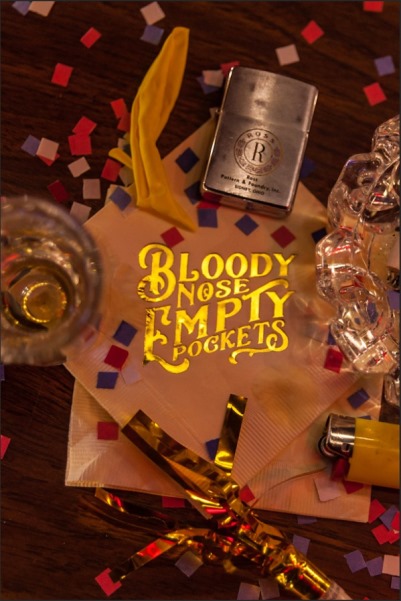
 Ross brothers’ lilting, mellow and intoxicating docu-fiction Bloody Nose, Empty Pockets – evoking memories of the boozy atmosphere, bohemian spirit and laidback charm of a James Crumley and a Charles Buchowski – brilliantly blurred the lines between documentary authenticity and performative narrative. The film is ostensibly set in a Las Vegas bar called The Roaring 20s – an engrossing, smoke-filled, nostalgia-laden sanctuary, escape, and even home, for its regulars who’re a mix of laidback old-timers, gutsy youngsters, misfits, eccentrics, outsiders, loners, rebels and romantics – which is closing down for reasons alluded to but unspecified. Hence, on its final day of existence, the barflies gather for one last hurrah – hanging out, reliving old memories, basking in the infectious ambiance, and indulging in a spectacular bout of binge drinking through the day and night – before bidding a desolate adieu to the joint. However, ironically, this bar’s actually in New Orleans and is still very much open. Further, the cast was an assorted assemblage of everyday folks – a wise but jaded former actor, a scarred Black war veteran, a shy Australian, a bear-like bartender who loves crooning on his guitar, a tough single-mom bartender, an Einstein lookalike, a bon vivant who’s proud of her “60-year old tities”, a vivacious trans-woman, etc. – who play themselves without a script, and in the process unreservedly reveal their vulnerabilities, bitterness, dashed hopes, lost youth and existential pangs; and this startling candidness, albeit in a staged setting, further obscured the porous boundaries between “truth” and “artifice”. The rambling, booze-fueled, and freely improvisational conversations, accompanied by pop-rock soundtracks, provided understated commentary on a wide range of topics – both political and mundane – but delightfully laced with little epiphanies, bittersweet revelry and melancholy.


Director: Bill Ross IV & Turner Ross

Genre: Documentary/Drama

Language: English

Country: US