Thursday, 12 April 2012

The Rules of the Game (La Règle du Jeu) [1939]


Jean Renoir’s The Rules of the Game didn’t receive a favourable reception upon its release from the viewers and critics alike; even the powers that be tried to destroy the prints. It received a proper release nearly two decades later, and since then it has come to be recognized as one of the greatest films ever made. The movie is about a lavish party thrown by wealthy aristocrat Robert and his wife Christine at their palatial manor house in the Parisian countryside. Andre, a national hero in love with Christine, Octave, the lady’s buffoonish childhood friend, Robert’s mistress on the sly, and a garrulous General, are among the various guests invited – consequently numerous complications arise as a result. Meanwhile, complications also crop up among the servants when the gamekeeper of the house notices that the new recruit is flirting with his wife who happens to be Christine’s personal maid. While those belonging to the upper floors are more interested in preserving their show of geniality and propriety, such is not the case with their lower floor counterparts. Thus this party becomes a microcosmic representation of the society at large, and the ensuing comedy of manners a scathing commentary on both class divisions and human behavior. Though some of the plot developments and the acting (which is quite over-the-top at times) might seem dated by today’s standards, there’s no doubting its artistic merit and in its usage of fluid camera movements and deep focus. It also provided the template for such diverse movies as Bunuel’s Exterminating Angels, Altman’s Gosford Park, Nihalani’s Party, among others.


Director: Jean Renoir
Genre: Comedy/Comedy of Manners/Ensemble Film/Romantic Comedy
Language: French
Country: France

Wednesday, 11 April 2012

Chorus [1974]


Mrinal Sen made Chorus at perhaps the most creative phase of his filmmaking career (he had just completed his acclaimed Calcutta Trilogy); this movie also marked a gradual transition from his avant-garde and political filmmaking to more traditional forms of storytelling. This trenchant political satire didn’t just comprise of scorching sociopolitical commentary, it also had Sen at his most gleefully wicked, thus reminding us of his earlier masterpiece Interview. The opportunistic Chairman (played by the inimitable Utpal Dutt) of a large corporation has decided to exploit the widescale unemployment among the youth through an act of seeming goodwill. He decides to distribute 3000 forms for that purpose in a show of his compassion, and then randomly select 100 people out of them. But his carefully chiseled plans go haywire as the angry and disillusioned mob manages to look through the company’s false veneer, and mobilizes an ominous and anonymous protest movement that leaves the Chairman and the head of the police department (a pet of the Company) completely flummoxed despite resorting to draconian measures to crush the movement – a disconcerting reference to the urban Naxal revolution. This thread has been interjected with poignant chroniclings of the lives of some of the people who are a part of the huge crowd impatiently waiting in front of the company’s gates. The film begins and ends with brilliantly written songs (sung by the gods, led by Robi Ghosh) that are as ironic as they are acerbic – reminiscent of the unforgettable couplets in Ray’s Hirak Rajar Deshe. The movie abounds in Nouvelle Vague styles like freeze frames, jump cuts, direct addresses to the audience, cinema vérité sequences, and the likes.


Director: Mrinal Sen
Genre: Political Satire/Social Satire/Avant-Garde
Language: Bengali
Country: India

Tuesday, 10 April 2012

Jukti Takko Aar Gappo [1974]


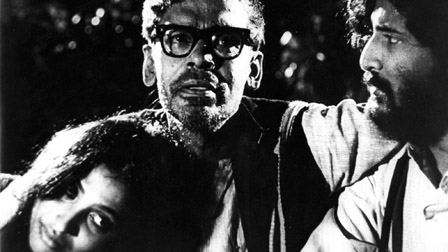
The last film of the perennially misunderstood and mercurial genius Ritwik Ghatak (he made only 8 feature films in his life), Jukti Takko Aar Gappo was a complex and fascinating synthesis of the various themes, ideas, obsessions and stylistic preferences that marked his life and work – thus making this deeply autobiographical film a definitive crystallization of all that he stood for and believed in. Not one to shy away from his personal demons, Ghatak himself played the role of the central protagonist Nilkantha Bagchi, an alcoholic, disillusioned and washed out intellectual who, upon being left by his wife and young son, has now become a happily destitute vagabond. Giving him company are his young protégé and a young refugee girl (Shaonli Mitra). Over the course of his journey he meets an assortment of unique people – a former contemporary (played by Utpal Dutt) who has made it big unlike him (an underhanded reference to his legendary rival Satyajit Ray), a penniless Sanskrit teacher (Bijon Bhattacharya) who joins him in his journey through rural Bengal, a poor village handloom worker (Jnanesh Mukherjee) forever reminiscing about loss of old traditions, and a young and fearless Naxal rebel (militant Leftist). The film abounds in the various themes and ideologies that regularly recurred in his films – undivided Bengal and the horrors of Partition, Leftism and politics, homelessness and familial alienation, fascination with Tagore’s music, and vanishing rural traditions, all presented through his unique melodramatic style filled in equal measures with poignancy and darkly humorous content. No one but Ghatak could have played the role of Nilkantha, a stand-in for Ghatak himself, with terrific supporting turns provided by Bhattacharya and Mukherjee.


Director: Ritwik Ghatak
Genre: Drama/Rural Drama/Social Drama/Experimental Film
Language: Bengali
Country: India

Monday, 9 April 2012

The Lovers (Les Amants) [1958]


The Louis Malle-Jeanne Moreau vehicle The Lovers, upon its release in the US, immediately attracted the ire and attention of American lawmakers. The state of Cleveland convicted the concerned theatre owners for public display of obscene material, which the US Supreme Court overturned with the now legendary definition of obscenity, viz. “I know it when I see it”. Yet, on hindsight, it is strange that this movie generated such controversy as, for me, this is a stunningly made and a deeply affecting romantic drama on the theme that love surfaces at the most improbable of places and materializes between the unlikeliest of people. Jeanne Tournier (Moreau) is the bourgeois wife of a wealthy newspaper who is always busy with his work. In order to escape boredom she regularly flees to Paris from their suburban villa, and is also embroiled in an extra-marital affair with a debonair polo player. Her jealous husband, aware of his wife’s dalliances, invites her lover for dinner; ironically, never did either of the two men ever guess what would transpire that night or the following morning. A young archaeologist (Jean-Marc Bory) gets accidentally invited to the dinner when he gives Jeanne, stranded on account of her broken-down car, a ride to the house – and what ends up brewing between the two is both romantic and surprising. That Jeanne eventually ends up leaving her family and her comfortable life on such a short notice, speaks volumes about her as also the staid environ she used to reside in. This delightfully sensuous, sentimental and elegantly made film was aided by it’s beautifully composed B/W photography, soft and lilting score, and a wonderful central performance by the incredibly beautiful Jeanne Moreau.


Director: Louis Malle
Genre: Drama/Romance
Language: French
Country: France

Party [1984]

Made right after Ardh Satya, a powerful cop movie and possibly Govind Nihalani’s most famous work, Party was a searing social satire and remains relevant to this day. The movie, which belonged to the ‘Indian Parallel Cinema’ movement, is about the titular party thrown by a wealthy socialite in order to celebrate the winning of a prestigious prize by a famous playwright. A lot of people – poets, theatre actors, journalists, social activists, hack writers – belonging to various social strata and subscribing to divergent social and political points of view, have gathered, and the various interactions they have there form the crux of the storyline. But for a few initial scenes where the characters are briefly introduced, most of the film was shot in real time with varying amounts of time devoted to the motley characters attending the lavish party – and over its course, we get to know them, and are also made aware as to who among them are the genuine ones and who all are essentially hypocrites desperately trying to project themselves under the guise of false pretenses. Though highly engaging, and in equal parts bitingly satirical and intensely serious, it did seem a bit overlong, especially during some of the rather lengthy conversations during the last third of its length. But, that apart, this remains a prescient and incisive social commentary, and boasts of a number of noteworthy turns by its stellar ensemble cast comprising of the likes of, Amrish Puri, Om Puri, Rohini Hattangadi, Deepa Sahi, Shafi Inamdar, Soni Razdan, among many others, with Naseeruddin Shah having provided the voice for a character that forms the story’s moral and intellectual backbone despite his not being present there in person.  


Director: Govind Nihalani 

Genre: Drama/Comedy/Social Satire/Political Drama/Ensemble Film 

Language: Hindi 

Country: India