Sunday, 31 July 2022

History of Ha [2021]

 Lav Diaz’s sublime 4-hour gem History of Ha bore the hallmarks of “slow cinema” and the free-spirited Filipino maestro’s oeuvre – formally rigorous, structured around a metaphorical and deeply existential voyage, infused with trenchant political commentaries, filmed in entrancing single takes and stark B/W, and with continuous interplays between silence and conversations. It’s foregrounded on Philippines’ murky and turbulent political history, wherein even its most respected leader Ramon Magsaysay had problematic shades associated with his stint – his anti-Marxist Cold War interventions, militarism, and links to the US – while two repressive, brutal right-wing rulers, viz. Marcos and Duterte – ironically alluded to as “leader from the South” and “leader from the North” in the film, even if they were deliberately anachronistic as the film is set in 1957 – would dominate the country’s political scenes in the future. Akin to Hou’s masterful The Puppetmaster – which portrayed a puppeteer amidst complex, tragic political forces – the protagonist here’s Hernando (John Lloyd Cruz), a well-known ventriloquist and socialist poet, who retires around the same time as Magsaysay’s death in an aircraft accident. As his country’s dark fate gets sealed and his personal life is thrown into despair upon his fiancée’s decision to marry a landlord to help pay her family’s debts, the lonely and disillusioned man embarks on a directionless cross-country voyage and takes refuge in self-imposed silence – speaking, where unavoidable, through his puppet Ha. During his odyssey, he’s joined by three oddball characters – a do-gooder nun, a brash prostitute and a lost teenager – who all wish to go to an island where gold rush is underway, and finds himself in a disturbing psychological tussle with a despotic local strongman (Teroy Guzman) who’s a Marcos/Duterte stand-in.


Director: Lav Diaz

Genre: Drama/Political Drama/Road Movie

Language: Tagalog/English

Country: Philippines

Wednesday, 27 July 2022

Mariner Of The Mountains [2021]

 Karim Aïnouz’s origin is a complex melting pot, in that he was born to a Brazilian mother and resides there, while his name is of Algerian descent courtesy his father, even though he hadn’t visited the country until now in his 50s. This duality imbued his marvellous and deeply personal docu Mariner of the Mountains, both in terms of its form and visual palette. It operated at an intriguing interjection between essay film, memoir, epistolary diary, travelogue, political inquiry, oral history and anthropology, and Aïnouz captured that through a myriad cinematographic means – vistas, kaleidoscopic montages, handheld cams, washed-out images, sepia-toned colours, black-and-whites, archival footage, etc. The resultant work, consequently, was elegiac, atmospheric and intimate, laced with melancholy and quirky humour. It chronicled his voyage from Fortaleza in Brazil to Algeria in order to know his heritage, meet family members from his father Majid’s side – who he never really knew while growing up – and understand the late Iracema who brought him up as a single mom. Heady political forces brought his parents together and separated them thereafter. They’d met and fallen in love while in the US as students; however, while the 1964 military dictatorship in Brazil compelled her to return home, he went back to Algeria with the dreams of building a new future for his country upon the Algerian War that freed them from colonialism and made it – along with Cuba and Vietnam – the then world capital of revolution. There he strolls through Algiers, visits his ancestral village in the Atlas Mountains, wryly reflects on the turbulent political destinies of Algeria and Brazil, and forms a more profound connect with his mother whose memories continue to haunt him.


Director: Karim Ainouz

Genre: Documentary/Diary Film/Essay Film

Language: Arabic/Portguguese/French

Country: Brazil

Saturday, 23 July 2022

Once Upon a Time in Calcutta [2021]

 Aditya Vikram Sengupta’s 3 films are a study in contrasts and commonalities. Where Asha Jaoar Majhe was a marvellously muted tone-poem and Jonaki a haunting, surreal tapestry on memories, Once Upon A Time in Calcutta – his most narratively ambitious effort thus far given its multiple characters, interlocking sub-stories and highfalutin title – is a bold mix of broken marriages, crumbling cultural citadels, nostalgic artefacts paving way for the future, and new-age business models selling false hopes and disenfranchising the disenfranchised. Yet, despite their narrative divergences, one can still perceive here the aesthetic minimalism, urban loneliness and elegiac reflections that his earlier films were suffused with. Ela (Sreelakha Mitra), an enterprising woman who dreams of owning an apartment and works at a TV show peddling lurid astrological crap to gullible viewers, walks out of her dead marriage to a simple, middle-class teacher residing in a quintessential old North Calcutta house, upon a terrible personal bereavement. When hopes for bank loan fails, she tries convincing her obsessively reticent half-brother (Bratya Basu) to sell off the abandoned, dilapidated building he stays in – what was once an iconic theatre with a revolving stage – to realtors. Meanwhile she allows for a quid pro quo affair with her slimy boss – who has been openly salivating for Ela and also runs a nefarious chit fund scam for swindling the poor – in exchange for a flat, while also embarking on a relationship with an old acquaintance who’s in charge of constructing a flyover that necessitates the dismantling of a once famous T-Rex structure. The film’s soap opera storyline, charged socio-political undercurrents and quirky use of Tagore’s songs were surprisingly juxtaposed with luminous cinematography, intimate compositions and melancholic air.


Director: Aditya Vikram Sengupta

Genre: Drama/Urban Drama

Language: Bengali

Country: India

Sunday, 17 July 2022

Vortex [2021]

 Gaspar Noé suffered a near-fatal brain haemorrhage in early-2020, and that experience inspired the implosive, gut-wrenching and magnificent Vortex. It was permeated with extraordinarily brooding and profoundly bleak exploration of ageing, mortality, and the engulfing chaos that precedes death. He covered this grim ultimate truth of life through claustrophobic vividness, wintry sparseness, and stunning formal bravado where we simultaneously see the two halves of an aged couple – each approaching death in their own sinewy, disorderly routes – through split screens. The film, unsurprisingly, reminded me of Haneke’s masterful Amour – where too an aged couple grappled with a harrowing downward slide – while the stunning use of dreary, incisive split screens made me draw parallels with two other brilliant works – where this formal choice achieved similarly discomfiting parallel gazes – viz. Godard’s Numéro Deux and Carrasco’s The Year of the Discovery. The narrative was steadfastly centred on an aged couple residing in a cramped apartment in Paris packed with books, artefacts and memories – comprising of “husband” (legendary Italian filmmaker Dario Argento, who picked up French for the role, and is therefore seen speaking in a deliberate, halting manner), a film critic writing a book on cinema and dreams, who suffered heart attacks in the recent past, and “wife” (veteran actress Françoise Lebrun, most famous for her role in Eustache's remarkable The Mother and the Whore), a former psychiatrist, who’s irrevocably slipping into the dark vortex of dementia – who we observe in parallel with stark, voyeuristic intimacy. The film began with Françoise Hardy’s haunting song Mon Amie la Rose that fittingly set the tone for this devastating chamber drama where one’s left with paralyzing sense of inevitability as things go from bad to worse.


Director: Gaspar Noe

Genre: Drama/Chamber Drama/Marital Drama

Language: French

Country: France

Tuesday, 12 July 2022

The Power of the Dog [2021]

 The Power of the Dog, Jane Campion’s first feature in a decade, is a film that’s bound to keep one unbalanced – for its genre subversions, psychological interplays and character dichotomies. It’s a spare, moody and stunningly composed revisionist Western, but it’s temporal setting, locational vistas and stylistic archetypes aside, it’s almost an anti-Western in how it’s focused on complicated relationships and anachronous thematic explorations. It’s a brooding, and oftentimes ferocious, meditation on a man’s complex relationship with his brother, demons, vocation, identity, garbled notions of manhood, and most importantly, conflicted sexuality. Phil Burbank (Benedict Cumberbatch) is the quintessential Western anti-hero – tough, macho, taciturn, gruff, unpredictable, with natural-born leadership qualities and a sinister penchant for violence; and yet, ironically, he was academically brilliant, has a talent in music, is emotionally bound to his brother George (Jesse Plemons) – whose plump, soft-spoken, gentle demeanour, and intellectual mediocrity couldn’t make them more antithetical – to the point where it’s discomfiting, and is ravaged by a scalding sense of conflicts, guilt and vulnerability. His brazen and brutal self-assuredness, therefore, are profoundly affected when George marries Rose (Kirsten Dunst) – a widowed and emotionally fragile single mother bordering on alcoholism – and brings her to their home; and if his brother’s love getting divided isn’t enough, they’re joined in their arid cattle ranch by Rose’s frail and artistic young son Peter (Kodi Smit-McPhee), who Phil torments to start with but takes him under his wings with feelings bordering on homoerotic, the way he’d once become a protégé to his dashing late mentor he hero-worships. The oblique and gripping tale bordering on the gothic – laced with ambiguity and simmering melodrama – is led by a terrific, smouldering turn by Cumberbatch.


Director: Jane Campion

Genre: Drama/Psychological Drama/Western

Language: English

Country: New Zealand

Saturday, 9 July 2022

Ahed's Knee [2021]

 Nadav Lapid’s Ahed’s Knee was angst-ridden, provocative, coruscating, and combative to the point of being a vitriolic tirade at times, further amplified through impulsive narrative movements, staccato editing, and jarring, stylized camera work that can get on one’s nerves. But, that said, it was also an intensely semi-autobiographical and a politically radical work, with its lashing takedown of Israel’s proud apartheidism, militarization, otherization of Palestinians, censorship, and in turn Godardian illustration of cinema being a political manifesto rather than just an artform. Its form, therefore, was defined by its agitprop stance, which made it both assaultive and oppressive. Y (played with seething fury by Avshalom Pollak) – a celebrated and controversial filmmaker, and stand-in for Lapid himself – is in the casting stages for his latest feature which is inspired by the fearless Palestinian activist Ahed Tamini, who created a furore in the settler colonial state by slapping an Israeli soldier on camera. While in the midst of that, he visits an arid little town in the Arava Valley where his previous film is being screened. His hostess is the coquettish Yahalom (Nur Fibak, in a turn filled with sly ambiguity), an official with the Ministry of Culture and vociferous admirer of Y’s filmography, who flirtatiously instructs him to abide by government-sanctioned and pro-state positions during his address to the attendees. He of course has no intentions of toeing the official line, and consequently forms an ambivalent relationship with her while reminiscing his damaging memories from his compulsory military service days and veering towards bold individual resistance. The film’s episodes – many taken directly from Lapid’s own experiences – were filled with courage, urgency and anguish, even if they were overwrought on occasions.


Director: Nadav Lapid

Genre: Drama/Psychological Drama/Semi-Autobiographical Film

Language: Hebrew

Country: Israel

Tuesday, 5 July 2022

The Tsugua Diaries [2021]

  One generally associates something dramatic, visceral and even out of the ordinary – with the possible emergence of startling disclosures – with reverse narrative chronology in cinema… after all, there’s something flamboyant about it. Maureen Fazendeiro and Miguel Gomes’ The Tsugua Diaries (“tsugua” being literally “august” spelled in reverse) was the very antithesis of that idea, and therefore diametrically removed from films that’ve resorted to this formal device, e.g. Memento, The Sweet Hereafter, Eternal Sunshine of the Spotless Mind, Irreversible, Sinq Fois Deux, etc. It had its share of simmering drama and unforeseen revelations too, and yet was such a seemingly breezy, freewheeling, carefree, improvisational and loosely structured work – and filled with such a lazy elegance – that it almost defied the formal rigour of filmmaking in general and such a punctilious narrative choice in particular. The film began with a dazzling and immersive sequence where its three main characters – Crista (Crista Alfaiate), Carloto (Carloto Cotta), and João (João Nunes Monteiro) – are seen dancing and enjoying over music and blazing colourful lights in a room. It immediately informed the strained character dynamics and gradually established the premise that they’re stuck in a tranquil and isolated country-house during Covid-19 lockdown. Over the course of August – where the days runs backward as indicated through vibrant cards – we observe them transforming a shabby place into something lovely by cleaning the pool, building a beehouse, arranging plants, flirting and lazing around. Eventually, the artifice behind the enchanting holiday is revealed – the fact that this is essentially a film-within-film, and the three are actors – thus adding sly, self-reflexive metanarrative to this befuddling yet playful pandemic movie. The alternatively sun-soaked and flashy cinematography added to its mystifying charm.


Director: Maureen Fazendeiro & Miguel Gomes

Genre: Drama/Experimental Film

Language: Portuguese

Country: Portugal

Friday, 1 July 2022

Licorice Pizza [2021]


 Licorice Pizza was perhaps the most loosely structured and therefore atypical work in PTA’s oeuvre – coming after a string of formally rigorous and ambitious films – even if it did hark back the element of nostalgia for a lost (and freer) time, and the freewheeling narrative styles, of Boogie Nights and Inherent Vice. By focusing on first love, charming coming-of-age and idiosyncratic experiences, it managed to be amusing, carefree and whimsical on occasions, with a surprisingly unmoored script. However, alongside that, it was also too sketchy, sentimental and thematically insubstantial to be taken seriously. It, in fact, might’ve worked better if it was either more compact with some of the chaff edited out, or had its scope been broadened to provide a more sprawling evocation of the period. Set in California’s San Fernando Valley in early-70s – where Anderson himself grew up – it chronicled the unconventional friendship turned romance between Gary (the great Philip Seymour Hoffman’s son Cooper Hoffman), a precocious 15-year-old child actor and incorrigible entrepreneur, and Alana (Alana Haim), a gauche and confused young woman 10 years his senior. Their relationship – traversing through camaraderie, business partnership, jealousy, conflicted feelings and love – was regularly interspersed with asides that imbued the proceedings with an episodic form and rambling flavour. Its most hilarious episodes involved wealthy, neurotic and self-absorbed men they come in contact with – Sean Penn as a motorcycle-loving film star modelled after William Holden, Tom Waits as a garrulous director, Bradley Cooper as an irascible producer, etc. The lovingly shot and joyously scored movie had potential – given the ideas and evocative set-pieces it contained – but stopped short of being anything much beyond an erratic love story and cute nostalgia trip.


Director: Paul Thomas Anderson

Genre: Drama/Romantic Comedy

Language: English

Country: USA

Tuesday, 28 June 2022

Happening (L'événement) [2021]

 Celebrated French writer and feminist Annie Earnaux’s oeuvre was a running fictionalized autobiography of her life and in turn analysis of France’s evolving sociopolitical landscapes. Happening captured a watershed and perhaps the most intensely personal chapter in her life – viz. her decision to have an illegal abortion as a young college student in 1960s France, despite crushing medical, legal and social obstacles, in order to be able to continue with her studies – which paved way for her to become what she became.  French-Lebanese filmmaker Audrey Diwan’s adaptation of this autofiction text therefore was, understandably, intimate, poignant, stark and harrowing in equal measures. And she made it especially claustrophobic through striking stylistic choices – a near-documentary flavour despite the seething emotional undercurrents (reminiscent of Mungiu’s masterful 4 Months, 3 Weeks and 2 Days; incidentally, both films had unsettling sequences on underground abortion); counterpointing of vibrant lighting with debilitating psychological turmoil; and, most notably, placing the camera uncomfortably close to her heroine almost throughout the film’s length, along the lines of the Dardennes’ The Son and Nemes’ Son of Saul. The tightly contained narrative followed Anne (played with stunning restraint by Anamaria Vartolomei) over 9 nightmarish weeks – a brilliant college student with a promising life ahead – as she realizes that she’s pregnant, her futile pleas to doctors, getting distanced from her buddies when they realize her radical intent, her inability to share her predicament with her working-class mother (Sandrine Bonnaire), and the ordeal that she must battle through alone in order to get an abortion. Excepting a sequence towards the end that felt gratuitous and therefore antithetical to the film’s austere palette, this was both a viscerally arresting and politically prescient film.


Director: Audrey Diwan

Genre: Drama/Psychological Drama/Film a Clef

Language: French

Country: France

Saturday, 25 June 2022

Joji [2021]

 Dileesh Pothan’s Joji was as much a macabre and darkly funny crime thriller, as it was a commentary on patriarchy and masculinity, the arrogance of power and affluence, and the lust for wealth and violence. Either way it was a wickedly delicious work set during the pandemic, and filled with acrid familial fault lines, feuds and outright dysfunctions bordering on the comically grotesque… unsurprisingly, the director cited Shakespeare’s Macbeth as an inspiration. Kuttapan, the muscular, disdainful and domineering patriarch of a closely-knit family – comprising of the physically imposing and short-tempered eldest son Jomon (Baburaj) who’s closest to his father; the whimpering middle son Jaison (Joji Mundakayam) who feels trapped under his father’s iron-grip; the youngest son Joji (Fahadh Faasil) who’s a college dropout and detests his father’s contemptuous attitude towards him; Jaison’s taciturn wife Bincy (Unnimaya Prasad) who inwardly riles at her position as a voiceless housewife; and Jomon’s teenage son – living amidst his lush and sprawling estate in Kerala. Hence, when he suffers a near-fatal stroke, each of his sons react differently – Jomon is devastated and becomes increasingly erratic to the point of insulting the local clergy; Jaison hopes to finally have financial freedom; but it’s the seemingly meek and loafing Joji who decides to take matters into his own hands… and, as he does so, he displays a terrific capacity for smouldering fury, unpredictable ferocity, and calculated violence – with neither patricide nor fratricide being beyond his reach – and Bincy becomes an unlikely ally. Faasil, with his captivating turn as the sociopathic antagonist, led a cast full of compelling performances, in this spare, bleak and minimalist work punctuated with ironies, wry humour and a sparingly used moody score.


Director: Dileesh Pothan

Genre: Crime Drama/Family Drama

Language: Malayalam

Country: India

Saturday, 18 June 2022

Întregalde [2021]

 Radu Muntean’s excellent new film Întregalde had all the quintessential hallmarks of Romanian New Wave – the kind championed by Muntean himself in his memorable Tuesday, After Christmas from a decade back – viz. narrative sparseness, ultra-realism, formal rigour, voluble script, bone-dry humour, lack of non-diagetic sounds, long and unobtrusive single takes, and near real-time filming. He expertly infused these with atmosphere, tenseness and brewing suspense that made it akin to a slow-burn thriller, in striking juxtaposition to the deliberately paced and darkly satirical human drama. The film began with an exquisite mise-en-scène wherein a terrific tracking shot – with a gently roving camera moving through a crowded space – took us amidst the volunteers of a philanthropic social service group, who’re embarking on trips to small villages to distribute essential items to the destitute on the occasion of Christmas. The narrative then zooms in to three of them – Maria (Maria Popistaşu), Ilinca (Ilona Brezoianu) and Dan (Alex Bogdan) – who’re travelling together in an off-roader vehicle to the titular Transylvanian village. On the way they pick up an elderly and possibly senile man called Kante (Luca Sabin) who suggests a short-cut to their destination, and that’s when their lucks take a nose-dive. As things go south in an uninhabited and bitingly cold environ, incommunicado to the outside world, their temper, morality and sense of charity undergo nerve-racking pressure tests. Sabin, an amateur actor and apparently an actual resident of the eponymous village, was extraordinary as the wiry, garrulous and unpredictable man stuck in a time warp – portrayed through audacious single takes where he blabbers endlessly – and served as the fillip to the gripping narrative, and in turn the three edgy, brilliantly enacted volunteers.


Director: Radu Muntean

Genre: Drama/Psychological Drama

Language: Romanian

Country: Romania

Tuesday, 14 June 2022

Hit the Road [2021]

 Panah Panahi proved that he’s his father’s son in his debut film Hit the Road. Even if it’ll take him some time to fill the great Jafar Panahi’s shoes and emulate his voice – and it did feel slight and tad unmoored on occasions, and the cuteness went overboard at times – this charming, effervescent, and funny road movie – a quintessential American genre that, ironically, has paved way for a number of Iranian gems too – displayed in no uncertain terms Panahi Jr.’s storytelling mettle, willingness to use narrative as a springboard rather than an end in itself, and – like his defiant father who’s never tempered his dissent nor his distinctive chuckle – the gall and temerity to tackle politically uncomfortable topics, albeit under the guise of a playful and unassuming exterior, that may not please the authorities. Gray-haired vivacious mom (Pantea Panahiha), gruff but adorable father (Hassan Madjooni) with a broken leg in cast, brooding and taciturn elder son (Amin Simiar), and one of the most energetic, precocious and chatty 6-year-old kids (Rayan Sarlak) imaginable, are on a cross-country road trip in their old and dusty station wagon. They drive, sing, smoke, argue, fight, reflect, reminisce and bond as part of their seemingly aimless journey – through some stunning and excellently photographed Iranian landscapes – while the real reason for their trip, and therefore their possible destination, gradually emerge. That, in turn, provided context to the interpersonal undercurrents that were regularly alluded to until the disclosures happened, and which added interesting emotional dynamics to this tender, bittersweet and featherweight comedy. There were a few interesting asides too, especially a hilarious one involving a motorcyclist who’s compelled to take a brief ride with the family.


Director: Panah Panahi

Genre: Drama/Road Movie

Language: Persian

Country: Iran
Wednesday, 8 June 2022

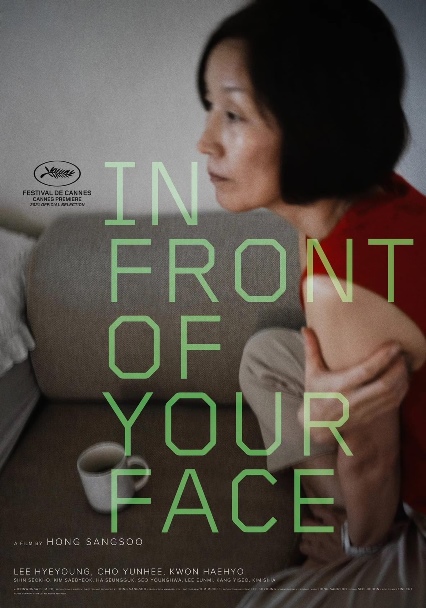
In Front of Your Face [2021]

 Hong Sang-soo, poet of the understated and the quotidian, crafted a disarmingly sublime work – delicately laced with melancholy, regrets, old memories, and impermanence – in his 26th feature, and second in 2021, In Front of Your Face. And its striking self-reflexive flourishes and sly infusions of wry, deadpan, self-deprecating humour made it an archetypal work in his prolific but understated canon. The protagonist here is Sangok (Lee Hye-young) – a middle-aged woman and one-time actress – who’s come back to Korea after many years in the US. The gently unfolding narrative captured small yet surprisingly profound moments over 1 ½ days – bittersweet reconciliation with her younger sister (Jo Yoon-hee) who clearly loves her but was left deeply hurt upon her sudden disappearance from their lives many years back; a quiet cigarette under a bridge during a walk in the gardens; bafflement at seeing Seoul’s urbanization (euphemism for relentless construction of skyscrapers) and gentrification during her absence; an elegiac visit to the house where she’d grown up; and a customary extended session of rambling conversations over endless glasses of soju at a lonely café where a garrulous and effusive filmmaker (Kwon Hae-hyo) is desperate for her to come out of her self-imposed retirement in order to star in his next movie. The film, in itself, was captivating in its evocative portrayals, formal sparseness, humane character and Hong’s continued exploration of Seoul’s locales, taverns and back-alleys. And these attributes were made even more fascinating by the fact that the lead actress – a former star in the country during the 80s – was the daughter of legendary filmmaker Lee Man-hee, with whom Hong’s mother Jeon Ok-soon – who was a movie producer – had collaborated on five films.


Director: Hong Sang-soo

Genre: Drama/Family Drama

Language: Korean

Country: South Korea

Sunday, 5 June 2022

The Souvenir Part II [2021]

 If “art imitated life (and vice-versa)” in Joanna Hogg’s nakedly autobiographical film The Souvenir, that was twice over in her superb, intimate, nuanced, delicately composed and wonderfully metatextual sequel. Where the former film was about its heroine’s debilitating affair with an enigmatic man – based on the director’s remembrance of her own days as a young woman – the complex interplay of “real” and “reel” were taken a step further as the protagonist here decides to make a film to remember, interpret and understand that tragic relationship, along the lines of what Hogg already did in the earlier one; therefore, like Kiarostami’s sublime masterwork Through the Olive Trees, the protagonist – who herself is a stand-in for the filmmaker – directs an actress who’s a stand-in for her in the film-within-film. And yet, despite the formal ingenuity, the work itself brimmed with disarming simplicity, poignant reminiscences, affecting mix of emotions – joy, melancholy and pathos – and fine evocation of an artist’s startling coming-of-age as a woman and an artist through her art. It took off where the earlier one ended, with Julie (Honor Swinton Byrne) trying to recover – at the charming countryside estate of her parents (played by Tilda Swinton, Byrne’s real-life mother, and James Spencer Ashworth) – from the crushing impact of her boyfriend’s addiction and demise. And, as part of this recovery process, she first tries to understand who he really was, and thereafter deconstruct her own memories of him and their relationship through her graduation film – a memoir, instead of a social-realist documentary that she’d initially planned for – against her professors’ wishes. Multiple moments of self-deprecating humour and bold stylistic splashes were adroitly blended into this otherwise sombre, muted and self-reflexive gem.


Director: Joanna Hogg

Genre: Drama/Film a Clef

Language: English

Country: UK

Thursday, 2 June 2022

Unclenching the Fists [2021]

 Ada (Milana Aguzarova), a deeply conflicted, vulnerable and troubled young Muslim woman – the protagonist in Kira Kovalenko’s Unclenching the Fists – is haunted by the past and oppressed by the present; she’s inextricably bound to her overbearing family, while furiously desirous of breaking free; she wants to explore her womanhood, but is held back by fear, shame and denial of agency. These complex dualities formed the crux of this bleak, lyrical and defiantly feminist film that, through its claustrophobic story, covered a woman’s aching cry for liberation amidst political violence, societal alienation and stifling patriarchy. Ada lives with her domineering, over-protective father (Alik Karaev) who she’s desperate to escape from, and her younger brother who’s disturbingly close to her, in the desolate former mining town of Mizur in Russia’s North Ossetia region. She pines for her elder brother (Soslan Khugaev), who’s relocated for work, to return and take her away, while also torn by the amorous overtures of a goofy loafer. Her social construct was further complicated by allusions to the Chechen-Russian conflict, and the 2004 Beslan school hostage tragedy in particular where the siege by Chechen rebels was crushed by the state with brutal iron-fist, leading to 333 deaths, including that of 186 children. Ada was one of the students who survived the bloody massacre; however, she still carries the painful physical scars and debilitating psychological trauma which has made it profoundly difficult for her to have physical intimacy with anyone. Aguzarova gave a stunningly assured, courageous and ferocious turn in this bold directorial work by the second student of celebrated filmmaker Alexander Sokurov – after her batchmate Kantemir Balagov who made Beanpole two years back – to achieve international recognition.


Director: Kira Kovalenko

Genre: Drama/Psychological Drama/Family Drama

Language: Ossetian

Country: Russia

Sunday, 29 May 2022

The Year Before the War [2021]

 The gold standard for picaresque works centred on impassive and amoral protagonists – who drift through historical moments through a mix of lucky coincidences and ability to change political colours based on what’s expedient – have been, for me, the blazing Polish filmmaker Andrzej Munk’s Bad Luck and the towering Czech writer Bohumil Hrabal’s I Served the King of England, alongside, to a marginally lesser degree, Czech New Way giant Jiri Menzel’s adaptation of the latter novel. Latvian filmmaker and university professor Dāvis Sīmanis’ audacious, feverish, flamboyant and politically ambiguous movie is a fascinating addition to that list. He captured the singularly fragile point of inflection that Europe was in, in 1913 – with its nationalist hysteria, warmongering and violence – and which would soon explode into a devastating war engulfing and ravaging the continent, through formal bravura – it’s made in the veins of silent-era German Expressionism, through dazzling high-contrast visuals, disorienting compositions, chiaroscuro, and changing film-speeds – lacerating satire, bleak ironies, brash historical evocations and bold surrealist splashes. Peter (Petr Buchta) – a.k.a. Hans – starts out as a doorman at a luxury hotel in Riga, until he loses his job upon an attack by anarchists. The inscrutable anti-hero, thereafter, traverses across Switzerland, Prague, London, Vienna, etc. over this tumultuous year, has dramatic interactions with various historical figures – a hideously cartoonish Lenin (Lauris Dzelzītis), a sultry Mata Hari (Inga Siliņa), a lascivious Freud, a buffoonish Hitler –, and participates in defining incidents that literally triggered the Great War. While the film’s politics can be troubling at times, there were some striking displays of empathy towards the little people facing bigotry, brutality and discrimination at the hands of those in power that underscored its humanist core.


Director: Davis Simanis

Genre: Black Comedy/Political Satire

Language: Latvian/French/Russian/German

Country: Latvia

Friday, 27 May 2022

What Do We See When We Look at the Sky? [2021]

 Alexandre Koberidze’s sophomore feature was a quirky, playful and charming ode to youth, flights of imagination, football, cinema and the ancient Georgian city of Kutaisi. It effortlessly operated in the intersection between endearing romance, magic realism and city symphony, through freewheeling infusion of humour, fantasy and whimsy. At the heart of this lilting film is a wistful, oddball romance between two soft-spoken loners. Medical student Lisa (Ani Karseladze) and football player Giorgi (Giorgi Ambroladze) bump into each other twice over the course of a day, upon which they agree to fix a date as they start experiencing the soft pangs of first love. However, in a curious twist of fate, they wake up the next day looking completely different (now played by Oliko Barbakadze and Giorgi Bochorishvili) and shorn of their vocational skills. And hence, while their plans go for a toss, in an ironic development they end up getting employed by an affable, middle-aged café owner who’s spectacularly unsuccessful in increasing his business, though not for lack of trying. As we hope for luck to shine back on these two lost individuals, we’re presented with a series of captivating digressions capturing the myriad idiosyncratic shades of the city – viz. the unique personalities of stray dogs, the tradition of watching football games which is amplified during the World Cup, people’s love for whiling time, a director’s attempt at filming actual couples, and the gentle ebb of life in general. Lovingly shot in saturated colours, set to an eclectic score that alternated between peppy and mournful, laced with deadpan humour, and accompanied by narration by the director himself, this film was imaginative, impish and uplifting, albeit tad frothy at times.


Director: Alexandre Koberidze

Genre: Drama/Romantic Drama/Fantasy

Language: Georgian

Country: Georgia
